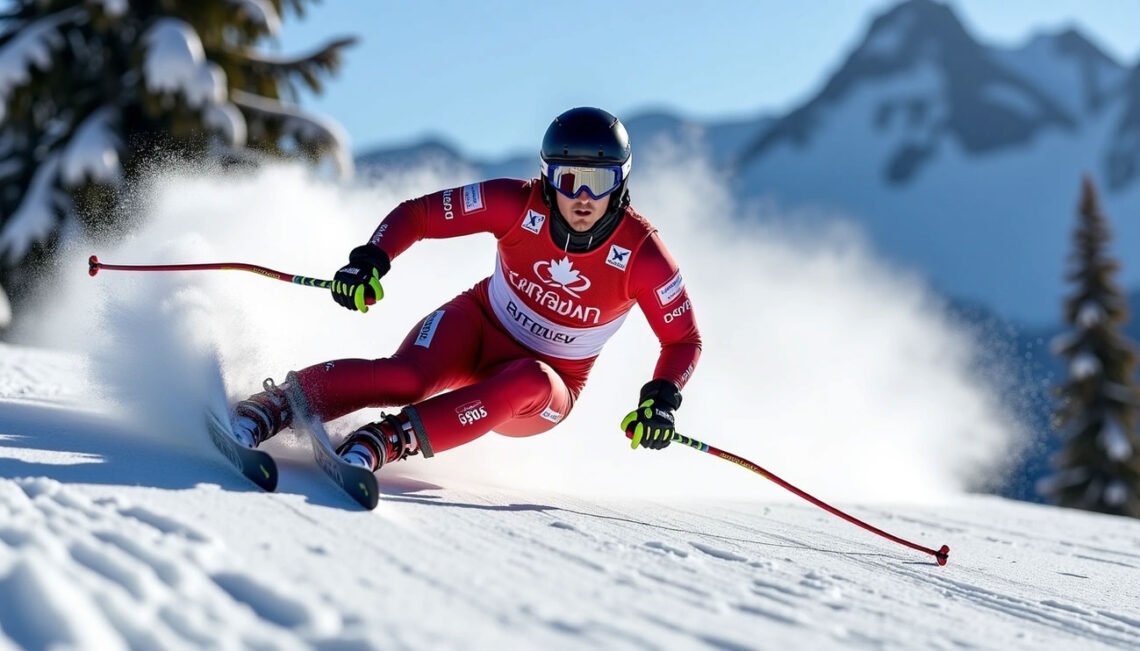
The Boy from Mont-Tremblant with a Need for Speed
Long before the world records and the roar of the World Cup crowds, there was just a boy from Mont-Tremblant, Quebec, growing up in a “skiing family atmosphere.” It was in his blood. His father, Conrad, was a ski coach who taught him and his brothers, Kristian and Stefan, everything they knew. His mother, Ellen, a ski instructor at Tremblant, was his “guiding light,” a constant source of love and encouragement.
Skiing wasn’t just a sport; it was the family’s chemistry. Guay would later recall the magic of having three generations—his parents, himself, and his own young daughters—all skiing together on the same hill. It’s a rare bond, one that grounded him throughout his high-flying career.
He didn’t stay a local secret for long. After joining the Canadian Alpine Ski Team in 1998, he made his mark. In 2007, he won his first World Cup downhill in Garmisch-Partenkirchen, Germany, becoming the first Canadian man to do so since 1994. The boy from Mont-Tremblant had arrived, and he was just getting started.
Forging a Champion: Resilience Through Six Surgeries
To understand Erik Guay, you have to understand the pain. His career was a relentless cycle of injury and comeback. He endured an astonishing six knee surgeries and battled chronic back problems that would have ended most careers years earlier. He even missed the entire 2014-15 season to recover from his final, major knee operation.
Many would have quit. But Guay was different. When asked how he found the motivation to return from setback after setback, his answer was simple and full of the quiet confidence that defined him.
“I just knew I had more in me. I know that when I’m not injured, I can compete with the best. So my motivation was to get to a place physically where pain was not preventing me from reaching the level I expect to be at.”
— Erik Guay
That determination found its ultimate vindication at the 2017 World Championships in St. Moritz. Just ten days after a horrifying crash in Garmisch where he caught an edge at 115 km/h, the 35-year-old Guay stepped into the starting gate for the Super-G. With nothing to lose, he felt a strange calm. “I almost knew I was going to win before I even pushed out of the start gate,” he said. “I just had that feeling.”
He was right. He flew down the mountain, winning gold and becoming the oldest World Champion in alpine skiing history. It was the perfect testament to his career: a story of mind over matter, of refusing to be broken, and of finding victory when no one expected it.

A Career Defined by Comebacks
| Year(s) | Injury/Setback | The Comeback |
|---|---|---|
| 2006 | Knee injury before Olympics | Finishes 4th in Super-G, missing medal by 0.1s |
| 2011 | Knee issues | Wins World Championship Downhill gold |
| 2014 | Meniscus tear before Olympics | Wins World Cup downhill in Kvitfjell just after the Games |
| 2014-15 | Misses entire season (6th knee surgery) | Returns to the World Cup circuit |
| 2017 | Major crash 10 days before Worlds | Wins Super-G gold, becomes oldest World Champion |
| 2018 | Back injury | Forced to withdraw from his final Olympic Games |
The “What If?” of an Olympic Dream
For a man who won almost everything, the story of Erik Guay and the Olympics is one of agonizingly close calls. It’s a narrative of “what ifs” measured in fractions of a second. Three times, he was a blink of an eye away from the one prize that eluded him.
At the 2006 Turin Games, despite a knee injury, he finished fourth in the Super-G, missing the podium by a mere tenth of a second. Four years later, on home soil at the Vancouver 2010 Olympics, the pressure was immense. He finished fifth in the downhill. Then, in the Super-G, he was just three-hundredths of a second from a bronze medal. A cruel, almost imperceptible margin.
His perspective on the Games was complex. He famously called the Olympics a “little bit of a Mickey Mouse show” after his 2017 World Championship win, frustrated that people couldn’t celebrate his current victory without immediately asking about his past Olympic results. Yet, he also admitted it was the “elusive Olympic medal that most motivates me.” He even confessed that if asked to carry the Canadian flag at the Opening Ceremony—a potential distraction before a race—he would have accepted without hesitation, calling it the “single biggest honour.”
This wasn’t a contradiction; it was the honest tension of an elite athlete. He was a professional who knew the World Cup circuit was the true test of a skier’s season-long skill, but he was also a patriot who desperately wanted that one iconic moment for his country. That he never got it doesn’t diminish his career; it adds a layer of relatable, human drama to his legend.
The Moment Everything Changed: A Sudden Retirement
In November 2018, Erik Guay was at Lake Louise for the first speed event of what he had already announced would be his final season. He was preparing for a farewell tour, a chance to say goodbye to the sport on his own terms. But a single, horrifying moment changed everything.
During a training run, his teammate and friend, Manuel Osborne-Paradis, suffered a violent, high-speed crash. Guay watched in shock as Manny was airlifted off the mountain with a severe leg injury. For Guay, a 37-year-old father of four young daughters, something inside him snapped. The risks he had accepted his entire life suddenly seemed unbearable.
“When Manny crashed, I thought I should just take the lift down.”
— Erik Guay, on his decision to retire immediately
He didn’t just withdraw from the race; he retired on the spot. The calculated risks of downhill racing no longer made sense. The allure of one more season couldn’t compete with the pull of home and the sudden, stark reminder of what was truly at stake. Instead of a farewell tour, he ended his career with a quiet, powerful statement about his priorities, choosing his family and his future over one last chase for glory.
A Legacy Beyond the Podium
Erik Guay’s legacy isn’t defined by the Olympic medal he didn’t win, but by the mountain of achievements he built. He was inspired by the legendary “Crazy Canucks” of the 1980s and made it his mission to “return the favour” for the next generation. Today, his impact is felt across Canadian skiing.
He remains deeply involved in the sport, serving on the Board of Alpine Canada and working as a mentor-coach for young athletes at the Apex2100 International Ski Academy. He even played a key role in bringing a women’s World Cup race back to his home mountain of Mont-Tremblant. His work ensures that his influence will shape Canadian skiers for years to come.
But perhaps his greatest legacy is the one he is building at home. The world-traveling racer who once yearned for the next competition now treasures his time as a “family man.” He has found his greatest joy in a life far from the finish line, skiing the familiar slopes of Mont-Tremblant with his wife, Karen, their four daughters, and his own parents—three generations sharing a love for the snow. It’s a quiet, perfect ending to the untold story of one of Canada’s greatest athletes.
Erik Guay’s Record of Success
| Achievement | Record/Detail |
|---|---|
| World Cup Podiums | 25 (Most by a Canadian male alpine skier) |
| World Cup Victories | 5 |
| World Cup Title | 2010 Super-G Crystal Globe |
| World Championships | 2 Gold (2011 Downhill, 2017 Super-G), 1 Silver (2017 Downhill) |
| Unique Record | Oldest Alpine World Champion (Age 35 in 2017) |
Frequently Asked Questions
- 1. Did Erik Guay ever win an Olympic medal?
- No, Erik Guay never won an Olympic medal, though he came incredibly close. He finished fourth in the Super-G at the 2006 Turin Olympics, missing the podium by just one-tenth of a second. At the 2010 Vancouver Games, he finished fifth in both the downhill and Super-G, missing the Super-G bronze by a mere three-hundredths of a second.
- 2. Why did Erik Guay retire so suddenly?
- Erik Guay announced his immediate retirement in November 2018 after witnessing the severe training crash of his teammate, Manuel Osborne-Paradis. As a father of four, the incident was a stark reminder of the sport’s dangers, and he decided it was time to prioritize his family and his health over continuing to race.
- 3. How many World Championships did Erik Guay win?
- Erik Guay won two World Championship gold medals. He won the downhill title in 2011 at Garmisch-Partenkirchen and the Super-G title in 2017 at St. Moritz, where he also won a silver medal in the downhill.
- 4. What is Erik Guay doing now after retiring from ski racing?
- Since retiring, Erik Guay has remained a prominent figure in Canadian skiing. He serves on the Board of Alpine Canada, works as a mentor-coach for the Apex2100 International Ski Academy, and was instrumental in bringing the World Cup back to his home of Mont-Tremblant. He lives there with his wife and four daughters.
- 5. Who are the ‘Crazy Canucks’ and how did they influence Erik Guay?
- The ‘Crazy Canucks’ were a group of Canadian downhill racers in the late 1970s and early 1980s, including Ken Read and Steve Podborski, known for their fearless style. Guay has often cited them as his primary inspiration, stating they “set the bar for Canadian ski racing” and that he hoped his career would inspire the next generation in the same way.
A Champion Defined by Heart
In the end, the story of Erik Guay is a powerful lesson in resilience, the razor-thin line between victory and heartbreak, and the ultimate priority of family. He is a champion defined not by the one medal that got away, but by the countless times he battled back from injury and the grace with which he chose his final finish line.
What’s your favorite memory of Erik Guay’s incredible career? Share your thoughts in the comments below!