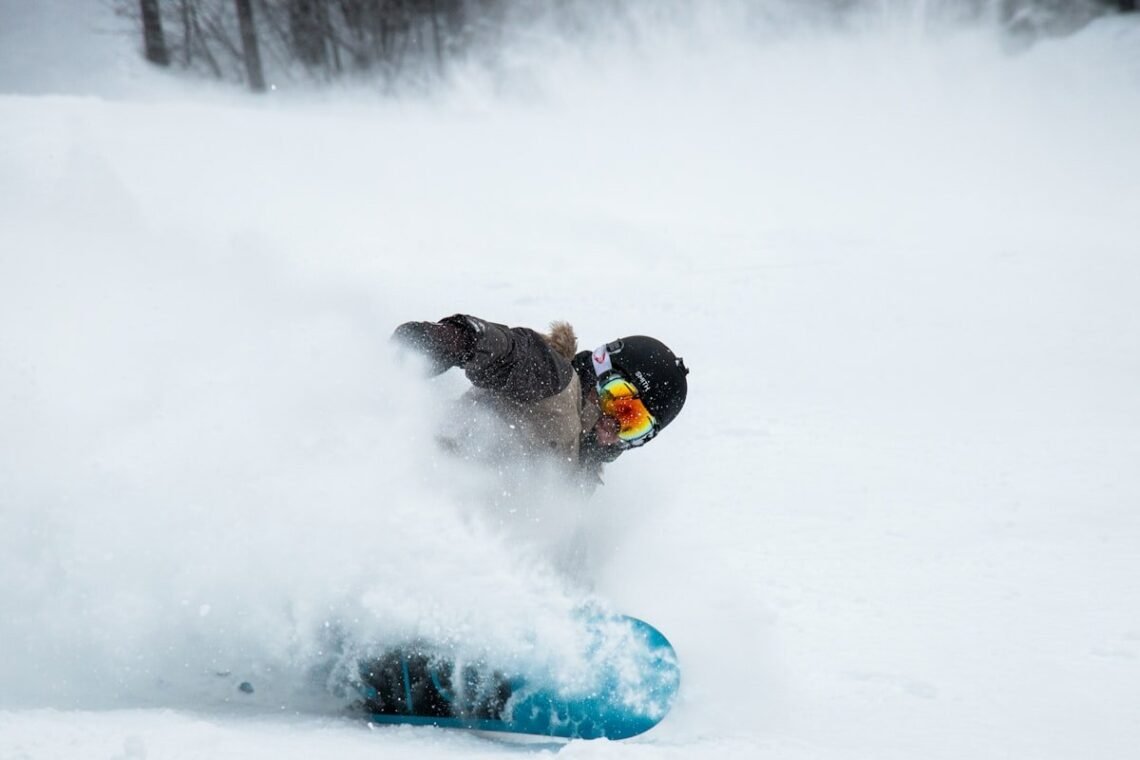
Yes, you should wear wrist guards snowboarding, and the type you pick matters more than the logo on it. Wrist fractures are the single most common snowboarding injury, and guards measurably cut that risk.
Most buying advice skips the part that actually decides whether you keep wearing them: whether the guard works with the gloves you already own. A guard that fights your mitts gets left in the car by week three.
So this guide sorts the market into three types, tells you which one fits which rider, and deals honestly with the fit headaches nobody puts on the product page.
Why snowboarders break wrists more than skiers
When a snowboarder falls, both feet stay strapped to one board, so there is no stepping out of it. Hands go down by reflex, and the wrist takes the full load of a moving body hitting packed snow.
Wrist injuries make up roughly a quarter of all snowboarding injuries, and beginners take the worst of it because they fall low and often. The classic result is a distal radius fracture, the same break you get slipping on an icy sidewalk.
The part that surprises experienced riders: technique stops protecting you on ice. You can know exactly how to fall and still snap a wrist, because a heel edge letting go on a frozen patch gives you no time to tuck anything.
“Like other commenters also have 2 decades boarding so understand how to fall the right way. Just pulled up on what turned out to be an icy patch with a light covering of fresh snow and heel edge gave out. Had fully stopped so was relaxed and trailing arm behind me was the first thing to hit resulting in a broken wrist. Can’t explain why I put hand down but shit happens. 4 weeks left trying to use a mouse with a cast. If it’s going to save your job go for it. Will be grabbing some recommendation…”
– r/snowboarding, September 2025 (13 upvotes)
Guards work. A controlled study of over 5,000 snowboarders found wrist guards cut wrist injuries by about half, and later reviews put the reduction anywhere up to 85 percent depending on guard design (PubMed).
The three types of wrist guards for snowboarding
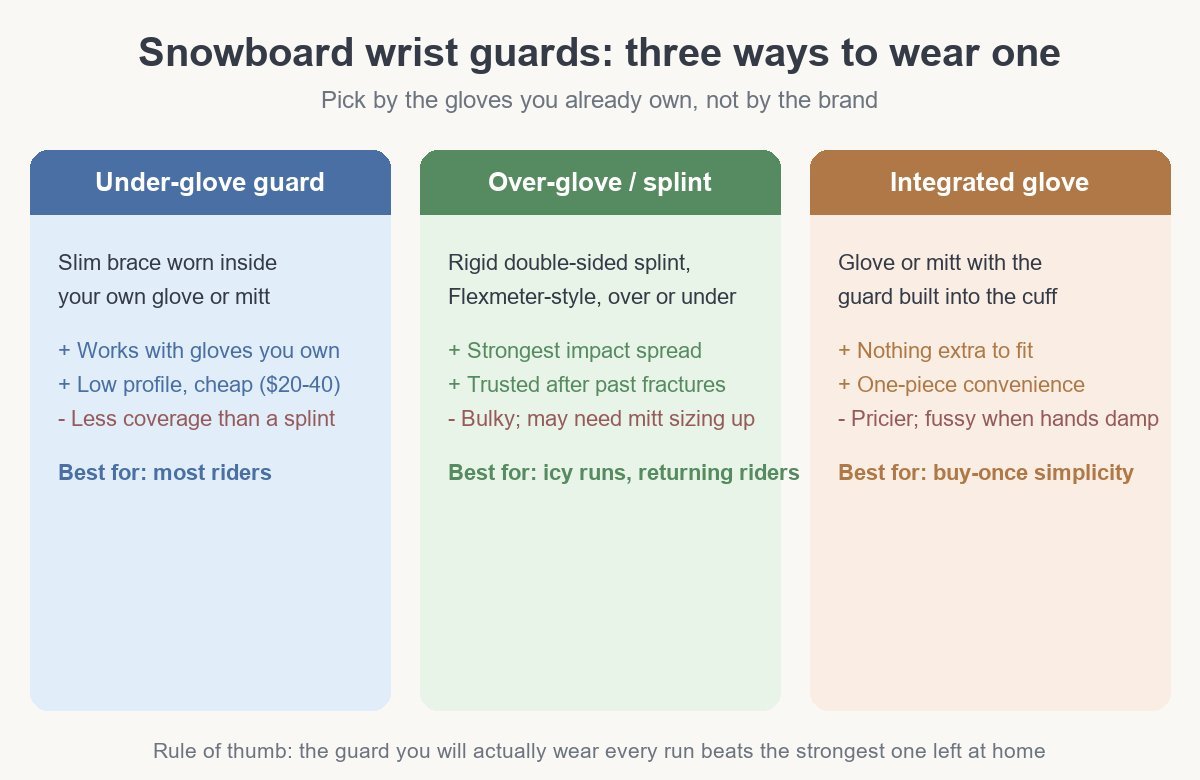
Every guard on the market is one of three designs: a slim brace worn under your glove, a rigid splint worn as its own layer, or a glove with the protection built in. Each trades protection against convenience differently.
Under-glove guards
These are low-profile braces, usually a metal or plastic bar along the palm held by a neoprene cuff. Demon’s Wrist Guard V2 and Burton’s Impact Wrist Guard are the two names that come up in almost every r/snowboarding thread, and both cost somewhere around 20 to 40 dollars.
The appeal is that your gloves stay your gloves. The compromise is coverage: a slim palm bar spreads impact but does not lock the joint the way a full splint does.
Over-glove splints
Flexmeter-style splints put rigid plates on both sides of the wrist and flex progressively, so they absorb a fall instead of just blocking it. This is the design most riders land on after a fracture, because it is the closest thing to wearing a removable cast.
The cost is bulk. Depending on the model you may need to size your mitts up half a size, and the plate can dig in when you rest a chairlift bar across your lap.
Integrated glove guards
Burton, Dakine and Level all make gloves and mittens with the guard sewn in. One purchase, nothing extra to align, and Level’s BioMex-equipped mitts have a loyal following among riders who broke a wrist without protection and never want to think about it again.
Two catches: you are replacing gloves you may already like, and the built-in sleeve gets fussy to pull on when your hands are damp, which on a warm spring run is most of the time.
Which type for which rider
The honest comparison is not about which guard protects best in a lab, but which one you will still be wearing in March. Here is how the three designs stack up on the things that decide that.
| Type | Typical price | Protection level | Works with your gloves? | Best for |
|---|---|---|---|---|
| Under-glove guard | About $20-40 | Good | Yes, if the glove is roomy | Most riders, first-time buyers |
| Over-glove splint | About $50-90 | Strongest | Yes, worn over or under | Icy regions, riders returning from injury |
| Integrated glove | About $60-150 | Good to strong | Replaces them | Riders due for new gloves anyway |
If you cannot decide, buy the under-glove guard. It is cheap enough that a wrong guess costs you a lift-line burrito, and it removes the most common excuse for riding unprotected.
Getting a guard to fit under your gloves
Fit under the glove is where most wrist guard purchases succeed or die, because a guard that turns getting dressed into a wrestling match stops getting worn. A few habits from riders who stuck with theirs solve nearly all of it.
Wear a thin liner glove under the guard. It stops the cuff chewing on your skin over a full day, and riders who do this report the comfort complaints mostly disappear.
“I wear gloves liners underneath wrist guards and haven’t had this issue. I use flexmeter wrist guards, they’re very comfortable”
– r/snowboarding, November 2025 (7 upvotes)
Mittens hide guards better than gloves, since the extra interior room swallows a slim brace without bunching. If you ride tight pipe gloves, try the guard inside them in a shop before you commit, not on the first chairlift of the day.
Sizing in thirty seconds
Measure your hand circumference around the knuckles, ignore your usual glove size, and use each brand’s own chart, because a Demon medium and a Burton medium are not the same hand. Between sizes on a snug-fit brace, size down so the armor stays put on impact.
That is genuinely all sizing requires. Spend the saved effort trying the guard with your real gloves instead.
The forearm-fracture worry, answered
You will read that guards just move the break up the arm, and the research mostly does not back that fear. Studies have found a small shift of some injuries toward the elbow with certain short, rigid designs, while overall injury numbers still drop clearly with guards on.
Longer splints with progressive flex, the Flexmeter approach, exist specifically to spread load up the forearm gradually. Picking one of those answers the objection about as well as current evidence allows.
FAQ: wrist guards snowboarding
Do wrist guards actually work for snowboarding?
Yes. Controlled studies show riders wearing wrist guards suffer roughly half the wrist injuries of unprotected riders, with some reviews finding even larger reductions. No protective gear in snowboarding has stronger evidence behind it.
Can you wear wrist guards under normal gloves?
Yes, low-profile designs like the Burton Impact and Demon V2 are built to slide under standard gloves and mittens. Roomy mitts work best; tight-fitting park gloves may need a size up or a shop try-on first.
Is learning to fall enough instead of wearing guards?
No. Fall technique reduces risk but cannot save you when an edge washes out on ice, which is exactly how experienced riders break wrists. Riders with 20 years of technique still end up in casts; guards cover the falls you never see coming.
Do beginners need wrist guards more than experienced riders?
Beginners face the highest fracture risk because low-speed, hands-down falls happen constantly while learning. If you buy one piece of protection for your first season beyond a helmet, make it wrist guards.
The only rule that matters
Buy the guard that fits the gloves you already own, because the one that goes on without a fight is the one still on your wrists in the afternoon. A midweight brace worn every single run protects you more than the strongest splint sitting in a drawer.
And if your hands earn your living, stop debating the 30 dollars. A cast costs you about six weeks of typing either way.

