A ski trip costs about $250 to $400 per person per day at a U.S. destination resort once lift tickets, lodging, food, and getting there are added up, so a five-day trip lands between $1,500 and $2,000 for one person who already owns gear. A long weekend at a local hill by car runs $450 to $700. Add rentals, lessons, or a peak-holiday week and the same trip doubles.
Those ranges are real, but they hide the interesting part: the same trip to the same mountain can cost one family half what it costs the family in the next condo, and the difference is almost entirely decided months before anyone packs a bag. The line items below come from actual receipts, and the section after them explains which lines you control.
A Real Family Trip, Line by Line
The most useful cost post on r/skiing this year came from a Midwest family of eight, five adults, two teens, one child, all with their own gear, who spent four ski days at Winter Park, Colorado, and published the bill:
“FWIW, here’s some detail on this year’s family ski trip, coming from the Midwest to CO. 8 people. Five adults, 2 teens, 1 child. All have equipment. **Lift Tickets**. Purchased in July, Winter Park Flex Midweek Pack, 4 day. $316 for adults/teens, $240 for the child. So $79 per day. Family total $2,452. **Lodging**. Our transportation changed, so we spent an extra day. Six nights at the Vintage Hotel for $1,675 total. Reserved in July. $280 a night, but $35 per person. **Transportation**. Amtrak…”
– r/skiing, April 2026 (151 upvotes)
Read the numbers slowly, because they contain the whole lesson. Lift tickets bought in July for February came to $79 a day, at a resort where a peak-window day ticket runs well past $200. Six hotel nights for eight people came to $1,675, which is $280 a night but only $35 per person per night. Both lines were booked in July, and one of the top replies grumbles that planning a February trip in July “does feel bit crazy,” which is exactly the point: the crazy-early booking is what made the trip cheap.
What a Ski Trip Costs Per Person
Three trip shapes cover most searches for this question. Ranges below assume one adult who owns gear; rentals add $40 to $125 per day and a group lesson roughly $150 to $250 per session at major U.S. resorts.
| Line item | Weekend, local hill by car (2–3 days) | 5 days at a destination resort (fly) | 1 week in the Alps or Japan |
|---|---|---|---|
| Getting there | $60–$140 gas and tolls | $300–$900 flights, plus $80–$320 transfer or car | $700–$1,600 long-haul, plus $80–$280 transfers |
| Lift tickets | $120–$240 | $350–$800 (window price) or under $400 booked early | $300–$700; European passes run far cheaper per day |
| Lodging | $150–$420 | $450–$1,400 | $500–$1,600 |
| Food and drink | $90–$240 | $180–$520 | $220–$650 |
| Extras (parking, tune, odds and ends) | $30–$90 | $60–$220 | $60–$350 |
| Realistic total | $450–$700 | $1,400–$4,400 | $1,900–$5,400 |
The mid-column ranges match what The Snow Chasers laid out in their 2026 cost breakdown, and the Winter Park family’s per-person math sits toward the low end of that column, which is the whole argument for the next section. For two people, roughly double the destination column and shave lodging by a quarter, since a room costs the same for one or two. Per day of actual skiing at a U.S. destination resort, budget $250 to $400 all-in; the day-ticket line alone is $80 to $250 depending on when you bought it.
The Lines You Control, and When You Control Them
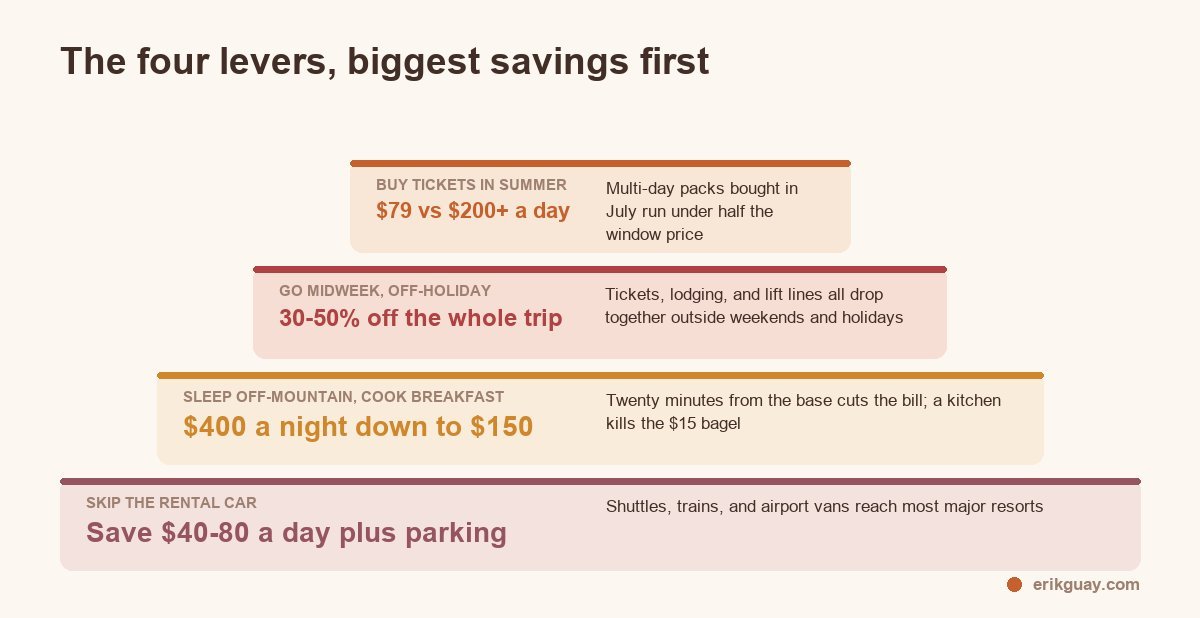
Every ski trip budget has four decisions that swing the total more than everything else combined, and none of them are made at the resort. Lift tickets are the biggest lever: at large U.S. resorts the window price and the pre-bought price for the same day can differ by more than half, and multi-day packs bought in spring or summer, when they first go on sale, are the cheapest lift access anyone without a season pass will ever get. If a trip involves more than about five ski days across a season, a multi-resort pass usually beats even discounted tickets.
Timing is the second lever, and it moves every line at once. Midweek outside holiday periods, tickets, lodging, and lift lines drop together; the family above skied a Monday-to-Thursday block on a midweek pack, which is why their day rate was $79 rather than $200. Lodging is the third, and it responds to distance: a room twenty minutes from the base often costs a third of the slopeside version, and a kitchen erases the $15 breakfast bagel and $28 lunch burger that resort towns are famous for. Transportation is the fourth; a rental car adds $40 to $80 a day plus resort parking, and most major resorts now have shuttle, train, or airport-van options that make the car optional. The Winter Park family took Amtrak straight into the valley and skipped the car entirely.
Two costs resist all four levers. Food at the mountain stays expensive unless you pack it, and skiing has genuinely become a pricier sport in the last decade, a point that community threads about first ski purchases make with some sadness:
“I’m only saying this out of pure informational help and thinking about OP. I saw in another comment, “$300 is too much, what can I get with $200?”. It pains me to say this, but skiing has become a pricey sport to participate in. A fair amount of resorts are charging $80-$200 a day pass, or $800 minimum for a season pass. Another person in here smartly broke down that $900 skis used over 10 years means you’re paying less than $100 a year. OP is trying to accomplish the same for less than $20 a y…”
– r/skiing, March 2026 (28 upvotes)
The gear math in that thread is worth keeping: skis that last ten seasons cost under $100 a year, which is roughly two days of rentals. For anyone planning more than one trip, the spring and summer clearance windows turn gear from a recurring trip cost into a one-time purchase.
Europe and Japan: Cheaper Once You Land
The flight is the price of admission and the mountain is the discount. European lift passes routinely cost half of what comparable U.S. resorts charge per day, lessons are cheaper because independent ski schools compete with resort-run ones, and rentals and food in the big Alpine valleys undercut Colorado, as ski-school marketplace Maison Sport lays out in its Europe vs U.S. cost comparison. A couple who paid about £2,500 all-in for a week in Alpe d’Huez, flights, transfers, lodging, passes, rentals, and six days of lessons for two, was told by the community that they had done fine. Once a U.S. skier is flying anyway, a week in the Alps often costs the same as a week in Utah, and Japan follows the same pattern with even cheaper lift tickets offset by the longer flight.
How Much Does a Ski Trip Cost: FAQ
How much money do you need for a ski trip?
Budget $250 to $400 per person per day at a U.S. destination resort, or $150 to $250 a day at a local hill you can drive to, if you already own gear. First-timers should add roughly $100 a day for rentals plus $150 to $250 per group lesson.
How much is a 4-day ski trip in Colorado?
Around $1,000 to $2,000 per person for four ski days if you fly in, with tickets bought early and lodging shared; the Winter Park family above spent roughly $600 per person on tickets and lodging combined by booking in July. Peak holiday weeks with window-price tickets and slopeside rooms can push the same four days past $3,000.
Is a 3-day ski trip worth it?
Yes if the mountain is within a drive; a three-day weekend at a regional hill runs $450 to $700 and delivers three full ski days. Flying for three days is where the math turns: airfare and transfers spread over so few days can push the per-day cost above $500, so fliers should stretch to five days or pick a closer hill.
What is the cheapest month to ski?
January after the holiday crowds leave is usually the cheapest full month for lift tickets and lodging in North America, with early December and late March close behind. Whatever the month, midweek and non-holiday dates matter more than which month you pick.
Book the tickets the week they go on sale, pick midweek dates, sleep one town over, and let the resort keep its $28 burger. Done that way, $250 a day is a ceiling, not a floor.