Train for hiking by climbing with a loaded pack. Every other piece of a training plan exists to let you do that more often, and to keep your knees intact while you do it.
Most plans you will find open with an eight-week calendar of squats, lunges and planks. Those exercises help. They also treat every hike as the same hike, which is how someone trains for two months and still gets shut down by 3,000 feet of switchbacks before lunch.
The number that should shape your training sits in the trail description: total elevation gain.
Start with the hike you booked
Before you pick a single exercise, pull these off the trail page or the guidebook entry: distance, total ascent, the highest point you will reach or sleep at, how many days run back to back, and what your pack will weigh when it is full of water. Those numbers turn a vague goal into a training target you can measure. They also tell you when your goal is out of reach for the time you have left, which is useful information in week one and painful information in week seven.
There is an old piece of arithmetic that converts those numbers into hours. A Scottish mountaineer named William Naismith published it in 1892, and hillwalkers still use it: allow one hour for every 3 miles of distance, then add an hour for every 2,000 feet of ascent. Modern guidebooks fiddle with the constants, but the original rule is close enough for planning.
Run a 9-mile loop with 3,000 feet of gain through it. Three hours for the distance, another hour and a half for the climbing, so about four and a half hours of moving. Add water stops, a lunch, one wrong turn and a friend who stops for photographs, and the day lands near six hours on your feet.
Six hours is the session you are training for. The mileage is almost incidental, which is why people who train by walking flat 10-mile loops arrive at a mountain trailhead in the wrong kind of shape.
Set the target from there. By two weeks before departure, your longest training day should reach roughly two-thirds of the trip’s hardest day: about four hours moving, somewhere near 2,000 feet of climbing, carrying the pack you plan to carry. Hit that once and the trip becomes a stretch. Hit it three weekends running and the trip becomes a good day out.
“The best way to get in hiking shape is just to put in the miles it seems. The gym can certainly help with overall fitness but it doesn’t translate perfectly”
– r/hiking, February 2026 (52 upvotes)
That commenter has the direction right. Trail time is the specific stimulus and no machine reproduces it. The catch is availability: very few people can reach 3,000 feet of vertical on a Tuesday evening after work, and the ones who can are not the ones searching for a training plan. Everything in the gym is a substitute you use during the week so the weekend session goes better.
Multi-day trips and thru-hiking change the number
For a thru-hike, the trail does most of the training. Nobody arrives at Springer Mountain in thru-hiking shape, and the opening fortnight of low miles is the conditioning block. What you can build beforehand is the capacity to carry load and to get up and do it again the next morning.
The coach behind Couch to Trail, a former soldier who watched lean runners fall apart under 45-pound rucks, frames it as a ratio. If you squat around 300 pounds, a 45-pound pack draws on maybe 15% of your capacity. If your squat is half that, the same pack costs you twice as much of your ceiling on every step, all day, for months. Strength is slow to build and slow to lose; conditioning moves fast in both directions. Load the early weeks with strength and let the endurance come last.
The eight weeks before a hard hike
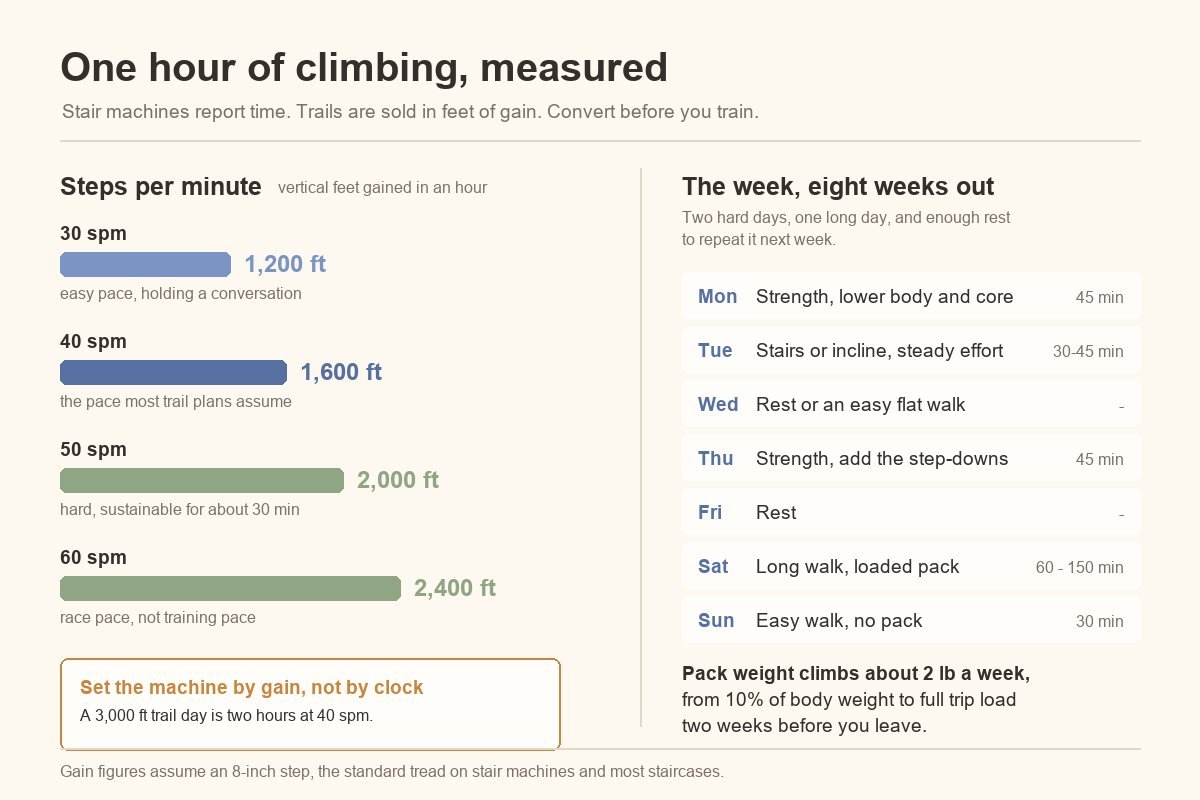
REI’s training article puts the starting line at eight weeks out and sketches a sensible week: two nonconsecutive strength days, three cardio sessions, two rest days, then a switch to hour-plus pack hikes for the final fortnight. It is a good skeleton with one gap. It never says how much heavier anything is supposed to get.
Progression is the part that does the work, and it is boring on purpose:
- Pack weight: begin at 10% of your body weight, add about 2 pounds a week, and reach full trip load with a fortnight to spare
- Long walk: begin at an hour, add roughly 15 minutes each week, and stop growing it at two and a half hours
- Vertical: count feet climbed each week, not time on a machine, and add about 10% a week
- Strength: hold the same lifts for six weeks and add small amounts of weight, since novelty is not progress
Fill the pack with water jugs. A gallon runs 8.3 pounds, which makes the arithmetic easy, and if the walk turns bad three miles from home you can pour the load into the grass and finish light. Bricks and sandbags give you no such exit.
Those long weekend walks are also the only chance to find out that your shirt does not dry, your socks bunch under the arch, or your rain shell traps every bit of heat you produce on a climb. Sort out what to wear when hiking during training, when a bad choice costs you an afternoon rather than a summit.
Cardio volume is where hikers under-train quietly. Coaches at Outdoor Adventure Training put the aerobic base at 180 minutes a week of easy effort, with 30% to 40% of your total cardio hours pushed up near threshold. The American College of Sports Medicine sets a floor of 150 minutes a week of aerobic activity for adults over 50, which is a health minimum and not a mountain minimum. Easy means you can talk in full sentences and feel slightly winded at the end of each one. Most people walk their easy days too hard and their hard days too easy, then wonder why eight weeks produced very little.
The rehearsal, two weeks out
One session tells you more than the eight weeks of workouts leading to it. Two weekends before you leave, run a dress rehearsal and judge it honestly:
- Two-thirds of the trip’s hardest day, done in one push, no long café stop in the middle
- Full pack weight, water included, in the boots and socks you intend to wear
- A climb steep enough that you stop talking on the steepest section
- The descent walked, never shuttled, all of it
- The same food and drink schedule you plan to use on the trip
Steady legs at the bottom and no hot spots on your heels mean you are ready. Quads shaking on the last half mile down, or a blister forming at hour three, means the trip will hand you the same result with worse consequences and no car at the end of it. You still have a fortnight to fix footwear, drop pack weight, or pick an easier objective, and all three of those beat finding out on day one.
How to train for hiking in the gym
Training for hiking in the gym comes down to three jobs: build enough leg and back strength to make the pack feel light, log vertical on a stair machine or inclined treadmill, and teach your quads to absorb the downhill.
Strength work is unglamorous and short. Squats, deadlifts or trap-bar pulls, weighted step-ups onto a knee-high box, split squats, and a loaded carry. Two sessions a week, five or six sets each of the main lifts, done for six to eight weeks. Step-ups deserve the extra attention because they copy the movement that a steep trail demands several thousand times a day.
Then there is the shoulder problem nobody mentions until day two. Step Massive makes the case that weak traps, not weak legs, are what leave hikers rubbing their shoulders at camp, since the trapezius carries pack weight for hours at a stretch. Shrugs and farmer’s carries at high reps fix it cheaply.
Stair machines report time and trails are sold in feet, so convert before you climb. A standard tread is 8 inches, which is two-thirds of a foot. Forty steps a minute gives you 2,400 steps an hour, and 2,400 times two-thirds is 1,600 feet of gain. At 50 steps a minute the same hour buys you 2,000 feet. Training articles that quote 1,500 feet an hour at 40 to 50 steps per minute are being conservative by a few hundred feet, which matters when you are trying to match a 4,000-foot objective inside a lunch break.
The inclined treadmill covers similar ground at 10% to 15% grade, with one rule: let go of the handrails. Leaning on the rails hands a share of your body weight to your arms, and the trail offers no handrail. Load a pack with 10% of your body weight on the machine and the numbers finally start meaning something.
What the gym cannot give you is the descent. Stair machines have no down. Treadmills tilt a couple of degrees below flat at best. That gap is why so many well-trained hikers get wrecked on the way back to the car.
Training for mountains on flat ground
“i want to work up to longer day hikes but right now anything with steady incline smokes me. i can handle flat miles fine. what helped you build endurance for climbs? stair machine, weighted pack, just hiking more? looking for something simple and realistic.”
– r/hiking, February 2026 (17 upvotes)
Flat miles and climbing feel like the same sport for about ninety seconds. Then the grade tips up, your heart rate climbs into a zone flat walking never touched, and the aerobic fitness you built on level ground turns out to be filed under a different heading.
If you live somewhere flat, you are hunting for repeatable vertical rather than scenery. Stadium bleachers. A parking garage, where floor-to-floor height runs close to 10 feet, so a ten-storey garage is 100 feet a lap and 30 laps is a respectable morning. Highway overpasses. Levees and canal banks. An apartment stairwell in bad weather, which is grim and effective in equal measure. Count laps, convert to feet, write the number down, and beat it next week by a small margin.
Now the half that hurts. Descending loads your quadriceps eccentrically, meaning the muscle lengthens while resisting, and that pattern causes most of the delayed soreness hikers blame on the climb. It is also where knees and ankles get injured, because fatigue arrives at the same time as the loose rock.
Practise going down, deliberately and slowly, carrying the same weight. Walk down every flight you climbed. Add reverse step-ups, where you lower one leg under control from a box until the heel brushes the floor, which trains the same braking action in a place you can fall safely. Side-step the steepest sections to spread the load through your hips. And learn how to use trekking poles before the trip, because poles take a slice of the impact off your knees on every downhill step and they only help if your hands already know what to do with them.
Altitude is not a fitness problem
Training for altitude hiking runs into a hard limit early. The CDC’s Yellow Book is blunt about it: training and physical fitness do not affect risk of altitude illness. Susceptibility is largely genetic, there is no screening test for it, and marathon shape buys you exactly none of it.
What does work is going up slowly. Above about 9,800 feet, the Wilderness Medical Society recommends raising your sleeping elevation by no more than roughly 1,600 feet a night, adding a spare night to acclimatise for every 3,300 feet gained, and never jumping from low ground to a 9,000-foot bed in one day. Sleeping elevation is what counts. A day trip to a high summit followed by a night back down low is far gentler on the body than sleeping up there.
Fit hikers get caught more often than they should, and the reason is behavioural. Strong legs let you climb faster, faster climbing is a faster ascent profile, and the ascent profile is the thing that decides who gets a headache at dinner. Being trained gives you the option to go slow comfortably, so use it.
None of this section is medical advice for a body that already has a reason to be careful. Heart or lung conditions, pregnancy, sickle cell trait, or a previous bout of altitude sickness all deserve a conversation with a doctor before you book a high trek, not a training plan off the internet.
Common questions about hiking training
Short answers to the things people ask once they have a date on the calendar and a trail in mind.
How do I get in shape for hiking?
Walk more, then walk uphill, then walk uphill carrying weight. Add two strength sessions a week built on squats, step-ups and loaded carries. Progress the pack by about 2 pounds a week and the vertical by roughly 10%.
How long should you train for a hike?
Eight weeks is the standard recommendation, and it fits a moderately active person preparing for a long day hike. Scale it to the gap you are closing. Someone who walks daily and wants a 6-mile trail with 1,200 feet of gain can be ready in three to four weeks. Someone starting from a desk job and aiming at a 4,000-foot summit day needs twelve, and someone planning consecutive 15-mile days with a full pack should think in seasons. The rehearsal day described above will tell you more than any week count.
What is the 3-3-3 rule for workout?
It is gym shorthand that circulates in several incompatible versions: three sets of three exercises three days a week, or three sets of three heavy reps, or three rounds of three movements. None of them is a hiking protocol. No version of it accounts for pack weight, elevation gain, or the descent, which are the three variables that decide whether a hike goes well.
How to train for hiking as a beginner?
Start with walking and let the distance grow before the weight does. The most upvoted advice on r/hiking is a ladder anyone can climb: walk to the corner and back, then around the block, then a few blocks, then a nearby park, and only then bring a small pack and start looking for hills or stairs. Beginners get hurt by jumping straight to a friend’s favourite 10-mile route with 2,500 feet of gain. Book a 3-mile trail with under 700 feet of climbing for the first outing and tell whoever you are hiking with what pace you intend to keep.
Can you train for hiking in three weeks?
Partly. Three weeks is enough to break in boots, get used to carrying a loaded pack, and do two or three long walks with real climbing in them. It is not long enough to build strength or an aerobic base, so pick a smaller objective and plan a slower pace than you would like.
Taper the final week. Short flat walks, full nights of sleep, no new distance, because anything gained in those seven days arrives as fatigue. How the climb goes was settled somewhere around week five, on a stairwell, under a pack that got heavier every Saturday.