The 2026-2027 winter weather predictions all orbit one signal: a strong, possibly record-class El Niño building in the Pacific. For U.S. skiers that pattern historically means a juiced southern storm track, big potential for California and the Southwest, and a warmer, leaner look for the Pacific Northwest and northern Rockies.
That is the honest summary, and everything below is detail, probability, and the limits of the whole exercise. Seasonal forecasting deals in tilted odds, never appointments. The tilt this year happens to be unusually strong.
What the Models Agree On
El Niño is the warm phase of the El Niño Southern Oscillation, the Pacific Ocean temperature cycle that NOAA’s climate.gov tracks as the single biggest lever on North American winters. In its late-spring update, NOAA’s Climate Prediction Center put the odds of El Niño conditions at 96 percent by December, with roughly even odds of a “strong” event, meaning Pacific surface temperatures more than 1.5 degrees Celsius above average, as Freeskier reported from the agency’s numbers.
Push past 2 degrees and forecasters start using the phrase super El Niño, a class of winter that has happened only a handful of times in the modern record. Long-range model runs from NOAA’s own seasonal suite have flirted with that threshold for months, and European long-range analysts have gone further, flagging early signs that a strong event could destabilize the polar vortex, which is the wildcard that turns a mild pattern into a headline cold outbreak. Their reasoning stacks three signals: strong El Niño events pump wave energy into the polar stratosphere, this year’s stratospheric wind phase loses its stabilizing grip as winter matures, and Arctic sea ice sits at a deficit in exactly the region tied to a weaker vortex. The practical translation is timing: the cold-outbreak risk concentrates in mid and late winter, and the aftermath of a vortex collapse has historically meant above-normal snowfall for the eastern U.S. and Midwest. The current official picture is on the Climate Prediction Center’s seasonal outlook, which updates monthly and is the page worth bookmarking over any almanac.
What a Strong El Niño Does to a Ski Winter
El Niño redraws the jet stream map. The subtropical jet strengthens and sags south, so Pacific storms that would normally slam Washington and British Columbia aim instead at California, the Great Basin, and the southern Rockies. The northern tier of the country tilts warmer and drier; the southern tier tilts wetter.
Wetter does not automatically mean deeper. The same pattern that delivers moisture also drags in milder air, so low-elevation ski areas can catch rain from the exact storm that buries the high ones. Elevation is the quiet variable in every strong El Niño winter: the higher your resort’s base, the more of that southern-track moisture arrives as snow.
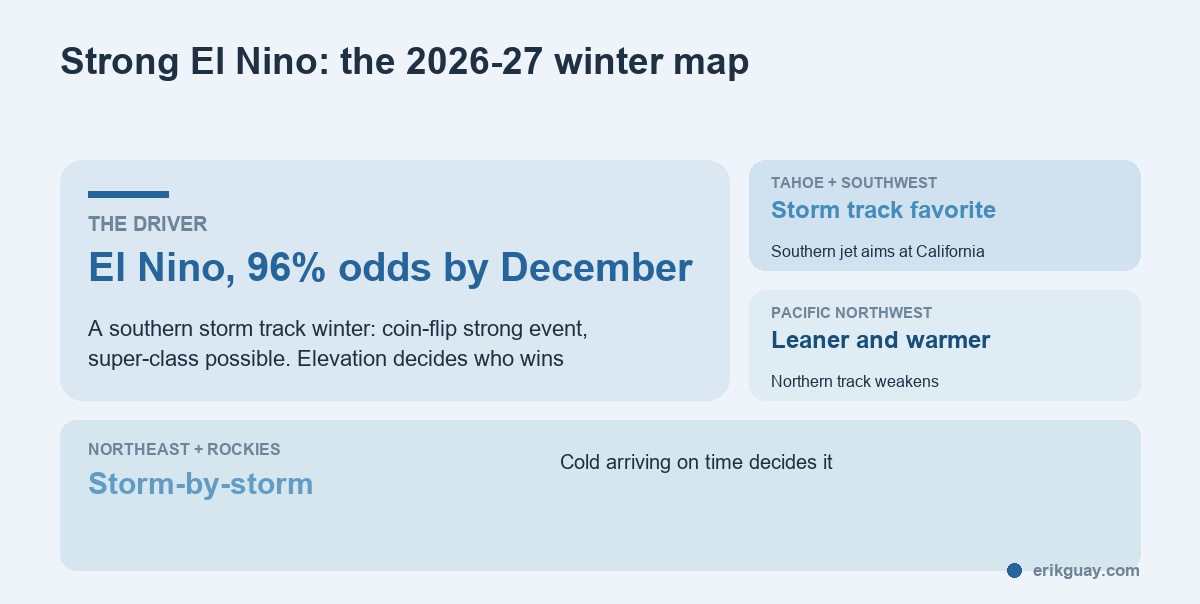
Region by region, the historical lean goes like this. Tahoe and Southern California are the pattern’s favorites, and some of the deepest Sierra winters in memory arrived with a strong El Niño offshore, though the correlation is a lean rather than a law. The Southwest, from Taos to Arizona Snowbowl, tends to feast. Colorado and Utah sit between the storm tracks and land closer to a coin flip, with the southern ranges favored over the northern ones, so Colorado’s first flakes may still arrive on schedule even if the northern mountains run lean. The Pacific Northwest, northern Rockies, and often the lake-effect belts run warmer than average. The Northeast becomes a storm-by-storm gamble where coastal systems can still produce, provided the cold shows up at the same time. Farther afield, Japan’s famous powder pipeline also tends to run below its absurd normal in El Niño winters, worth knowing before you book the Japan trip specifically for bottomless snow.
The Almanacs and the Skeptics
The Farmers’ Almanac has already published its 26/27 winter forecast, headlined “Snow, Sleet, and Surprises,” and this year it leans the same way the models do: an active southern storm track, cold shots across the North, and a messy rain-sleet-snow mix for the Northeast, a rundown Powder covered region by region. Enjoy the almanacs as tradition all the same; their methods are proprietary formulas dating to the 1800s, and their season-ahead specificity, naming cold snaps for particular weeks in particular states, is precision no physical model can honestly offer. This year they happen to agree with the Climate Prediction Center. In years they do not, trust the CPC.
Skiers who have watched many forecasted winters arrive wrong have earned their skepticism, and the threads previewing this season read accordingly:
“One of my neighbors (longtime Vail resident) said that the last 3 winters like this over the past 40 years was followed up by gigantic snow years. Which means precisely nothing. But, we can hope…..”
– r/COsnow, March 2026 (9 upvotes)
That is the right posture. A seasonal outlook can shade where you book a February trip; it cannot tell you whether opening weekend will be deep. Treat every 2026-2027 winter weather prediction as a probability statement that individual storms are free to embarrass.
2026-2027 Winter Weather Predictions FAQ
Will winter 2026-27 be cold in the U.S.?
The pattern favors a milder-than-average winter for the northern half of the country and near-normal to cool, stormy conditions across the south. One caveat keeps forecasters awake: a mid-winter polar vortex disruption, which strong El Niño events can trigger, would open the door to sharp cold outbreaks despite the mild seasonal average.
What about Ohio, Michigan, and the Midwest?
Strong El Niño winters usually run milder than average across the Great Lakes, with below-normal lake-effect snow because the cold outbreaks that drive it come less often. Snow still falls; the season just tends to arrive later and thinner unless the polar vortex breaks down.
Will Georgia and the Southeast have a cold winter?
The Southeast typically lands cooler and wetter than average in strong El Niño winters, because the southern storm track runs directly overhead. That combination raises the odds of rare southern winter-weather events when a storm and a cold shot line up.
Does an El Niño winter delay resort openings?
In the northern half of the ski map, it can, since warm late autumns squeeze snowmaking windows. Southern-track resorts see the opposite risk profile, with early-season storms possible. Either way, resorts lean on snowmaking for opening day, and cold nights matter more to that than storm totals.
Check the CPC outlook again in September and October; the forecast sharpens as winter approaches. And whatever the Pacific decides, legs trained in September ski every version of this winter better than legs that waited for the verdict.