A ski season workout needs six to eight weeks, three sessions a week, and a bias toward leg strength you can control on the way down. That is the whole formula. Everything else, the exercise menus, the phase charts, the gadget drills, hangs off those three numbers.
The mistake most skiers make in August is picking a program sized for a college athlete, following it for eleven days, and showing up at the mountain in November having done nothing since Labor Day. A modest plan you finish beats an impressive one you abandon. So before choosing exercises, look at a calendar and count the weeks between today and the day you expect to click in.
How Many Weeks Do You Have Left?
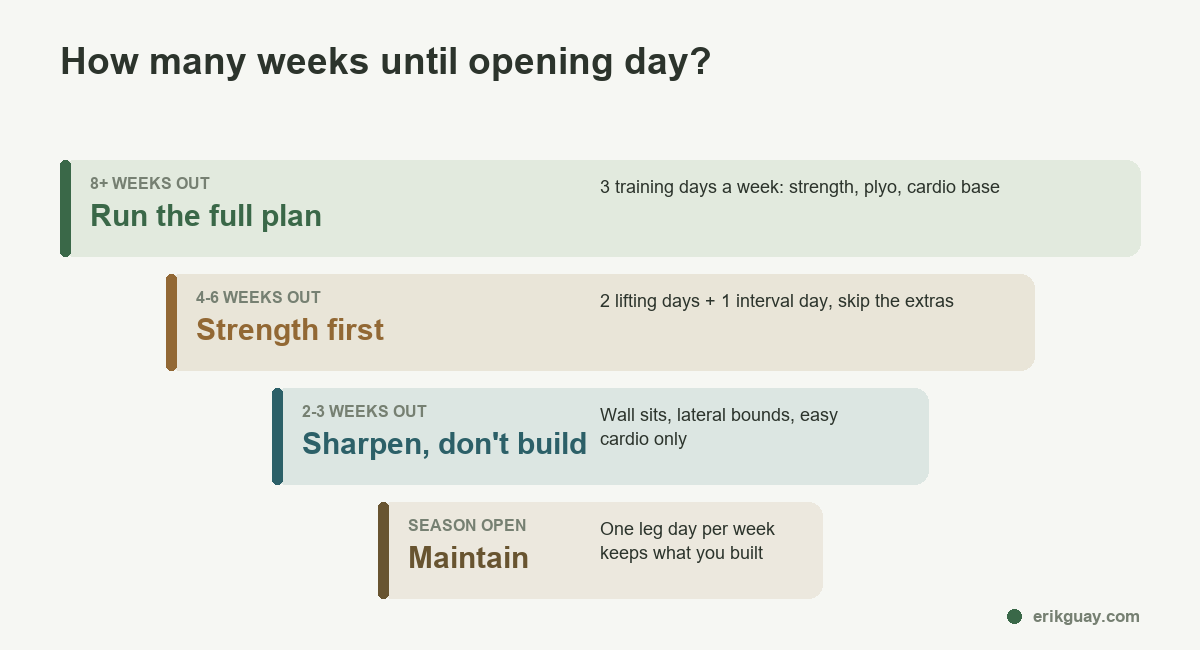
Count back from your realistic first ski day, not from the resort’s earliest possible opening. Eight or more weeks lets you run a full three-day program; with twelve, spend the first month on an easy cardio base before the lifting starts. Four to six weeks means strength work first and extras dropped. Inside three weeks, sharpen what you have instead of trying to build.
Most Rocky Mountain resorts open between mid-November and early December, so an eight-week runway means starting in late September. Wagner Skis is honest about this in its 6-Week Ski Prep program: the staff admit the plan realistically takes seven to eight weeks to complete. Programs always take longer than their names claim, because life gets in the way of week four.
If you are reading this in August or early September, you are early, which is the best position. Build an easy cardio base now, two or three sessions a week of hiking, cycling, or jogging, and save the hard leg work for the final eight weeks.
Skiing Is a Braking Sport
Skiing punishes muscles in a specific way: your quads spend most of a run lengthening under load while they resist gravity, absorbing terrain and braking through every turn. Exercise science calls this eccentric contraction, and it explains two things every skier has felt. It is why your thighs catch fire on the third run of opening day, and why the morning after, you walk downstairs backward while your legs file a formal complaint. Eccentric load is also the main trigger for that deep next-day soreness.
Training that only pushes weight up, leg presses, machine extensions, misses the braking half. Your plan should load the lowering phase on purpose: slow three-second descents in squats and lunges, step-downs from a box, downhill hiking with a loaded pack. For cardio specificity, hiking a hill and walking down it does more for November legs than flat jogging, because the descent is pure eccentric work.
Balance matters as much as raw strength. Wagner’s program notes that many knee injuries trace to quads overpowering the muscles around them, with desk-sitting glutes and hamstrings leaving the ACL to absorb the difference. Strength work pays off beyond the knees, too: a 2019 Cochrane review summarized in American Family Physician found exercise cut fall risk by 15 percent in adults 60 and older, and balance-focused functional training cut the rate of falls by 24 percent. Staying upright in variable snow is partly a strength skill.
The Six Movements That Matter
Every credible ski prep program, from resort trainers to Gym Jones instructors, converges on the same short list. You do not need thirty exercises. You need these six patterns, loaded progressively:
- Squat (goblet or barbell): the base pattern for absorbing terrain. Lower for a slow three-count.
- Romanian deadlift: wakes up hamstrings and glutes, the muscles that protect your ACL from your own quads. Three sets of 8 to 10, hinging slowly enough to feel the hamstrings the whole way down.
- Lateral lunge: skiing happens side to side; most gym training happens front to back. Two or three sets of 10 to 12 per side bridges the gap and mirrors the carve.
- Single-leg step-down: the closest gym analog to a mogul absorption, and the most honest test of side-to-side imbalance.
- Wall sit: isometric quad endurance for the long groomer where you cannot shake out your legs mid-run.
- Lateral bound (skater jump): explosive edge-to-edge power with a controlled one-leg landing.
The last one belongs to a category skiers skip most and need most: plyometrics. Asked what leg work stops the mid-run burnout, the most upvoted answer in a r/skiing thread was blunt:
“Plyometeics. Lots of jumping. You really need to replicate the shock absorption your legs go through to strengthen that movement over and over.”
– r/skiing, July 2026 (127 upvotes)
Core work rides along with all of this: planks, side planks, and weighted carries at the end of each session, five to ten minutes. Upper body gets one slot of push-ups and rows per week so your pole plants stay ahead of you, and that is genuinely all it needs.
The Three-Day Ski Season Workout, Weeks 1–8
Each session follows the same shape, borrowed from how professional mountain-fitness coaches structure training: about ten minutes of easy warm-up, 15 to 20 minutes of the day’s main work, five to ten minutes of core or balance extras, then a short cooldown. Plan on 45 to 60 minutes door to door.
| Phase | Day A (strength) | Day B (power & balance) | Day C (engine) |
|---|---|---|---|
| Weeks 1–2 Learn the moves | Squat, RDL, step-down: 3 sets of 10–12, light, slow lowering | Lateral lunge, wall sit 3×30 sec, single-leg balance holds | 30–45 min hike, bike, or jog, easy pace |
| Weeks 3–4 Add load | Same lifts, heavier, 3–4 sets of 8–10 | Add lateral bounds 3×8 per side, wall sit 3×45 sec | Intervals: 6–8 rounds of 1 min hard / 1–2 min easy |
| Weeks 5–6 The dropout weeks | Top loads, 4 sets of 6–8, full rest between sets | Bounds and jump squats, stick every landing; wall sit 3×60 sec | Hill repeats, walk down slowly for eccentric work |
| Weeks 7–8 Sharpen | Drop to 2–3 working sets, keep weight, stop fresh | Short explosive sessions, perfect form | One longer hike or ride, one short interval day |
The plan repeats on purpose.
Muscles respond to boring repetition with rising intensity, and two scheduling rules do most of the injury prevention along the way. Never train legs hard more than two days in a row, and treat recovery days as active recovery: a walk, a foam roller, stretching. Weeks five and six get a label in the table because that is where people quit; the Wagner coaches flag the same stretch in their own program. Expect the motivation dip, schedule the sessions in your calendar like meetings, and let the phase change at week seven pull you through.
Only Have Two Days a Week?
Two 30-minute sessions a week, done every week from now to opening day, will still change how your first month of skiing feels. Session one: squats, RDLs, and wall sits. Session two: lateral lunges, step-downs, and bounds, with ten minutes of intervals after. That is the whole floor plan.
This is worth saying because the standard advice assumes an appetite most skiers do not have. The person asking about ski prep on Reddit usually lifts once or twice a week already and wants to know if that can work. A 60-something ski professional who trains instructors in the Rockies answered with his own approach:
“Ski Pro here—I hire/train/manage ski instructors in the Rocky Mountains, I’m on skis 120-ish days a year. Over all fitness is important so you need a good base to start, resistance training of any sort is always a good start—and contrary to what a lot believe you can get a good cardio workout from proper weight training so it’s a twofer. In my mid 60’s I have to be prepared to start training staff in early November and to be able to ski 5-10 days in a row right from day one. So I weight train y…”
– r/skiing, September 2025 (94 upvotes)
Someone who skis 120 days a year and starts every season with five-to-ten-day teaching blocks builds his base on plain resistance training. Consistency carries more of the load than program design does.
The Final-Week Readiness Test
Three self-tests, run in your final week, tell you whether the training worked. Hold a wall sit for 90 seconds. Do ten slow single-leg sit-to-stands from a chair on each leg without the free foot touching down. String together 20 lateral bounds with quiet, stuck landings.
These are practical bars, not lab standards. Pass all three and your legs will outlast the lift lines on opening weekend. Fail one and you know exactly which movement needs the remaining sessions. Either way, ski the first day like it is week one, because it is: even well-trained legs need a day or two of actual skiing before the sport-specific endurance shows up.
FAQ
Can I do a ski season workout at home with no equipment?
Yes, bodyweight covers most of the list: air squats with a slow descent, single-leg sit-to-stands, lateral lunges, wall sits, skater bounds, and planks. Load a backpack with books when squats get easy, and use stairs for step-downs and hill repeats.
What about ski exercises for seniors or bad knees?
Swap every jump for a controlled version: step-downs instead of bounds, sit-to-stands instead of jump squats, cycling instead of hill running. Keep the strength work, since the fall-risk reduction evidence cited earlier comes largely from older adults, and shorten the wall sits before you shorten the lifting. A history of knee surgery, heart trouble, or a long layoff from exercise is a reason to have a physical therapist or doctor look at the plan before week one.
When should I start training for ski season?
Eight weeks before your first planned ski day. For a Thanksgiving-week trip, that means the end of September. Started late? Run the four-week strength-first version instead of compressing all eight weeks into a heroic month that ends in a strained knee.
How long should each session take?
About 45 to 60 minutes for the full three-day plan, including warm-up and cooldown. The two-day floor plan fits in 30 minutes per session. If a session must shrink, cut the extras and keep the main strength block.
One last calendar note. If opening day is inside four weeks as you read this, skip the deliberation, do the two-day floor plan starting today, and book nothing for the morning after your first ski day. Your quads will still complain. They will just do it quietly enough to let you take the second run.