Skiing absolutely burns a significant number of calories — often more than people expect, and sometimes fewer than the mountain mythology suggests. A 160-pound skier can torch anywhere from 300 to over 600 calories per hour depending on terrain and effort, putting skiing firmly in the same league as cycling or rowing. Compared to a typical gym session? Skiing wins on most days, with some important caveats.
Body weight, terrain difficulty, and skiing intensity each pull the estimate in dramatically different directions. A casual cruise down a groomed blue run looks nothing like a mogul-bashing descent in terms of metabolic demand. And the biggest wildcard of all — how much time you actually spend skiing versus sitting on a chairlift — can cut those headline calorie numbers nearly in half.
How Many Calories Does Skiing Burn? (By Body Weight)
Downhill skiing burns roughly 300–600 calories per hour depending on body weight and intensity — making it a genuinely serious workout, not just a leisure activity. A 160 lb skier on moderate groomed terrain burns approximately 407 calories per hour, while that same skier pushing hard on black diamond runs can clear 500+ calories in 60 minutes of active descent.
Calorie Burn Estimates Per Hour
These estimates are derived from Metabolic Equivalent of Task (MET) values published by the Compendium of Physical Activities (2024 edition). The formula is straightforward: Calories/hour = MET × body weight in kg × 1.05. Moderate skiing carries a MET of approximately 5.3; vigorous skiing climbs to around 6.8.
| Skiing Intensity | 130 lb / 59 kg | 160 lb / 73 kg | 190 lb / 86 kg | 220 lb / 100 kg |
|---|---|---|---|---|
| Moderate (MET 5.3) | ~329 cal/hr | ~407 cal/hr | ~479 cal/hr | ~557 cal/hr |
| Vigorous (MET 6.8) | ~422 cal/hr | ~522 cal/hr | ~615 cal/hr | ~714 cal/hr |
The range across body weights is striking — a 220 lb skier burns more than double what a 130 lb skier burns at vigorous intensity during the same hour. Heavier skiers move more mass against gravity and friction on every single turn, which is why body weight is the single biggest lever in any calorie calculation.
What Drives the Difference?
Three variables account for almost all the variation between skiers: body weight, skiing intensity, and terrain type. Body weight dominates — as the table makes clear, it can swing hourly burn by nearly 300 calories.
Skiing intensity is harder to self-assess than most people expect. Cruising a wide groomed blue run feels effortful, but the metabolic load is meaningfully lower than charging moguls or carving steep fall-line pitches where your legs are under near-constant eccentric load. Terrain isn’t just scenery — it’s a direct dial on how many calories skiing actually burns.
Calories Burned by Terrain and Run Difficulty
Terrain is the single biggest lever you can pull to change how hard skiing works your body. A recreational skier cruising groomed blues burns meaningfully fewer calories per hour than someone grinding through mogul fields or breaking trail in the backcountry — and the gap is larger than most people assume, often 40% or more between the easiest and hardest terrain tiers.
Groomed Green and Blue Runs
Groomed terrain is where most recreational skiers spend the majority of their day. The predictable surface means your muscles work at a steady, moderate output — the treadmill jog of the ski world. According to the Compendium of Physical Activities, groomed alpine skiing sits at a MET of roughly 5–6, translating to approximately 300–400 calories per hour for a 160 lb (73 kg) skier.
Beginners especially live on this terrain, and the calorie burn is still comparable to a brisk cycling session. The limitation is consistency: groomed runs don’t force your stabilizers to fire unpredictably, so intensity stays relatively capped.
Black Diamond and Mogul Runs
Moguls change everything. Each bump demands an explosive absorption-and-extension cycle through your quads, glutes, and core — essentially a rapid-fire series of partial squats at speed. That constant edge-setting and reactive muscle engagement pushes the MET range to approximately 7–8, spiking calorie burn to roughly 420–530 calories per hour for the same 160 lb skier — a 30–40% jump over groomed terrain.
Picture a skier who does four mogul runs back-to-back versus four groomed cruisers in the same time window. The mogul skier is burning meaningfully more calories while also accumulating greater muscular fatigue, which is why legs give out faster on bump runs than on groomers.
Off-Piste and Backcountry Skiing
Off-piste and backcountry skiing represent the highest-intensity tier of the sport. Variable snow resistance — breaking through wind crust, sinking into heavy powder, or navigating untracked terrain — forces continuous full-body stabilization that groomed skiing simply doesn’t replicate. MET values can reach 8–10 based on Compendium classifications for cross-country and backcountry variants, pushing hourly calorie burn toward 500–650+ calories for a 160 lb skier.
Backcountry touring adds another layer entirely. Carrying skins, avalanche safety gear, and a loaded pack increases metabolic load before you’ve made a single turn. Boot-packing uphill — a staple of backcountry access — shifts the demand closer to loaded hiking, with calorie costs to match.
| Terrain Type | MET Range | Cal/hr — 130 lb | Cal/hr — 160 lb | Cal/hr — 190 lb | Cal/hr — 220 lb |
|---|---|---|---|---|---|
| Groomed Green/Blue | 5–6 | 260–372 | 320–460 | 380–541 | 441–630 |
| Black Diamond / Moguls | 7–8 | 434–496 | 536–613 | 634–727 | 735–840 |
| Off-Piste / Backcountry | 8–10 | 496–620 | 613–767 | 727–910 | 840–1,050 |
Skiing vs. Common Gym Workouts
Calorie numbers mean more when you can compare them against familiar benchmarks. For a 160 lb person, moderate downhill skiing (~407 cal/hr) outpaces general weight training (~224 cal/hr) and yoga (~298 cal/hr), runs roughly even with recreational cycling (~420 cal/hr), and trails behind running at 6 mph (~600 cal/hr) and high-intensity interval training (~530 cal/hr).
| Activity (160 lb person) | Approx. Cal/hr | MET Value |
|---|---|---|
| Moderate Downhill Skiing | ~407 | 5.3 |
| Vigorous Downhill Skiing | ~522 | 6.8 |
| Running (6 mph / 10 min mile) | ~600 | 9.8 |
| Cycling (12–14 mph, moderate) | ~420 | 6.8 |
| Swimming (moderate laps) | ~430 | 5.8 |
| HIIT / Circuit Training | ~530 | 8.0 |
| Weight Training (general) | ~224 | 3.5 |
The crucial difference: skiing sustains elevated calorie burn across hours in a way that gym workouts rarely do. Most people struggle to maintain a treadmill pace for 60 continuous minutes. Skiing distributes that effort across an entire day — punctuated by rest intervals on the chairlift — making it easier to accumulate a large total burn without the psychological grind of a long gym session.
Active Skiing Time vs. Total Mountain Time
Most calorie estimates for skiing quote an hourly figure and leave you to multiply — but that math is quietly misleading. A recreational skier on a typical 6-hour mountain day is only actively descending for roughly 1.5 to 2.5 hours. The rest is lift rides, lift queues, gear adjustments, a lodge lunch, and the occasional stand-around moment at the top of a run.
How Much Time Are You Actually Skiing?
Chairlift rides alone consume a significant chunk of the day. A lift with a 12-minute ride time, ridden eight times, accounts for 96 minutes of near-passive activity — MET values for seated lift riding sit around 1.5 to 2, barely above resting. Add a 45-minute lunch break and a few queue waits and active descent time often lands at just 30–40% of total mountain time for recreational skiers.
Expert skiers who ski aggressively, skip long lunch breaks, and choose lifts with fast turnaround can push active time closer to 50%. But for most people on a family ski trip? The lower end is more honest.
Realistic Full-Day Calorie Burn Estimates
For a 160 lb (73 kg) skier, the numbers shift substantially once lift and rest time are factored in alongside active descent calories.
| Scenario | Active Ski Time | Active Skiing Calories | Lift/Rest Calories | Estimated Daily Total |
|---|---|---|---|---|
| Moderate day (groomed blues) | ~1.5 hrs | ~430 | ~200 | ~630 |
| Hard day (blacks, moguls) | ~2.5 hrs | ~875 | ~180 | ~1,055 |
Those figures are meaningful for weight management — but they’re a far cry from the “600 calories per hour” headlines that circulate online. Realistic daily burn for most recreational skiers lands between 600 and 1,100 calories, not the 2,000+ that aggressive hourly math would imply.
How Ski Gear Weight Adds to Your Energy Expenditure
The gear itself costs you calories. Ski boots typically weigh 3 to 5 lbs each, and that distal weight on the lower leg dramatically increases the muscular effort required to walk — even short distances across a parking lot or base lodge. Research on loaded walking consistently shows that weight carried at the feet increases metabolic cost far more per pound than equivalent weight carried in a backpack.
Heavy layered clothing, skis over the shoulder, and poles in hand compound this effect throughout the day. Gear-related energy expenditure likely adds 5–10% to total daily calorie burn beyond what activity alone accounts for — a modest but real contribution that conventional estimates ignore entirely.
The Afterburn Effect: EPOC and Skiing
Skiing doesn’t stop burning calories when you click out of your bindings. Excess Post-Exercise Oxygen Consumption (EPOC) — commonly called the “afterburn effect” — keeps your metabolism elevated for hours after intense physical activity as your body repairs muscle tissue, replenishes glycogen stores, and restores homeostasis.
Vigorous skiing, particularly mogul runs and steep terrain that demand heavy eccentric muscle contractions, produces greater EPOC than steady-state cardio like jogging. Those rapid-fire quad contractions cause micro-tears in muscle fibers that require energy to repair — which is also why your legs feel destroyed the morning after a hard ski day. Estimates for EPOC range from an additional 50–150 calories over the 12–24 hours post-exercise, depending on intensity and duration.
Cold exposure adds a small but real metabolic bump on top of EPOC. Skiing in sub-freezing temperatures forces your body to generate extra heat through thermogenesis, which can raise resting metabolic rate by 5–15% during exposure. Combined with EPOC, that après-ski fatigue represents a genuine metabolic cost you won’t see on any fitness tracker.
How to Maximize Calorie Burn on the Mountain
Not all ski days are created equal. A few deliberate choices can meaningfully increase your total calorie expenditure without requiring you to become an expert skier overnight.
- Choose shorter lift rides. Lifts with 4–6 minute ride times give you more runs per hour and more active descent time. Gondola rides to the summit may be scenic, but they eat into your calorie-burning window.
- Skip the two-hour lunch. Cutting your lodge break from 90 minutes to 30 reclaims an hour of active skiing — potentially adding 300–400 calories to your daily total.
- Mix in harder terrain. Even one or two mogul or black diamond runs per hour can raise your average intensity well above the groomed-only baseline.
- Ski in the afternoon. Snow conditions typically get choppier and heavier as the day progresses, forcing more muscular engagement than morning corduroy.
- Carry your own gear. Walking from the parking lot to the lift in ski boots with skis over your shoulder is a legitimate low-grade workout. Embrace it.
Frequently Asked Questions
How many calories does skiing burn in a full day?
A 160 lb recreational skier typically burns 600–1,100 calories during a 6-hour ski day, depending on terrain difficulty and how much time is spent actively descending versus riding lifts. Aggressive skiers on steep terrain can push closer to 1,200–1,400 calories.
Does skiing burn more calories than snowboarding?
Skiing and snowboarding burn roughly similar calories at the same intensity level. The Compendium of Physical Activities assigns both moderate downhill skiing and moderate snowboarding a MET of approximately 5.3. The difference comes down to terrain choice and personal effort, not the discipline itself.
Is skiing a good workout for weight loss?
Skiing is an effective calorie-burning activity, but it works best as a supplement to consistent exercise rather than a standalone weight-loss strategy. A typical ski vacation might burn 600–1,000 extra calories per day — meaningful over a week-long trip, but easily offset by lodge meals and après-ski beer if you’re not paying attention to intake.
Does cross-country skiing burn more calories than downhill?
Yes, substantially. Classic cross-country skiing carries a MET of 6.8–9.0, and skate skiing can exceed 10.0 — placing it among the most calorie-intensive activities humans can sustain. A 160 lb cross-country skier can burn 550–770+ calories per hour with no lift breaks to reduce the total.
Do fitness trackers accurately measure skiing calories?
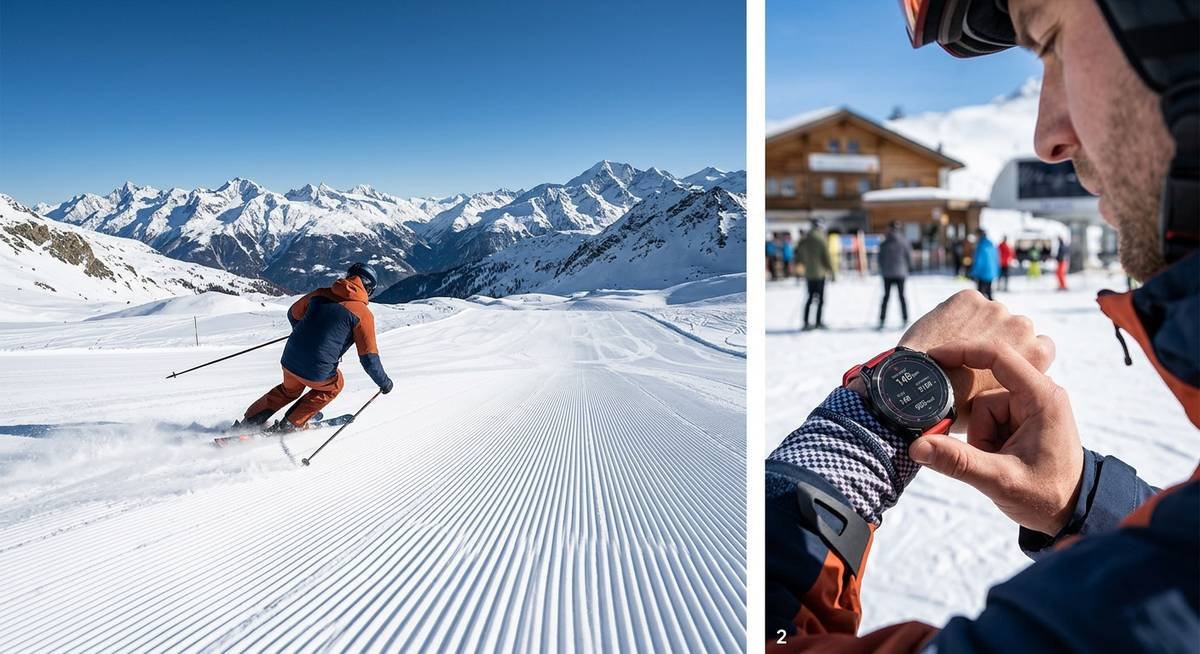
Most wrist-based fitness trackers overestimate skiing calorie burn by 15–40%. Skiing involves heavy lower-body eccentric work that wrist-mounted accelerometers struggle to capture accurately. Heart rate-based estimates are more reliable but still imprecise because cold temperatures and altitude can elevate heart rate independently of effort. Treat tracker numbers as a rough guideline, not a precise measurement.
Does altitude affect how many calories you burn skiing?
Altitude has a modest effect. At elevations above 5,000–7,000 feet, your body works harder to deliver oxygen to muscles, and your basal metabolic rate increases slightly. Studies suggest a 5–10% bump in calorie expenditure at moderate altitude compared to sea level, though acclimatized skiers see less of a difference.
Final Takeaway
Skiing genuinely burns a lot of calories — between 300 and 700+ per hour of active descent, depending on your weight and the terrain under your skis. But the real-world number for a full day on the mountain is lower than most online sources claim, because only a fraction of your time is spent actually skiing. A realistic range for a recreational skier’s full day sits between 600 and 1,100 calories, with EPOC and cold exposure adding a modest bonus afterward.
The most honest answer to “does skiing burn a lot of calories?” is: yes, especially if you ski hard terrain, minimize lift and lunch time, and spend multiple days on snow. It won’t replace a consistent training program, but as a calorie-burning activity that you actually want to do for six hours straight, skiing is hard to beat.