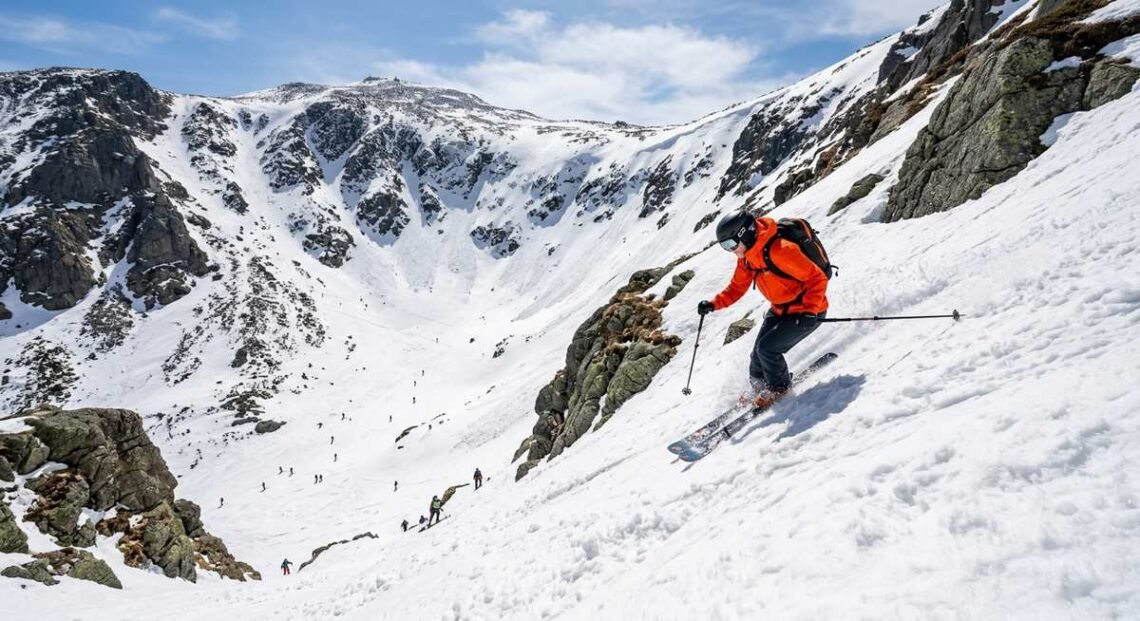
Every spring, skiers strap their gear to their backs and hike two and a half miles into a glacial cirque on Mount Washington — no lifts, no grooming, no ski patrol sweep at closing time. Tuckerman Ravine skiing is not a resort experience with backcountry aesthetics. It is the real thing: a 40-to-55-degree headwall, Mount Washington’s notoriously violent weather, and a snowpack that demands respect from the moment you leave Pinkham Notch Visitor Center.
The ravine has drawn skiers since the 1930s, when racers first schussed the headwall in leather boots and wooden skis. People have died here. People have also made turns so good they drove home without saying a word, too satisfied to bother.
What follows covers everything a skier needs to make a smart, safe, and genuinely rewarding trip — from honestly assessing whether your fitness and ski ability match what the headwall demands, to reading an avalanche forecast from the Mount Washington Avalanche Center, to picking the right month and having a backup plan if the ravine shuts you out.
Are You Ready for Tuckerman Ravine? Skill and Fitness Requirements
Most skiers who attempt Tuckerman Ravine are underprepared — not because they lack courage, but because no resort on the East Coast trains you for what the headwall actually demands. Before committing to the trip, honestly stack your skiing ability, physical conditioning, and backcountry experience against what follows. If gaps exist, address them first.
Skiing Ability — Headwall Lines and What They Require
Being an expert skier at a groomed resort is a starting point, not a qualification. The headwall pitches range from roughly 40 to 55 degrees, and the snow surface changes by the hour — wind slab in the morning, heavy wet corn by early afternoon, refrozen ice if you linger too late.
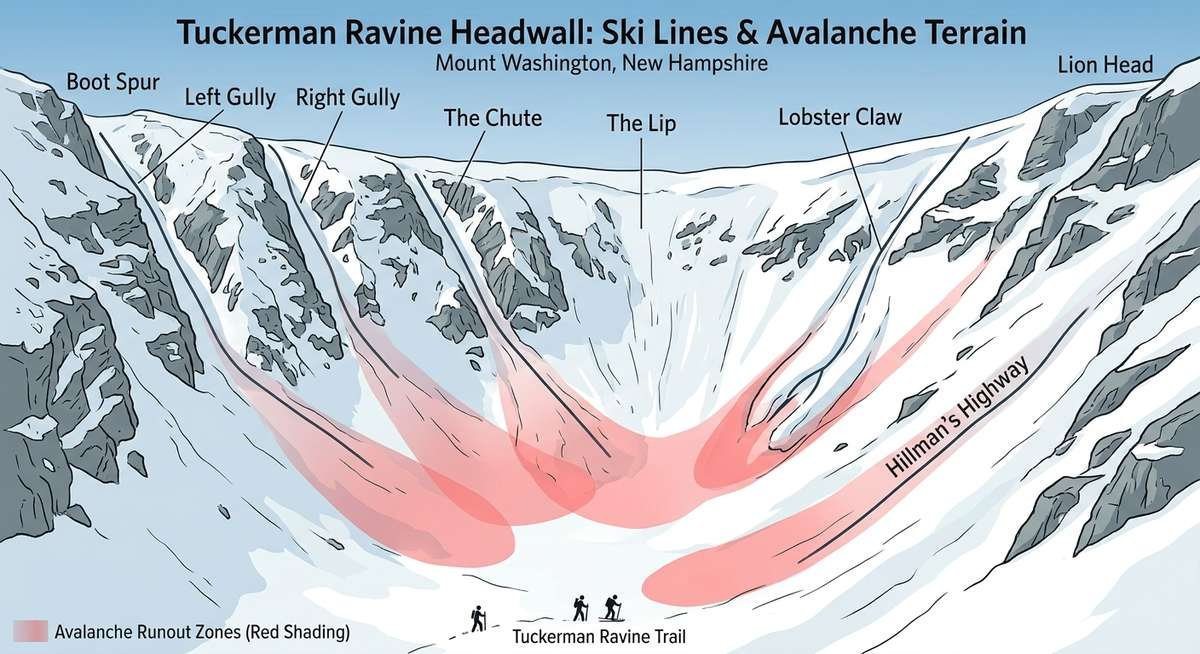
The lines are not created equal. Left Gully is the most forgiving entry point, with a slightly lower angle and a wider fall line, making it the standard recommendation for first-timers who meet the other requirements. Right Gully steps up the commitment. The Chute and Lobster Claw are narrow, consequential, and demand absolute confidence in steep variable snow — a fall in either has nowhere safe to go.
| Line | Approximate Pitch | Difficulty | Notes |
|---|---|---|---|
| Left Gully | ~40–45° | Steep Expert | Best first headwall line; wider runout |
| Right Gully | ~45–50° | Steep Expert | More exposure, narrower at entry |
| Hillman’s Highway | ~35–40° | Advanced | Below the headwall; lower-angle alternative |
| Chute | ~50–55° | Extreme | Very narrow; no margin for error |
| Lobster Claw | ~50–55° | Extreme | Technical entry; serious consequence terrain |
Hillman’s Highway, which sits below the main headwall, offers a lower-angle option around 35–40 degrees. It is not easy terrain by any normal standard, but it gives strong advanced skiers a taste of the ravine without committing to the headwall’s full steepness.
Physical Fitness and the Hike-In
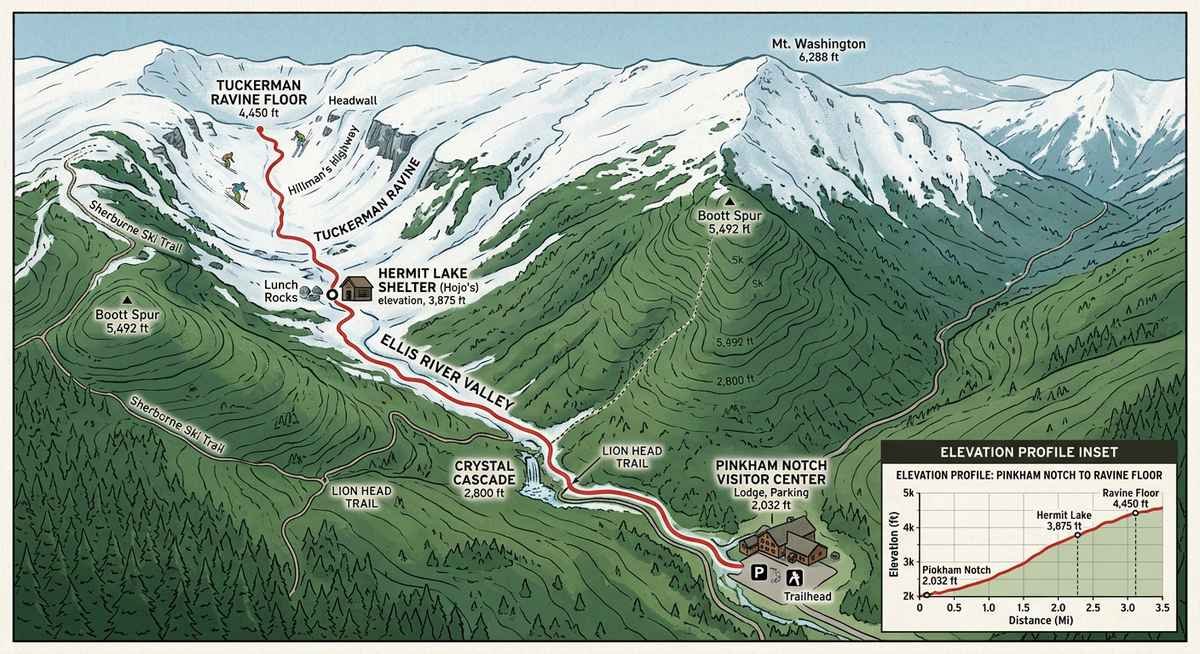
The Tuckerman Ravine Trail begins at Pinkham Notch Visitor Center (Route 16, Gorham, NH) and covers 2.4 miles to the ravine floor, gaining approximately 2,350 feet of elevation. That is a serious aerobic effort under any conditions. Add ski boots, skis strapped to a pack, avalanche safety gear, and layers, and you are typically carrying 25 to 40 pounds.
Fit hikers move through in around 1.5 hours. Most skiers carrying full gear take 2 to 3 hours. Arriving at the headwall with exhausted legs is not just uncomfortable — it is a genuine safety problem, because tired muscles fail on steep terrain exactly when you need them most.
Train specifically for this in the weeks before your trip. Weighted uphill hiking, stair climbs with a loaded pack, and single-leg strength work (Bulgarian split squats, pistol squats) build the endurance and stability the hike and headwall both demand. If you cannot hike 2,500 vertical feet with a 30-pound pack and still feel strong at the top, you are not ready.
Backcountry Experience Checklist
Tuckerman Ravine is not the place to learn backcountry skiing. Before your first trip, you should have completed at minimum:
- At least one guided or mentored backcountry ski tour on steep terrain
- An avalanche safety course (AIARE Level 1 or equivalent) covering beacon search, companion rescue, and snowpack assessment
- Practice with self-arrest using an ice axe on hard snow — the approach above the ravine floor can be icy and exposed
- Navigation experience in reduced visibility, because Mount Washington generates whiteout conditions with almost no warning
- Comfort skinning or bootpacking uphill for extended periods while managing energy and hydration
Guided services operate in the ravine for good reason. If your experience gaps are limited to terrain familiarity rather than fundamental skill, hiring a certified guide for your first trip is a sound investment — not a concession.
Avalanche Safety and Snow Conditions at Tuckerman Ravine
Tuckerman Ravine carries real avalanche risk from November through May. The headwall’s east-northeast aspect, chronic wind-loading from Mount Washington’s extreme gusts, and rapid spring freeze-thaw cycles combine to produce dangerous slab and wet avalanche conditions. Every party entering the ravine should carry a beacon, probe, and shovel — no exceptions — and check the Mount Washington Avalanche Center (MWAC) forecast the morning of their trip, not the evening before.
Understanding Avalanche Risk in the Ravine
The headwall faces east-northeast, which means it catches direct solar radiation in the morning and relentless wind transport from the west and northwest — Mount Washington’s prevailing wind direction. Those winds, which routinely exceed 100 mph on the summit, deposit enormous quantities of wind slab onto the upper headwall and the rollover zones above the main gullies. A snowpack that looks stable and skis beautifully one afternoon can fracture catastrophically the next morning after an overnight refreeze.
Spring temperature swings accelerate the hazard in a different way. On warm April and May afternoons, surface snow saturates rapidly, reducing the friction holding the snowpack together. Wet avalanche cycles — heavy, dense slides that move slower than dry slabs but bury victims just as effectively — become the dominant threat once daytime temperatures climb above freezing. The ravine has seen multiple fatalities from avalanches over the decades, including a fatal slide in 1964 that killed two climbers on the headwall.
The bowl geometry concentrates runout debris directly onto the flat apron where spectators and skiers congregate. A slide releasing from the upper headwall can travel the full vertical drop in seconds. Standing in the runout zone is one of the most common — and most preventable — mistakes visitors make.
How to Read the MWAC Forecast
The Mount Washington Avalanche Center publishes daily forecasts at mountwashingtonavalanchecenter.org during the active season (typically November through May). The forecast uses the North American Public Avalanche Danger Scale — five levels from Low (1) to Extreme (5) — and breaks hazard down by elevation band and aspect.
Reading the forecast correctly means going beyond the headline danger number. The avalanche problem type matters just as much. Wind slab problems dominate in early spring and after storm cycles. Wet avalanche problems take over on warm afternoons from mid-April onward. MWAC forecasters describe the likely trigger sensitivity, the elevation range of concern, and the specific aspects to avoid — all directly applicable to choosing which headwall line, if any, is appropriate that day.
A practical approach to using the forecast:
- Check the MWAC website the morning of your trip — overnight wind events and temperature shifts can change the danger rating by one or two levels from the previous evening’s update.
- Read the danger rating for the Tuckerman Ravine zone at headwall elevation, not just the general above-treeline rating.
- Identify the avalanche problem type (wind slab, wet slab, storm slab, persistent slab) and note which aspects and elevation bands are flagged.
- Match the flagged aspects against your planned line. If MWAC highlights east-facing terrain at headwall elevation, Left Gully and Right Gully are both directly in the danger zone.
- Set a turnaround time based on the wet avalanche outlook. If the forecast calls for rapid warming, plan to be off the headwall by late morning.
Safety Gear — Mandatory vs. Recommended
The table below separates what you must carry from what experienced parties add for additional margin. USFS Snow Rangers patrol the ravine during peak season and have the authority to turn back parties without basic avalanche safety equipment when danger is elevated.
| Category | Item | Why It Matters |
|---|---|---|
| Mandatory | Avalanche transceiver (beacon) | Enables companion rescue; must be worn transmitting on approach |
| Mandatory | Probe pole | Pinpoints burial location after beacon search |
| Mandatory | Collapsible shovel | Excavation tool; also useful for digging snow pits |
| Mandatory | Helmet | Rock and ice fall are constant hazards on the headwall |
| Recommended | Avalanche airbag pack | Increases survival odds in a burial scenario |
| Recommended | Ice axe | Essential for self-arrest on icy approach above Lunch Rocks |
| Recommended | Ski crampons or boot crampons | The final pitch to the headwall lip is often hard ice in the morning |
Pack weight adds up fast. Budget 30–40 pounds with skis, boots, safety gear, water, food, and layers. Every item earns its place or gets left behind — there is no lodge at the top.
Month-by-Month Conditions Calendar: When to Ski Tuckerman Ravine
The prime window for Tuckerman Ravine skiing runs roughly April through mid-May, when snowpack depth peaks, corn snow cycles become reliable, and most headwall lines are open simultaneously. Outside that window, conditions exist — but they demand either mountaineering-level experience or a willingness to accept significantly diminished terrain.
February–March: Early Season
Snowpack is still building through February and into March, and the avalanche hazard during this period is consistently among the highest of the season. Wind-loaded slabs accumulate rapidly on the headwall’s east-facing aspect, and MWAC frequently issues Considerable or High ratings for the Tuckerman zone.
Skiable terrain is limited — most headwall lines remain either buried under unstable snow or not yet filled in enough to be safe. Crowd levels are low, which can feel like a perk, but the solitude reflects the reality: these conditions are appropriate only for experienced mountaineers who understand avalanche terrain management and have prior winter experience on Mount Washington specifically.
Think of February and March as the ravine’s gatekeeping months. The mountain is not closed to you, but it is testing whether you belong there.
April: Peak Season Begins
April is when Tuckerman Ravine skiing shifts from mountaineering objective to legitimate ski destination. Snowpack typically reaches its seasonal peak — often exceeding 100 inches in the bowl according to MWAC seasonal summaries — and warming daytime temperatures trigger the corn snow cycles that make the headwall genuinely enjoyable rather than merely survivable.
Most major lines open during April, including Left Gully, Right Gully, and Center Headwall. Crowds build noticeably on weekends, particularly after the first stretch of warm, clear weather. Weekdays remain comparatively quiet and offer better snow before afternoon softening turns to slush.
Wet avalanche cycles become the primary concern as solar radiation increases. Timing your descent before early afternoon heating is a genuine safety consideration, not a comfort preference. Plan to be on the headwall by mid-morning and off it before 1 PM on warm days.
May–June: Late Season and Closing Window
May offers some of the most reliable corn skiing of the season. Overnight freezes set the snow surface, and morning sun softens it into predictable, carveable corn by mid-morning. The catch: terrain narrows as lower-elevation snow melts out, and the hike-in gets longer as the snow line retreats uphill. By late May, you may be bootpacking over bare rock and mud for the first mile before reaching snow.
June skiing is possible in big snowpack years but rare. Coverage becomes patchy, rocks emerge across most lines, and only the deepest pockets in Left Gully and the upper bowl hold skiable snow. By the second week of June, the season is typically over.
| Month | Snowpack | Primary Avalanche Type | Open Terrain | Crowd Level | Best For |
|---|---|---|---|---|---|
| February | Building | Wind slab, dry slab | Minimal | Very low | Experienced mountaineers only |
| March | Building to moderate | Wind slab, storm slab | Limited | Low | Experienced backcountry skiers |
| April | Peak depth | Wet slab, wet loose | Most lines open | Moderate–high weekends | Strong expert skiers |
| May | Declining | Wet loose, cornice fall | Narrowing | Moderate | Corn snow enthusiasts |
| June | Patchy / remnant | Minimal (rockfall risk rises) | Very limited | Low | Late-season diehards |
Trailhead Logistics and Planning
The Tuckerman Ravine Trail starts at the Appalachian Mountain Club’s (AMC) Pinkham Notch Visitor Center on Route 16 in Gorham, New Hampshire. The parking lot fills early on spring weekends — by 7 AM on a sunny April Saturday, you may be parking on the road shoulder. Arrive before dawn or go midweek.
There is no fee to hike the trail or ski the ravine. Pinkham Notch has restrooms, a trading post with basic gear and food, and AMC lodging if you want to stay the night before. The AMC’s Joe Dodge Lodge offers bunk-style rooms and a hot dinner — a practical option for groups driving long distances.
Cell service is unreliable once you leave the parking lot and nonexistent in the ravine itself. Download the MWAC forecast and any maps before you start hiking. The USFS Snow Rangers maintain a presence at the Hermit Lake shelters (about 2.3 miles in) during peak season and can provide real-time conditions updates — seek them out.
What to Do If Conditions Shut You Out
Not every trip to Tuckerman ends on the headwall. Avalanche danger, poor visibility, rain, or an icy boot-packed approach can shut down a ski day before it starts. Having a Plan B is not pessimism — it is the mark of someone who actually goes regularly.
Wildcat Mountain ski area sits directly across Route 16 from Pinkham Notch and offers lift-served skiing with views into the ravine. Skiing Wildcat on a blown-out Tuckerman day is a time-honored local tradition. Gulf of Slides, accessible from the same trailhead, provides lower-angle backcountry terrain with less avalanche exposure than the main ravine. And if the weather is truly hostile, the AMC Highland Center in Crawford Notch is a 30-minute drive and offers indoor programs, gear drying, and a warm meal.
Frequently Asked Questions
Do I need a permit to ski Tuckerman Ravine?
No permit is required. The ravine is on White Mountain National Forest land managed by the USFS, and public access is free year-round. However, USFS Snow Rangers have the authority to close specific terrain and restrict access when avalanche danger warrants it. Follow their guidance — they are the most experienced observers of conditions in the ravine.
Can I ski Tuckerman Ravine without avalanche gear?
Technically, no one will stop you at the trailhead. Practically, skiing the headwall without a beacon, probe, and shovel is reckless. During periods of elevated danger, Snow Rangers may turn back parties without proper equipment. Carry the gear, know how to use it, and practice companion rescue before your trip.
What ski setup works best for the hike-in and headwall?
Most Tuckerman skiers use alpine touring (AT) setups for the uphill efficiency and downhill performance. A stiff, mid-fat AT ski (88–100mm underfoot) handles both the variable headwall snow and the lower-angle apron below. Some skiers bring regular alpine gear strapped to a pack and bootpack the entire way — functional but punishing on the legs. Avoid heavy powder skis; you want edge control, not float.
How long does a typical Tuckerman Ravine ski day take?
Plan on 6 to 8 hours round trip. The hike up takes 2 to 3 hours for most parties. Add time for assessing conditions at the top, waiting for your line to soften, skiing (often multiple laps on the lower apron), and hiking back out. Start early — the earlier you arrive, the better your parking, snow quality, and margin for delays.
Is Tuckerman Ravine safe for snowboarders?
Snowboarders ride the ravine regularly. The main challenge is the hike: without skins, you are bootpacking the entire approach with a board on your back, which adds fatigue. The headwall itself rides well on a board, though the flat runout at the bottom requires some speed management. Splitboard setups make the approach significantly easier.
When was the last avalanche fatality in Tuckerman Ravine?
Tuckerman Ravine has seen avalanche fatalities across multiple decades, with recorded deaths dating back to the 1930s. The MWAC maintains records of significant events. Rather than focusing on a specific date, the relevant point is that the hazard is ongoing and real every season. No spring passes without at least one significant natural avalanche cycle on the headwall.
Making Your Trip Count
Tuckerman Ravine skiing rewards patience and preparation in equal measure. The skiers who have the best days are rarely the most aggressive — they are the ones who trained for the hike, checked the forecast that morning, picked a line that matched conditions, and left the headwall before the afternoon sun turned stable corn into unstable mush.
Start with Left Gully on a moderate April day. If the ravine gives you good snow and clear skies, you will understand immediately why people have been making this pilgrimage for nearly a century. If it does not — if the weather turns, the avalanche danger spikes, or your legs simply are not there yet — respect that answer and come back. The headwall will still be there next spring.