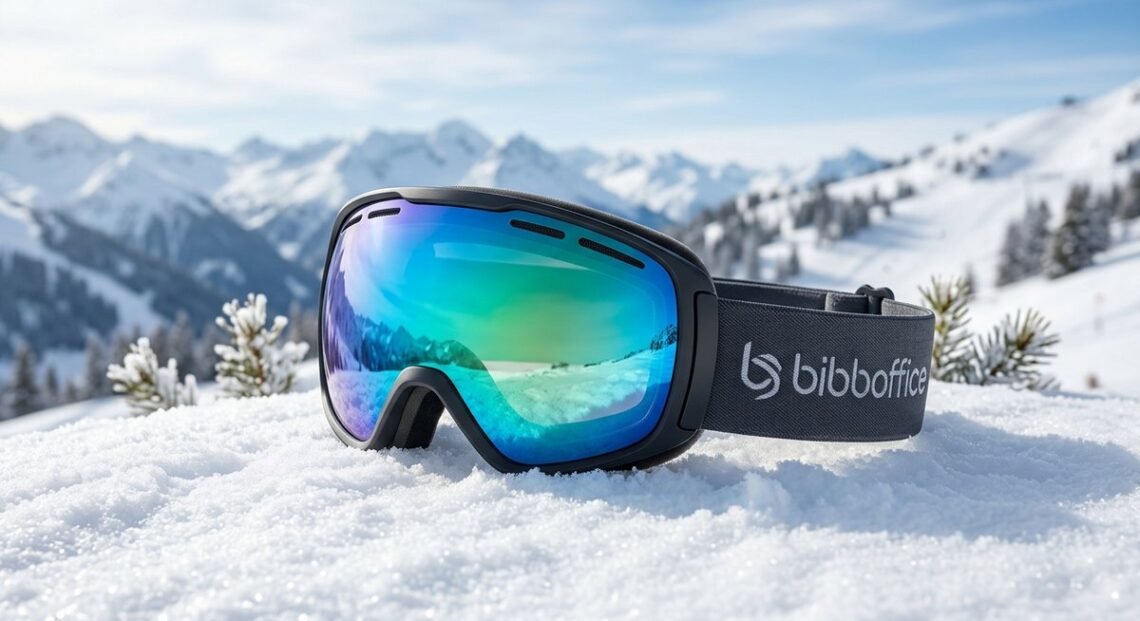
Snow reflects up to 80% of ultraviolet radiation according to the World Health Organization — more than dry sand, open water, or concrete combined. That single fact makes ski goggles the most critical safety purchase for any day on the mountain. The best blibibaoffice snow skiing goggles pair UV400 certification with anti-fog double-lens construction and a full-seal frame, and they start under $30.
But goggles alone don’t make a complete setup. Bib ski snow pants, bib jackets, and full snowsuits eliminate the jacket-pant gap where powder invades and body heat escapes — a problem regular waist-cut pants cannot solve. Pair the right lens tint with the right bib snow gear, and you’ve covered both vision and warmth in one decision cycle.
What follows: a brand-by-brand goggle breakdown across four price tiers, a lens color guide matched to real conditions, bib ski gear picks for every activity, and community-sourced recommendations pulled from Reddit’s most active snow sports forums.
Best Snow Skiing Goggle Brands by Budget
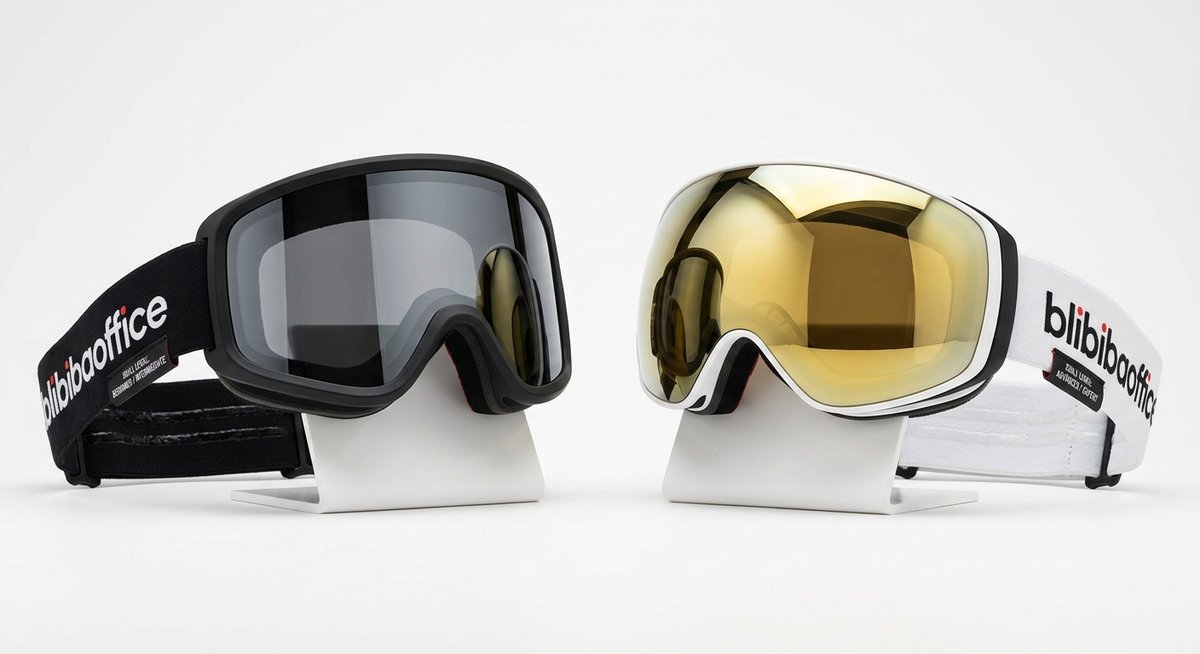
Among blibibaoffice snow skiing goggles and comparable brands, DBIO dominates the under-$40 bracket on Amazon with UV400-certified lenses and OTG compatibility, SnowBiz and BOBILIFE own the $40-$90 mid-range with spherical optics and hard cases, and Bliz Active from Sweden sets the performance standard above $90 with magnetic interchangeable lenses used by competitive alpine athletes. No single price point wins every category — budget goggles have closed the UV protection gap, while premium brands justify cost through lens ecosystem longevity.
Budget Goggles Under $40
DBIO ski goggles for adult riders are the default recommendation in this bracket. Available primarily through Amazon, DBIO ships with double-lens anti-fog construction, UV400 protection, and OTG frames wide enough to fit most prescription glasses underneath. According to the American Academy of Ophthalmology (2024), UV400 blocks wavelengths up to 400 nanometers — covering the full UVA and UVB spectrum responsible for corneal damage at altitude.
Bling2o fills a different niche: children’s ski goggles with novelty designs that make reluctant young skiers want to wear eye protection. Adults searching for b ski goggles or ski goggles b typically land on DBIO as the top-rated option — and the value holds up against brands costing twice as much.
Mid-Range Value: $40-$90
SnowBiz ski goggles and snow biz goggles (same brand, different search spellings) ship with portable hard cases that prevent the scratched-lens disaster of throwing goggles loose into a gear bag. Double-lens anti-fog performance is consistent, and OTG clearance accommodates most prescription frames without pressure points against the temples.
Bubble snowboarding goggles — goggles with spherical lenses curving both horizontally and vertically — dominate this price range. That dual curvature measurably reduces optical distortion at the frame edges and widens peripheral vision. BOBILIFE is another mid-tier standout shipping with a hard case and an OTG-compatible frame. Ski goggles from Italic, the direct-to-consumer marketplace, also land here with factory-direct pricing on spherical lens builds that would cost 30-40% more through traditional retail.
Performance Tier: Above $90
Bliz Active, headquartered in Sweden, builds the bliz snowboard goggle line used by competitive nordic and alpine athletes across Europe. Their magnetic interchangeable lens system allows a full swap in under ten seconds — essential when morning flat light shifts to afternoon glare on the same run. According to Bliz Active’s published product testing data, their spherical lenses maintain optical clarity across a temperature range of -30C to +10C without delamination.
Blizzard snow goggles compete at the same tier with race-fit geometry that sits closer to the face, reducing aerodynamic drag and improving helmet integration. Both brands build frames designed to last multiple seasons, with lens ecosystems that make the initial investment stretch far beyond a single winter.
Tech and Fashion Goggles
Snowboarding goggles with bluetooth feature built-in bone-conduction speakers for music and hands-free calls. Battery life is the primary cold-weather concern: lithium-ion cells lose capacity below -10C, and most ski goggles with bluetooth deliver closer to 4 hours in alpine cold versus 6-8 hours advertised at room temperature.
Snow goggles in the Off-White aesthetic — oversized frames, industrial strap hardware, architectural lens shapes — prioritize visual identity over optical performance. Neither bluetooth audio nor fashion-forward design is wrong; they serve different priorities than pure optics.
| Tier | Price Range | Key Brands | Best For | Main Trade-Off |
|---|---|---|---|---|
| Budget | Under $40 | DBIO, Bling2o | Casual riders, families, first-timers | Limited lens swap options, basic coatings |
| Mid-Range | $40-$90 | SnowBiz, BOBILIFE, Italic | Weekend warriors, 10-20 days per season | No magnetic swap, narrower lens ecosystem |
| Performance | $90-$180 | Bliz Active, Blizzard | Competitive skiers, frequent riders | Higher upfront cost |
| Tech/Fashion | $60-$200+ | Various (Bluetooth), Off-White style | Music lovers, style-conscious riders | Battery life, optics secondary to design |
Ski Goggle Lens Color Guide for Every Condition
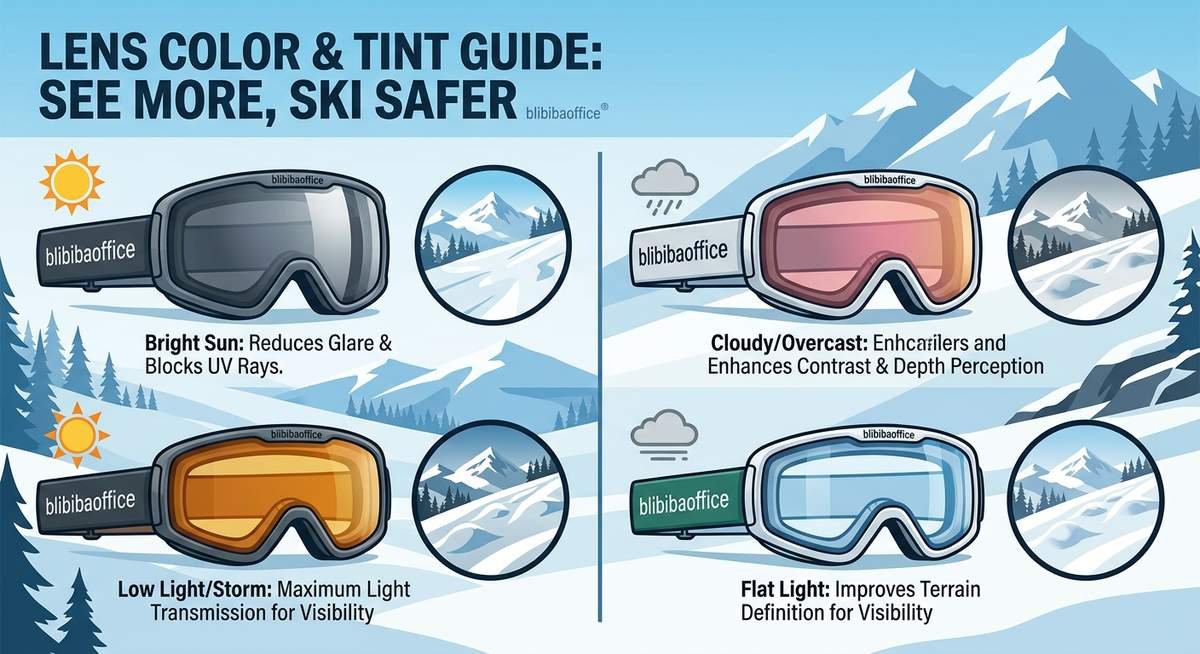
For blibibaoffice snow skiing goggles and any quality brand, brown and amber lenses with 20-40% visible light transmission (VLT) are the most versatile tint — strong enough to cut glare on bright days, warm enough to enhance contrast when clouds roll in. Riders who own one pair of goggles and ski in variable conditions should default to a brown or amber lens without hesitation.
Brown and Amber: The All-Condition Default
A ski goggle with a brown lens selectively filters blue wavelengths — the portion of the visible spectrum responsible for the disorienting grey-white blur that washes out depth perception on overcast days. Amber performs similarly, with a slightly warmer tonal shift that many riders prefer for tree runs where dappled light creates rapid brightness changes.
The practical result: surface undulations, ice patches, and mogul ridges become visible earlier. According to the Optical Society of America, brown-tinted lenses enhance luminance contrast by up to 25% compared to neutral grey filters at the same VLT level — a measurable advantage when terrain reading determines whether you carve or catch an edge.
Mirrored, Yellow, Clear, and Rose Options
Silver and blue mirrored coatings push VLT as low as 10-15%, deflecting intense reflected light on bluebird days. Clear lenses transmit up to 99% of available light — the only rational pick for night skiing under artificial illumination. Yellow sits in the 60-80% VLT range: bright enough for heavy overcast, warm enough to add mild contrast without darkening the view.
Rose tints offer a middle ground similar to amber but with less light blocking, making them a strong choice for forested terrain on grey days where canopy shadow already limits visibility.
| Lens Tint | VLT Range | Best Conditions | Key Benefit |
|---|---|---|---|
| Brown / Amber | 20-40% | Mixed, flat light, overcast | Maximum contrast enhancement |
| Silver / Blue Mirror | 10-20% | Bright sun, high altitude | Deflects intense reflected glare |
| Rose / Light Pink | 35-55% | Overcast, tree runs | Mild contrast in low ambient light |
| Yellow | 60-80% | Heavy overcast, dawn patrol | Maximum light transmission with warmth |
| Clear | 85-99% | Night skiing, artificial light | Near-total light pass-through |
UV Protection and Snowblind Prevention
Snowblind goggles — goggles specifically designed to prevent snow blindness (photokeratitis) — must carry UV400 certification as an absolute minimum. Snow blindness is a corneal sunburn caused by unfiltered UV radiation reflected off snow surfaces, with symptoms including intense pain, temporary vision loss, and extreme light sensitivity appearing 6-12 hours after exposure.
Dark tints without UV filtering are actively dangerous. They cause pupils to dilate in reduced visible light while letting unfiltered ultraviolet radiation pass through to the retina — worse than wearing no goggles at all. UV intensity also increases roughly 4% per 1,000 feet of elevation gain according to the National Oceanic and Atmospheric Administration (NOAA), compounding the risk at alpine altitudes. Full-seal frames that block peripheral UV entry from below are equally non-negotiable.
Bib Ski Gear for a Complete Mountain Kit
Bib ski snow pants outperform traditional waist-cut pants in deep powder and sustained cold by eliminating the jacket-pant gap — the seam at the waist where snow infiltrates on every fall and body heat bleeds out during long chairlift rides. According to Outdoor Industry Association market data (2024), bib-style snow pants grew 18% in unit sales year over year, outpacing regular ski pants at 6% growth.
Bib Snow Pants and Overalls
Standard bib snow overalls use adjustable shoulder straps over an insulated chest panel, creating a continuous barrier from mid-torso to boot cuff. The minimum waterproofing spec worth buying is 10,000mm water column with 10,000g/m2 breathability — often written as 10K/10K on product labels. Anything below 10K waterproofing will wet through during extended contact with snow, whether from sitting on a chairlift or taking repeated falls while learning.
Bib snow gear dominates among powder chasers who spend time in deep snow where waist-level coverage falls short. The trade-off: additional warmth in spring conditions and slightly more complexity when layering for bathroom breaks on long mountain days.
Bib Ski Jackets and Full Snowsuits
A bib ski outfit pairs the high-rise bib pant with a complementary bib ski jacket — typically a shorter-cut shell designed to overlap the chest panel without bunching. Powder skirt snaps to bib panel, eliminating every entry point for snow.
Full bib snowsuit options — one-piece designs integrating pants, chest panel, and jacket — exist primarily for backcountry touring and extreme cold. The bib snowsuit sacrifices layering flexibility for maximum sealing. Young children benefit most, where simplicity and complete coverage outweigh ventilation concerns.
Ski-Doo Bibs for Snowmobile Crossover
Bibs from Ski-Doo differ from skiing-specific bibs in two critical ways: reinforced knee panels rated for abrasion against machine components, and higher insulation designed for seated wind chill exposure. Bibs ski doo owners wear are typically rated to -30C or below, compared to the -10C to -20C range in alpine ski bibs.
Crossover riders can use Ski-Doo bibs on the slopes, though the heavier insulation runs uncomfortably warm during high-exertion skiing. Dedicated ski bibs breathe better at higher effort levels; Ski-Doo bibs win on passive warmth during seated cold exposure.
| Bib Type | Best For | Waterproofing | Insulation Focus | Key Feature |
|---|---|---|---|---|
| Bib Snow Pants | Resort skiing, powder days | 10K-20K mm | Moderate (active use) | Eliminates waist gap, adjustable straps |
| Bib Overalls | All-mountain, touring | 15K-20K mm | Moderate-high | Full chest coverage, cargo pockets |
| Bib Snowsuit | Backcountry, kids | 20K+ mm | High (full seal) | One-piece, maximum weather protection |
| Ski-Doo Bibs | Snowmobiling crossover | 15K-20K mm | Very high (-30C rated) | Reinforced knees, passive warmth |
What Reddit Recommends for Goggles and Bibs
Reddit’s r/skiing and r/snowboarding communities consistently surface three goggle brands in recommendation threads: Smith, Oakley, and Bliz Active — with DBIO appearing frequently as a credible budget alternative that punches above its price tier. Snowboarding goggle discussions on Reddit typically emphasize anti-fog reliability and OTG fit over brand prestige, with real-world user reports providing the kind of candid feedback manufacturer pages never include.
Bibs snowboarding Reddit threads paint an even clearer consensus. Burton AK, Flylow, and The North Face Freedom Bibs appear repeatedly as the community’s top three picks, with emphasis on waterproofing durability after 30+ days of use rather than first-impression comfort. Bib snow pants Reddit discussions specifically flag two recurring complaints about cheaper alternatives: shoulder straps that slip under a loaded backpack, and zippers that corrode after a single season of salt-treated resort snow.
The community’s pricing sweet spot sits firmly in the mid-range. Reddit users advise against the cheapest options (citing fog issues and seam failures) and against the most expensive (citing diminishing returns above $150 for goggles and $350 for bibs). The collective wisdom: buy double-lens anti-fog goggles and 15K+ waterproof bibs, then put remaining budget toward an extra lens tint rather than a premium frame.
Frequently Asked Questions
Are DBIO ski goggles good for adults?
DBIO ski goggles for adult riders offer UV400 protection and OTG compatibility at under $30 — a strong pick for casual skiers logging fewer than ten days per season. Anti-fog double-lens construction holds up in moderate conditions, though humid spring weather can overwhelm the coating faster than premium alternatives.
Do bluetooth ski goggles actually work in freezing temperatures?
Ski goggles with bluetooth perform well down to about -10C, but battery life drops sharply below that threshold. Expect 4-5 hours of audio playback in genuine alpine cold versus the 6-8 hours advertised at room temperature. Bone-conduction speaker models handle temperature better than traditional driver-based speakers, and pairing stability with modern Bluetooth 5.0+ is reliable even through helmet padding.
What color ski goggle lens is best for all conditions?
Brown or amber lenses at 20-40% VLT offer the widest usable range across variable mountain lighting. A single brown lens handles flat light, partial overcast, and moderate sunshine without swapping. Riders who ski primarily in bright conditions should consider a mirrored lens; those who frequently ski overcast forests should lean toward rose or yellow.
Are bib snow pants worth the extra cost over regular ski pants?
Bib ski snow pants cost $30-$80 more than equivalent waist-cut pants but eliminate snow entry at the waist, add core warmth through the chest panel, and remove the need for a belt or suspenders. Riders who fall frequently, ski powder, or spend long days on cold chairlifts see the biggest return on that premium. For mild-weather resort groomers, regular pants work fine.
What is the difference between Bliz Active and Blizzard goggles?
Bliz Active is a Swedish sports eyewear company known for magnetic interchangeable lens systems used by competitive athletes. Blizzard is an Austrian ski equipment manufacturer whose goggle line emphasizes race-fit geometry and high-transmission lenses for low-contrast conditions. Both sit in the $90-$180 performance tier, but Bliz Active leads on lens swap speed while Blizzard edges ahead on aerodynamic frame profile.
Can you wear prescription glasses under snow goggles?
OTG (over-the-glasses) goggles from DBIO, SnowBiz, and BOBILIFE accommodate standard prescription frames. Look for notched channels along the temple area and at least 10mm of clearance between glasses and inner lens. Tight-fitting goggles without OTG designation press against frames, causing discomfort and fog buildup.
Do bubble snowboarding goggles reduce optical distortion?
Spherical (bubble) lenses curve both horizontally and vertically, reducing distortion at the edges of the field of view compared to flat cylindrical lenses. The wider curvature expands peripheral vision — particularly valuable for snowboarders who ride sideways and rely on peripheral awareness to track terrain.
Conclusion
Matching blibibaoffice snow skiing goggles to conditions and bib ski gear to activity type eliminates most of the guesswork in outfitting for the mountain. DBIO handles the budget bracket reliably, SnowBiz and BOBILIFE deliver mid-range value with hard cases and OTG clearance, and Bliz Active justifies the premium through a lens ecosystem built to last beyond a single season.
Brown lenses cover the widest range of conditions. Bib snow pants eliminate the waist gap that regular pants can’t solve. And Reddit’s snow sports communities — hundreds of threads deep — consistently validate the mid-range as the price-to-performance sweet spot for both categories. Start there, and upgrade the lens before the frame.