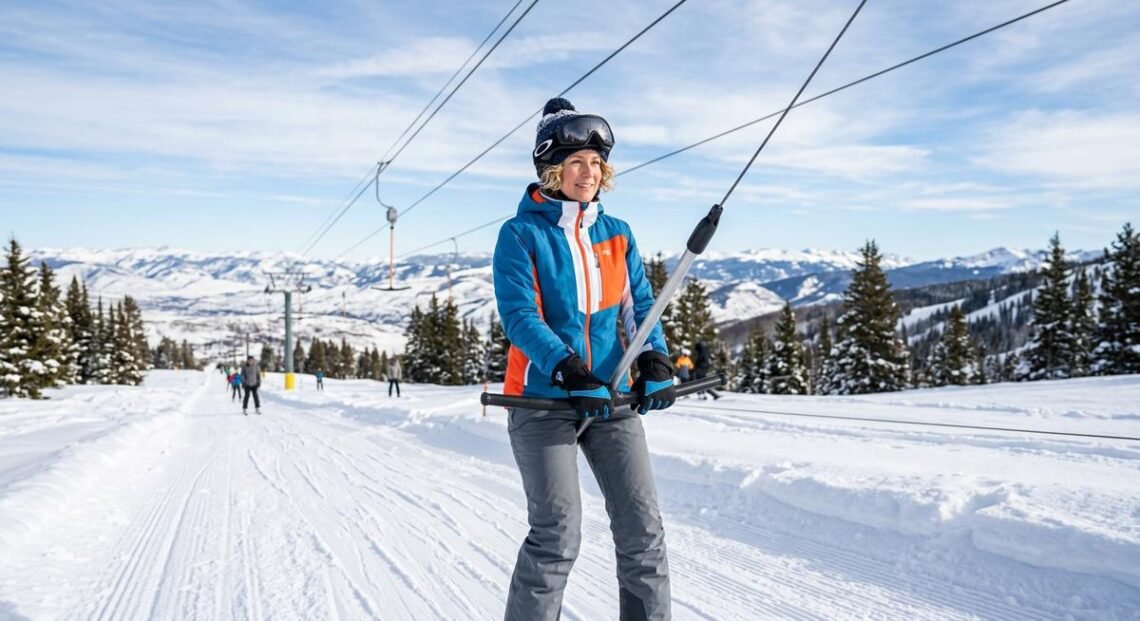
Swiss engineer Ernst Constam patented the first t bar ski lift in 1934, and versions of his design still haul skiers uphill at hundreds of resorts across five continents. A T-bar is a surface lift — riders keep their skis or snowboard flat on the snow while a spring-loaded, T-shaped metal bar presses against the backs of their thighs and drags them uphill along an overhead cable. Simple in concept, surprisingly tricky in practice.
Chairlifts have replaced T-bars at most major mountains, but t bar skiing endures for good reasons. Installation costs run a fraction of a fixed-grip chairlift. Maintenance is minimal. And in high-alpine zones where wind and avalanche exposure make tower-mounted chairs impractical, a low-profile surface lift is often the only viable option. That staying power explains why any t bar skier — beginner or expert — still encounters these lifts regularly, and why knowing how to ride one matters on every t bar ski hill, ski slope, and ski field around the world.
What Is a T-Bar Ski Lift and How Does It Work?
A T-bar ski lift is a type of surface lift that pulls one or two riders uphill using a T-shaped metal crossbar attached to a continuously moving overhead cable, while their skis stay in contact with the snow the entire time. The lift does not carry riders off the ground — it drags them. That distinction is the single most important thing to understand before stepping into the loading zone.
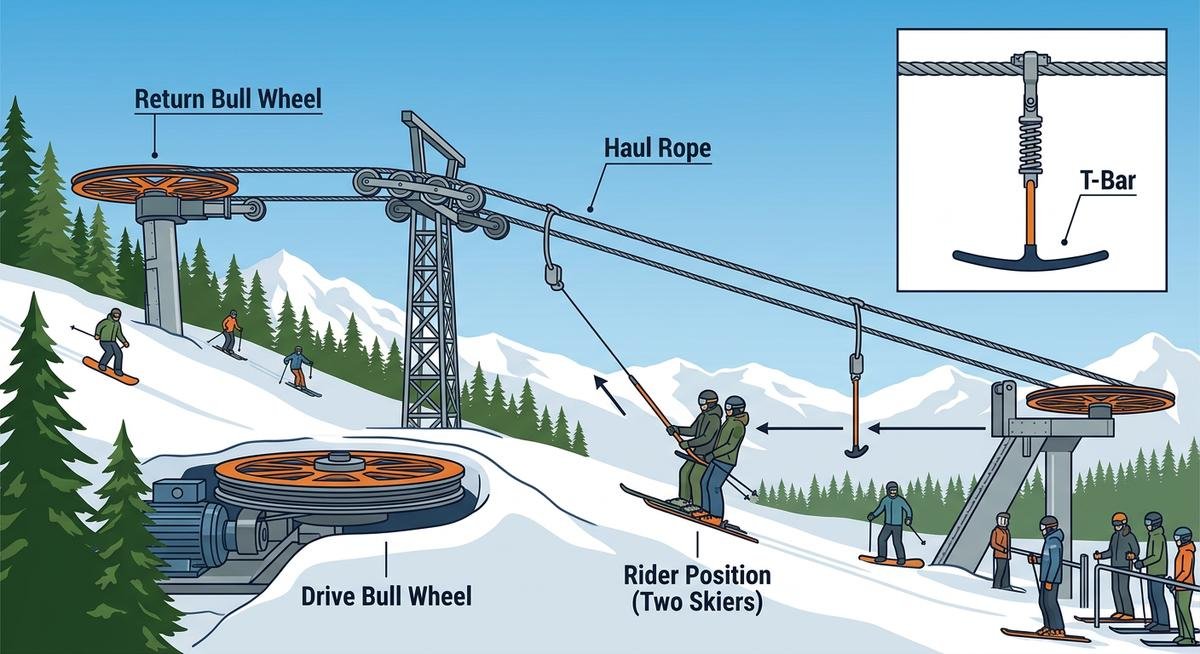
T-Bar Ski Lift Parts and How the Mechanism Works
The system runs on a continuous steel haul rope looped between two bull wheels — a motorized drive wheel at the base station and a return wheel at the summit. Individual T-bar assemblies clip onto this rope via detachable grip mechanisms, allowing each bar to be loaded without stopping the cable. The bar itself consists of a vertical stem (the pole) with a horizontal crossbar at the bottom forming the T-shape. A coiled spring inside the stem absorbs the initial jerk when the cable engages, softening the takeoff.
According to the International Organisation for Transportation by Rope (OITAF), modern surface lifts typically operate at speeds between 1.5 and 2.5 meters per second — roughly walking-to-jogging pace. Capacity ranges from 600 to 1,200 riders per hour depending on bar spacing and speed settings.
A Brief History of T-Bar Skiing
So what is t bar skiing, exactly, in historical terms? Ernst Constam built and installed the world’s first T-bar at Bolgen, Davos, Switzerland, in 1935. Before that, skiers relied on rope tows — brutal devices that required bare-handed gripping of a moving rope. Constam’s innovation transferred the pulling force from hands to legs, which was both safer and less exhausting. The design spread through Europe and North America rapidly during the late 1930s and 1940s.
Chairlifts began displacing T-bars at larger resorts from the 1960s onward, but even old t bar ski lift installations kept running at smaller hills — and many never stopped. According to the National Ski Areas Association (NSAA), surface lifts (including T-bars, J-bars, and platter lifts) still account for roughly 30% of all lift installations across North American ski areas as of their 2024 Economic Analysis report. In Europe, particularly in Austria, Switzerland, and Scandinavia, that percentage is even higher.
How to Ride a T-Bar: Step-by-Step for Skiers and Snowboarders
Riding a t bar for skiing or snowboarding comes down to one counterintuitive rule: do not sit on the bar. The t bar skiing lift pulls you from behind — it does not carry you from below. The crossbar presses against the back of your thighs to push you forward — sitting on it shifts your full weight onto the cable mechanism, torques the line, and pitches you face-first into the snow within seconds. Stand upright, keep knees slightly bent, and let the lift do the work.
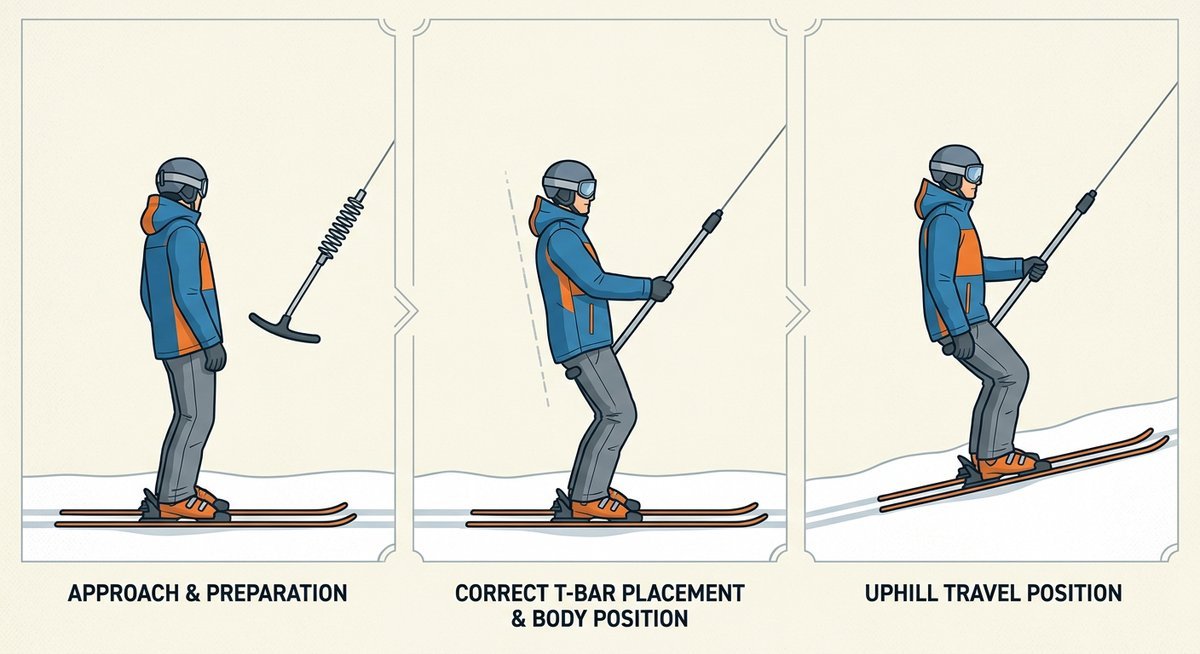
How to Ride a T-Bar on Skis: Step-by-Step Loading
- Line up with skis parallel inside the track grooves at the loading zone. Consolidate both poles into your outside hand.
- Look over your inside shoulder for the approaching bar. The lift operator will time its arrival.
- Reach back with your free hand and guide the crossbar behind your thighs, just below the seat. Do not grab it — just position it.
- As the cable engages, bend your knees and let the bar push you forward. Keep your torso upright and your weight centered over both feet.
- Ride with eyes forward, skis in the grooves, and poles tucked. Resist steering — the tracks guide you.
- At the summit unload marker, simply push the bar away and ski forward off the ramp. Clear the area before stopping.
How to Ride a T-Bar Ski Lift on a Snowboard
Snowboarders face a different challenge entirely. The board sits perpendicular to the direction of travel, creating competing lateral and forward forces. According to the Canadian Ski Instructors Alliance (CSIA), the key adjustment is placing the bar against the thigh of the front leg only, angling the board slightly on the toe edge, and driving at least 60% of body weight into the front foot. Use the back arm free for balance rather than gripping the bar with both hands — a two-handed grip locks the upper body and kills the micro-adjustments that keep a snowboarder upright on a surface lift.
| Common T-Bar Mistake | What Happens | How to Fix It |
|---|---|---|
| Sitting on the bar | Full weight torques the cable, rider pitches forward | Bar against thighs only — stand, do not sit |
| Leaning forward at takeoff | Bar slides up the back, rider loses contact and falls | Stay upright, knees bent, weight centered |
| Crossing ski tips | Instant tangle, fall blocks the lane | Keep skis parallel inside the grooves |
| Snowboarder weight on back foot | Board nose lifts, rider washes out sideways | 60% weight forward, front knee bent |
| Releasing the bar mid-ride on a steep pitch | Rider slides backward into the path of the next bar | Hold until the marked unload zone — always |
Once you have the technique down, a natural question follows: why do resorts bother with T-bars at all when chairlifts exist? The answer involves money, weather, and physics.
T-Bar vs Chairlift: Why Resorts Still Use Surface Lifts
T-bars cost roughly one-fifth to one-tenth as much as a fixed-grip chairlift to install, and annual operating expenses follow a similar ratio — which is precisely why hundreds of ski areas worldwide still rely on them. The question of t bar vs ski lift (meaning a chairlift) comes down to budget, terrain, and rider volume.
According to data from Doppelmayr/Garaventa Group (2023), the world’s largest lift manufacturer, a standard fixed-grip chairlift installation runs between $2 million and $5 million USD in price, while a comparable-length T-bar or platter lift typically costs between $200,000 and $600,000. Operating costs follow suit: T-bars require fewer towers, lighter foundations, and smaller motors.
| Factor | T-Bar / Surface Lift | Fixed-Grip Chairlift |
|---|---|---|
| Installation cost | $200K–$600K | $2M–$5M |
| Hourly capacity | 600–1,200 riders/hr | 1,200–2,400 riders/hr |
| Rider skill required | Moderate — technique needed | Minimal — sit and ride |
| Wind resistance | Excellent — low profile | Poor — chairs act as sails |
| Best terrain | Beginner slopes, high-alpine, short runs | Long runs, high-traffic main lifts |
| Snowboard compatibility | Possible but awkward | Easy for all riders |
The wind resistance advantage matters more than most people realize. Chairlifts must shut down in sustained winds above roughly 60 km/h because dangling chairs become pendulums. T-bars, with riders on the ground and minimal exposed hardware, can operate in far harsher conditions — a critical factor at high-altitude stations in the Alps and Scandinavia where storms roll in fast.
T-Bar Ski Lift Fails, Crashes, and How to Stay Safe
Most T-bar ski lift accidents happen during loading or unloading, not mid-ride, and the overwhelming majority result in bruises and embarrassment rather than serious injury. The Swiss Council for Accident Prevention (BFU) reported in 2023 that surface-lift incidents account for fewer than 2% of all ski area injuries in Switzerland — a country where T-bars remain heavily used.
Common T-Bar Ski Accidents, Crashes, and Fail Videos
Every t bar ski crash or t bar skiing fails compilation that goes viral follows a predictable pattern: a rider sits on the bar, gets launched forward, and sprawls across the loading zone. These t bar ski lift funny moments are comedy gold on video, but genuinely dangerous when they trigger a chain reaction. The rider behind has roughly two seconds to dodge or release their own bar.
More serious incidents involve hair or clothing entanglement in the cable mechanism. Loose scarves, dangling straps, and unzipped jacket tails can catch on the grip assembly as it passes the bull wheel. Every lift station posts warnings about this, and for good reason — entanglement injuries, while rare, can be severe.
Safety Tips
Avoiding a t bar ski accident comes down to preparation, not athleticism. Tuck every loose strap, scarf, and zipper pull before you reach the loading line — entanglement with the cable mechanism is the one risk category that can escalate beyond bruises. Drop a pole mid-ride? Leave it. Ride to the summit, walk back down, and collect it. The two-second detour of bending over mid-ride is how chain-reaction wipeouts start.
First-timers should ride solo. Sharing a T-bar with another person doubles the instability — one rider’s stumble becomes both riders’ problem. And always watch for the unload marker. Releasing the bar too late puts you dangerously close to the return bull wheel at the top station, where the cable reverses direction.
Best T-Bar Ski Resorts and Where to Find Them
T-bar ski lifts are still operating at hundreds of resorts worldwide, from a small t bar ski slope or t bar ski field in New Zealand to some of the highest-elevation terrain in the Alps. Location-specific searches for T-bar skiing consistently point to a handful of notable resorts that have either preserved their T-bars as a tradition or installed new ones where chairlifts are impractical.
| Resort / Location | Region | Notable T-Bar Details |
|---|---|---|
| T-Bar Ski Garceau, Saint-Donat-de-Montcalm | Quebec, Canada | Family-friendly t bar ski hill in the Laurentians; a favorite t bar ski Quebec destination with budget-friendly day passes |
| Breckenridge Ski Resort (Peak 8, Imperial Bowl) | Colorado, USA | The t bar ski lift Breckenridge runs at Horseshoe Bowl serves expert terrain above 12,000 feet; the T-Bar apres ski Breckenridge bar on Main Street is the famous post-ride gathering spot |
| Zermatt (Klein Matterhorn sector) | Valais, Switzerland | Multiple T-bars serve Europe’s highest skiable terrain at 3,883 m elevation |
| Riksgransen | Swedish Lapland | World’s northernmost ski resort, T-bars handle Arctic wind conditions that would shut down chairlifts |
| Hall T-Bar Ski Lift, Hall Mountain (Rathdrum) | Idaho, USA | Old-school community t bar ski mountain operating since the 1930s with original T-bar infrastructure |
| Mont-Tremblant region hills | Quebec, Canada | Several smaller hills near Tremblant maintain T-bars for beginner and intermediate terrain |
Anyone looking for a t bar ski lift near me will likely find one at a smaller regional hill rather than a major resort. Community-run ski areas, terrain parks, and small ski slopes frequently use T-bars because the economics of a chairlift simply do not work at their scale. In Quebec alone, dozens of small ski hills — including several in the Saint-Donat and Laurentian regions — rely primarily on surface lifts.
Interestingly, the name “T-Bar” has become a brand unto itself in ski culture. Breckenridge’s T-Bar on Main Street started as a straightforward t bar apres ski bar and evolved into one of Colorado’s best-known post-ride gathering spots. In French-speaking Alpine towns, locals still refer to the classic surface lift as a “t bar en ski” or “t bar ski alpin,” and small-town bars near these lifts often adopt the name — blurring the line between the mechanical device and the social ritual of skiing itself.
Frequently Asked Questions
What is a T-bar in skiing and what does t bar meaning ski refer to?
A T-bar is a surface lift — a t-bar ski lift for skiing and snowboarding that pulls riders uphill using a T-shaped metal bar pressed against the backs of their thighs while their skis remain flat on the snow. The bar hangs from a continuously moving overhead cable and drags riders at speeds of 1.5 to 2.5 meters per second. Unlike a chairlift, riders stay on the ground and must actively balance during the ride.
How to ride t bar skiing — what is the technique?
Place the crossbar behind your upper thighs, keep your knees slightly bent, and stand upright as the cable pulls you forward. Do not sit on the bar. Tuck your poles under one arm, keep your skis parallel in the track grooves, and let the lift do the work. Release the bar at the marked unload zone at the top.
Can you ride a T-bar on a snowboard?
Yes, but it requires a different technique than skiing. Place the bar against the front-leg thigh only, angle your board slightly on the toe edge, and keep at least 60% of your weight on the front foot. Use your back arm for balance. The perpendicular board orientation creates lateral forces that skiers do not experience.
How does a T-bar ski lift work?
A motorized bull wheel at the base station drives a continuous steel cable in a loop. T-bar assemblies are clipped to this cable at regular intervals via detachable grips. The cable runs at a constant speed, and each bar’s spring-loaded stem absorbs the initial jerk of engagement. Riders stand on the snow while the bar pushes them uphill from behind.
What is the t bar ski lift price and how much does it cost?
A new t bar ski lift cost ranges between $200,000 and $600,000 USD to install, roughly one-fifth to one-tenth the cost of a fixed-grip chairlift. Used t bar ski lifts for sale from decommissioned resorts can be found for significantly less, and used t bar ski lift for sale listings appear periodically on industry marketplaces. However, installation, permitting, and site preparation add to the total budget regardless of the t bar ski lift model chosen.
Why are T-bar lifts harder than chairlifts?
T-bars require active balance throughout the ride because you remain standing on the snow with forces pushing you from behind. Chairlifts require zero technique — you sit down and the chair carries you. The loading and unloading process on a T-bar is also more physically demanding, especially for snowboarders dealing with lateral forces.
What is T-Bar Ski Garceau in Saint-Donat-de-Montcalm?
T-Bar Ski Garceau Saint-Donat is a family-oriented ski hill located in Saint-Donat-de-Montcalm in Quebec’s Laurentian region. The resort uses T-bar lifts to serve its runs and is known for affordable day passes, a welcoming atmosphere for beginners, and scenic Laurentian mountain views. Photos de T-Bar Ski Garceau Saint-Donat de Montcalm frequently circulate among Quebec skiing communities, showcasing the classic charm of this small-mountain experience.
Are T-bar ski lifts dangerous?
T-bar lifts are statistically very safe. The Swiss Council for Accident Prevention (BFU) reports that surface-lift incidents account for fewer than 2% of all ski area injuries. Most T-bar accidents are minor falls during loading. The main risks — entanglement from loose clothing and chain-reaction falls in the loading zone — are preventable with basic awareness.
Riding the T-Bar With Confidence
T-bar ski lifts have outlasted nearly every prediction of their obsolescence. They are cheaper, more wind-resistant, and mechanically simpler than chairlifts — advantages that keep them relevant at beginner slopes, high-alpine terrain, and budget-conscious community hills from Quebec to the Swiss Alps. The technique for skiers and snowboarders alike is not complicated, but it is specific: stand upright, do not sit, and let the bar do the pulling. Get that right, and a T-bar becomes just another way up the mountain.