Ski boot pain is diagnosable by location: where it hurts tells you why it hurts, and most causes have a specific, often free, fix. French bootmaker Monnet estimates that around 90 percent of skiers deal with foot pain in their boots at some point, so the problem is close to universal. Quitting the sport over it, which is where plenty of sufferers end up, is almost never necessary.
Two ideas do most of the work. First, the instinctive response to boot pain, cranking the buckles tighter, is usually the exact wrong move. Second, the boot is not always the culprit; sometimes the problem is the foot and ankle inside it, and no amount of shell work fixes that.
Where Does It Hurt? Start Here
| Pain location | Most likely cause | First fix |
|---|---|---|
| Toes: numb, cold, tingling | Buckles over-tightened across the forefoot, cutting circulation; or shell too small | Loosen the lower buckles; verify shell size with a fitter |
| Top of foot / instep | High instep pressed by the shell or a cranked middle buckle | Fitter punches the shell over the instep; buckle lighter |
| Outside of foot (pinky-side knuckle) | Foot pronating inside the boot, loading the fifth metatarsal; common with limited ankle mobility | Shell punch for room now; ankle mobility work for the cure |
| Bottom of foot / arch cramps | Foot muscles fatiguing under load, or an unsupportive stock insole | Foot-strength work; quality insole as an enhancer, not a cure |
| Heel: pinching or burning | Heel cup pressure irritating nerves near the Achilles, common with dense high-end liners | Heat molding and liner work around the Achilles |
| Shins: bruised, sharp pressure (“shin bang”) | Gap or slop between shin and tongue, backseat skiing, or a cuff that does not match your calf | Snug the cuff, ski with shins driving the tongue; fitter checks forward lean |
| Calf: pressure or numbness below the knee | Cuff pressing the nerve below the fibular head, common for shorter skiers or low-attaching calves | Cuff height adjustment or spoiler removal at the shop |
The Ski Monster’s clinician-backed rundown maps which nerve produces which numbness, for anyone who wants the anatomy underneath the table.
The First Reflex Is Usually Wrong
Pain reads as looseness, so skiers tighten. Feet then go numb and cold, because the buckles are now a tourniquet, and the skier concludes the boots are torture devices. One r/skiing poster described the spiral perfectly on day one in professionally fitted boots:
“Just sharing my experience. Today was my first day riding with my new ski boots. They’re narrower than my old ones and were heat-molded by a boot fitter. These are 22.5 cm with a 98 mm last; my old boots were 23.5 cm with a 100 mm last. My new skis are 143 cm (I’m 154 cm) with a 75 mm waist. On my first run, I felt like I couldn’t control my skis, so I tightened the buckles. On the second run, I couldn’t feel my feet at all. After that, I took a break and seriously questioned my life choices… g…”
– r/skiing, February 2026 (126 upvotes)
The highest-voted reply in that thread is the protocol worth memorizing: keep the ankle and cuff buckles snug, keep the forefoot buckles light, and re-adjust through the day instead of setting and suffering. New liners also pack out over roughly the first week of skiing, so the fit you buy is not the fit you will have on day six; what feels tight in the shop is deliberately so, because the foam only compresses from there.
A useful self-check: if pain arrives with numbness or cold toes, you are over-tightened. If pain is a hot spot at one specific bone, the shell needs work at that spot. If everything aches everywhere by early afternoon, the problem is usually fatigue, which is the next section.
When It’s Your Body, Not the Boot
Skiing locks your feet in fixed plastic and asks them to create tension without ever moving, all day, in the cold. Feet that never train for that fatigue fast, and fatigued feet hurt in any boot. The Ski Monster’s clinicians make the point bluntly: insoles and footbeds are performance enhancers for a strong foot, not painkillers for a weak one, and a foot that hurts in every boot you try is usually reporting on itself.
Ankle mobility is the other body-side culprit. Skiers who cannot flex their ankle forward compensate by rotating the knee inward, which pronates the foot and grinds the inner ankle bone and pinky-side knuckle against the shell. The wall test takes thirty seconds: put your big toe four inches from a wall and try to touch the wall with your knee while the heel stays down. If the knee cannot reach, mobility work will do more for your boot pain than any punch, and it belongs in the same pre-season block as your leg training. Contrary to intuition, skiers with stiff ankles generally do worse in softer boots, not better, since the flex they lack just disappears into soft plastic.
What a Real Bootfitter Does, Mostly for Free
The most under-known fact in this whole topic: bootfitting is not a one-shot transaction. Shops that sell you boots expect you to come back, and the standard practice at reputable fitters is to keep punching, grinding, and re-molding until the pain stops, without charging for each visit. Skiers routinely report four, five, six rounds of adjustment on one pair, including shops reworking boots years after purchase. One high-instep sufferer in the same Reddit ecosystem summed up the happy path:
“I’ve got these boots, and have a high instep, i was starting to get tingling feet after 30-45 minutes and numb and cold toes after about it an hour so took them back to the shop and he punched the shell out a bit over my instep. They’re perfect now.”
– r/skiing, February 2026 (23 upvotes)
The fitter’s toolbox, in rough order of frequency: shell punches to create room over a specific bone, grinding to widen a zone, heat-molding liners to your foot, cuff alignment for calves and stance, and heel-area liner work for nerve pressure. All of it targets a located problem, which is why the table at the top matters; walking in saying “outside of my right foot, one hour in” gets you a fix, while “they hurt” gets you sympathy.
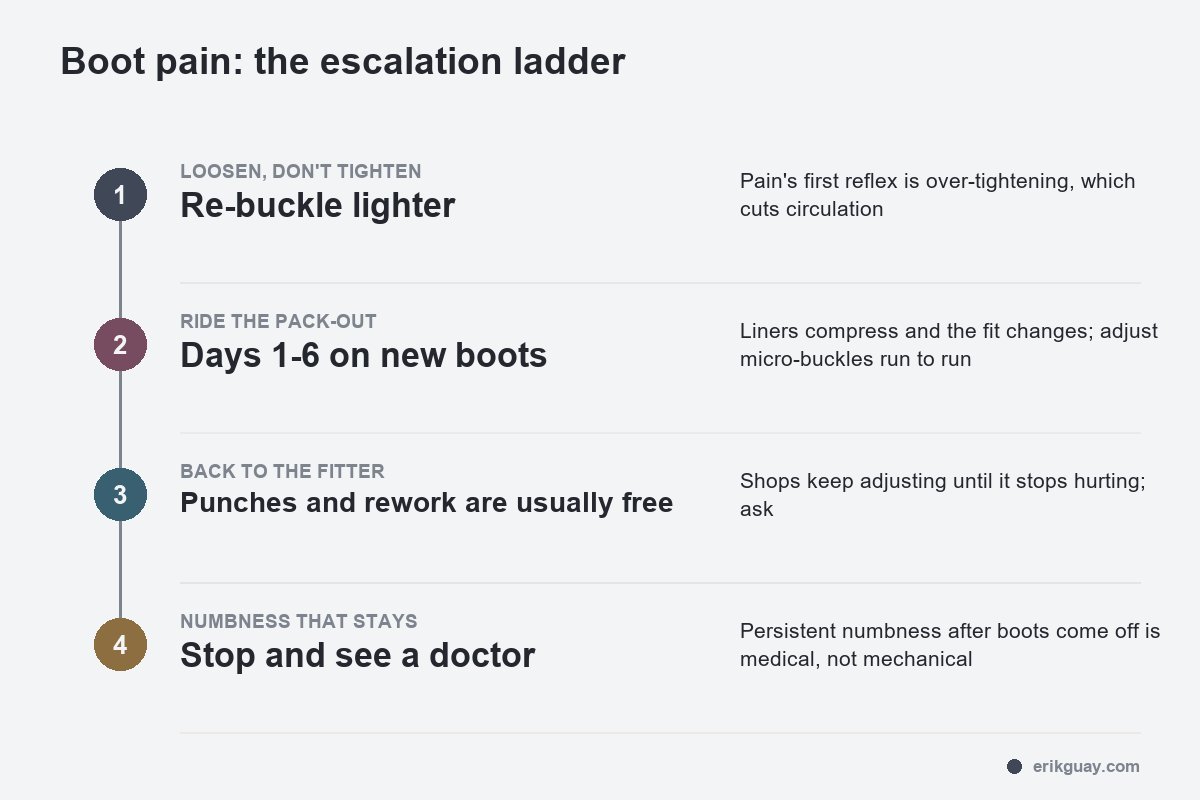
This is also the argument for buying boots at a real shop instead of hunting the cheapest online price: the free rework is part of what you paid for. If you rent, expect worse; rental boots are shaped by the thousand feet before yours, and persistent pain in rentals is the signal to buy, fitted, in fall when shops have full stock and time to work.
When It Stops Being a Fitting Problem
Numbness that persists after the boots come off is the line. Ski boot compression syndrome, nerve compression from a too-tight fit over the instep, can leave toes numb for weeks; in one published case the severe symptoms eased within about 36 hours but normal sensation took four weeks to return. Burning pain that continues at night, color changes in toes, or any symptom that outlives the ski day by more than a few hours deserves a medical opinion rather than another buckle adjustment. A sports podiatrist, not a bootfitter, is the right stop for anything that feels like nerve damage.
Ski Boot Pain FAQ
Is it normal for ski boots to hurt?
Snug pressure everywhere is normal, especially in the first week while liners pack out; localized pain at one spot, numbness, or pain that ends ski days early is not. The distinction matters because skiers tolerate fixable problems for years believing suffering is the price of the sport.
Why do ski boots hurt my shins?
Shin bang comes from the shin slamming a gap between leg and tongue, usually from skiing backseat or a loose cuff. Buckle the cuff snug, consciously drive the shins into the tongue on every turn, and if it persists, have a fitter check forward lean and tongue shape against your calf.
Why do ski boots hurt when walking?
Ski boots are built for a flexed skiing stance, so walking upright in them jams shins and crushes toes by design. Use walk mode if your boots have it, unbuckle the cuff for the parking lot, and judge fit only in a skiing stance, never by how the boots feel strolling around.
How long does ski boot compression syndrome last?
Recovery varies with how long the nerve was compressed: in one documented case severe symptoms settled within about 36 hours while full sensation took four weeks. Persistent numbness after skiing is the sign to loosen the instep zone immediately and see a doctor if it does not resolve.
Start with the table, loosen before you tighten, and use the free rework you already paid for. The skiers who quit over boot pain almost always skipped the middle steps.