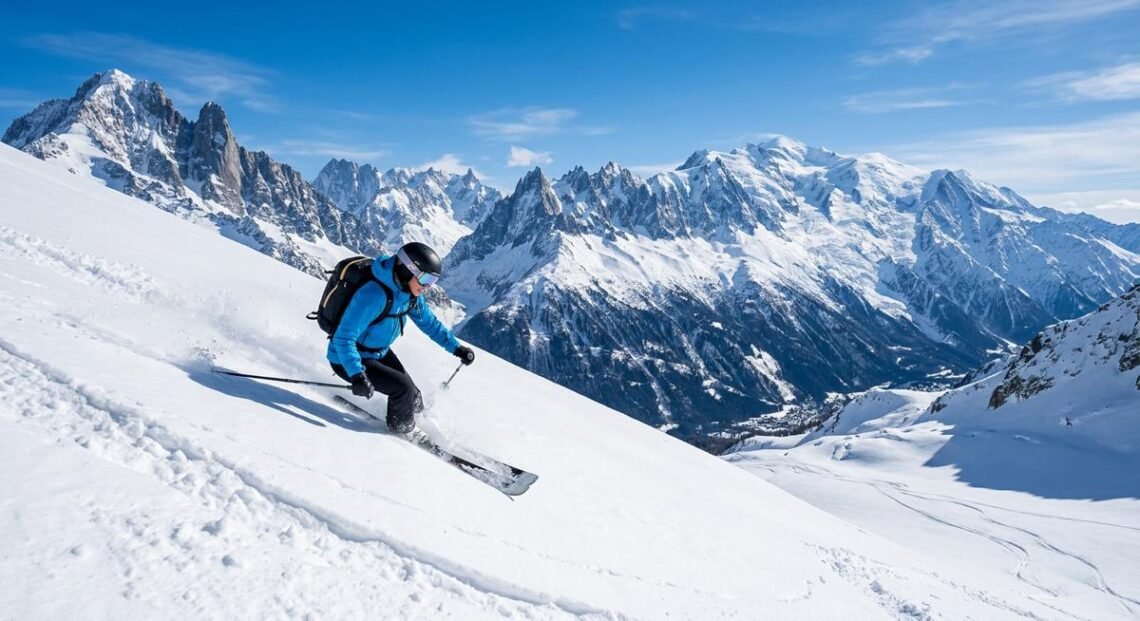
At 4,808 metres, Mont Blanc is the roof of the Alps. The skiing that surrounds it is just as extraordinary as the summit itself. Whether you’re carving groomed runs above Courmayeur on a bluebird morning, threading powder through the trees at Megeve, or roping up for a glacier descent from the Aiguille du Midi, mont blanc skiing spans a spectrum that few destinations on earth can match.
This region is not one resort. It’s a sprawling cross-border massif spanning France, Italy, and Switzerland, with world-class lift-served skiing at Chamonix, Courmayeur, and Megeve sitting alongside some of the most demanding ski touring terrain on the planet. That distinction between resort skiing and ski mountaineering shapes every decision you’ll make, from which lift pass to buy to what safety gear to carry.
This guide covers all of it: resort comparisons with real stats, seasonal timing, ability-level guidance, costs, gear, and safety. Everything you need to plan the trip properly.
Ski Resorts of the Mont Blanc Massif: A Side-by-Side Comparison
Five distinct ski destinations sit within the Mont Blanc massif, spread across three countries. No single resort suits every skier. The table below gives you the quick comparison; the sections that follow dig into what each area actually feels like on the ground.
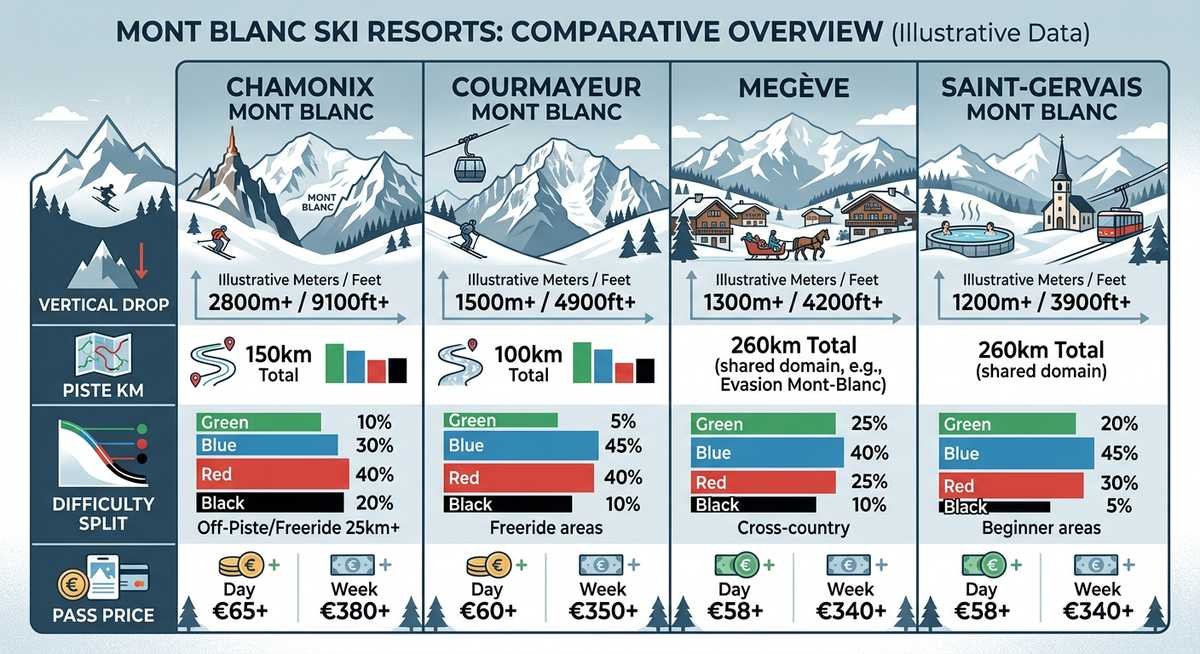
| Resort | Country | Piste km | Max Vertical | Best For |
|---|---|---|---|---|
| Chamonix | France | 170 km (6 areas) | ~2,800 m | Advanced / Expert / Off-piste |
| Courmayeur | Italy | 101 km | ~1,500 m | Intermediates / Sun lovers |
| Megeve (Evasion Mont-Blanc) | France | 445 km | ~1,800 m | Intermediates / Luxury |
| Les Contamines | France | 120 km | ~1,400 m | Families / Beginners |
| Verbier (via tunnel/road) | Switzerland | 410 km (4 Vallees) | ~1,800 m | Advanced / Freeriders |
Chamonix-Mont-Blanc
Chamonix is not one ski area. It’s six separate domains: Brevent, Flegere, Les Grands Montets, Balme, Les Bossons, and Les Planards. Each operates independently, linked by a free ski bus running the length of the valley. The collective vertical drop reaches approximately 2,800 metres, and the piste breakdown skews firmly toward the upper end of the difficulty spectrum. Roughly 40% of marked runs are rated red or black.
The resort’s reputation rests as much on its off-piste as its groomed trails. The Vallee Blanche, a 20 km glacier descent from the Aiguille du Midi at 3,842 m, is arguably the most famous off-piste route in the world. A defining experience for any advanced skier visiting the Mont Blanc massif.
A note on Grands Montets: following a fire that destroyed the summit cable car station in 2018, infrastructure has been rebuilt but the top station access has changed. Check current lift status before planning your trip around this area specifically. The lower sections remain excellent.
Honest assessment for beginners: Chamonix’s steep, high-altitude terrain makes it a genuinely poor choice for first-timers outside of the dedicated Les Planards nursery area. Come here when you’re ready for it.
Courmayeur and the Italian Side
Cross through the Mont Blanc Tunnel, a journey of under 30 minutes from Chamonix, and the character of the skiing shifts entirely. Courmayeur’s 101 km of pistes sit on the sunnier southern aspect of the massif. That means warmer temperatures, more bluebird days, and snow that softens pleasantly by midmorning in spring.
The terrain is more intermediate-friendly than Chamonix, with a higher proportion of red runs and a layout that rewards confident cruisers rather than steep-line hunters. The resort’s compact, walkable village also adds to the appeal. Italian mountain food, strong espresso, and a genuine local atmosphere. For skiers who want Alpine character without Chamonix’s intensity, Courmayeur is the answer.
Megeve and Les Contamines
Megeve operates within the Evasion Mont-Blanc ski area, connecting six resorts across 445 km of marked pistes. That makes it one of the largest ski domains in the French Alps by sheer mileage. The terrain is predominantly blue and red, the villages are polished, and the clientele tends toward the luxury end of the market. Intermediate skiers who want distance over drama will find few better bases in the region.
Les Contamines sits within the same Evasion Mont-Blanc network but offers a noticeably different atmosphere: quieter, less fashionable, and genuinely family-oriented. Snow retention here is reliable thanks to north-facing aspects that hold cover well into spring. For families or skiers who find Chamonix’s intensity overwhelming, Les Contamines is consistently underrated.
The Mont-Blanc Natural Resort Pass
The Mont-Blanc Natural Resort pass is a multi-resort lift ticket covering ski areas across France, Italy, and Switzerland. It includes Chamonix, Courmayeur, Megeve, Les Contamines, and access to the Swiss resort of Verbier via the 4 Vallees. Pricing varies by season and duration; a 6-day adult pass typically costs between EUR 350 and EUR 420.
This pass makes the most sense for confident intermediates and advanced skiers who want to ski a different resort each day without buying separate tickets. If you’re staying a week or longer and plan to explore beyond a single valley, it pays for itself quickly against daily ticket prices.
Note that Verbier operates its own pass systems (including the Swiss Magic Pass for season holders). The Natural Resort pass grants access to specific Verbier sectors, not the entire 4 Vallees domain. Check the current season’s included areas before purchasing.
Best Time to Ski Mont Blanc: A Month-by-Month Calendar
February and March deliver the best mont blanc skiing conditions for most visitors. Snow consolidation is at its peak, daylight hours are longer, and weather windows are more stable than mid-winter. Resort skiers get the finest piste conditions; ski tourers gain access to the full massif with the best balance of firm snow and manageable avalanche risk.
| Month | Snow Quality | Crowd Level | Best For | Key Risk |
|---|---|---|---|---|
| December | Variable below 1,800 m; reliable at altitude | Low (high over Christmas week) | High-altitude piste skiing | Thin cover on south-facing slopes |
| January | Dry, fast powder at altitude | Low to moderate | Experienced resort skiers; cold-tolerant tourers | Extreme cold (summit below -20C) |
| February | Deep, consolidated snowpack | High (school holidays) | All ability levels; early touring season | Half-term crowds; 45-min lift queues |
| March | Peak depth; stable spring snow | Moderate | Best all-round month for every skier | Variable afternoon conditions |
| April | Firm neve above 3,000 m; softening below | Low | Ski mountaineering; spring touring | Afternoon avalanche risk rises sharply |
| May | High altitude only | Very low | Expert alpinists; summit routes | Most lifts closed; glacier hazards |
December to January: Early Season
Snow below 1,800 metres is unreliable in December, particularly on south-facing slopes. Above that elevation, at Chamonix’s Grands Montets or Courmayeur’s high sectors, cover is generally solid and the pistes are far quieter than peak season.
January is the coldest month across the massif, with summit temperatures regularly dropping below -20C. That keeps the snowpack dry and fast, ideal for experienced resort skiers and high-altitude tourers, but genuinely hostile for beginners or anyone underprepared for the cold.
Avoid the Christmas-New Year window if crowds bother you. Chamonix in particular hits peak occupancy between 23 December and 6 January. Lift queues at Brevent and Flegere can stretch to 45 minutes during this period.
February to March: Peak Season
March is the single best month for mont blanc skiing across every ability level. Snow depth is at its seasonal maximum, daylight extends past 6pm, and weather patterns stabilise after the volatile mid-winter period.
For ski tourers, the February-March window opens the classic high routes, including approaches toward the Mont Blanc summit plateau, as the snowpack consolidates and becomes more predictable. Guided ski touring demand peaks in March. Book guides through the Compagnie des Guides de Chamonix well in advance.
February half-term (typically the last two weeks of February) brings French and British school holiday crowds. If you want peak snow without peak queues, the first two weeks of March consistently deliver both.
April to May: Spring Touring Season
Spring transforms the Mont Blanc massif into prime ski mountaineering terrain. High-altitude routes above 3,000 metres are at their finest in April and early May, with firm neve snow underfoot and extended daylight for long summit days.
The critical caveat: afternoon avalanche risk rises sharply as temperatures climb. Early starts, on the skin track by 4am or 5am, are not optional in spring. They are a safety requirement. Lower-altitude pistes in Chamonix and Megeve begin closing from mid-April onward as snow recedes. Resort skiing effectively winds down by late April across most areas.
Skiing Mont Blanc by Ability Level: From Beginner to Alpinist
The Mont Blanc massif suits every skier, but only if you choose the right area for your level. This is the honest breakdown that most guides gloss over.
| Ability Level | Best Areas | Key Consideration |
|---|---|---|
| Beginner / Family | Les Contamines, Megeve lower sectors, Les Planards (Chamonix) | Avoid Chamonix main areas; terrain is too steep |
| Intermediate | Courmayeur, Megeve, Balme (Chamonix) | Multi-resort pass adds excellent variety |
| Advanced / Expert | Grands Montets, Brevent, Flegere | North-facing aspects hold powder longest |
| Ski Mountaineer | Vallee Blanche, Glacier du Geant, Haute Route | Mountain guide and full avalanche kit mandatory |
Beginners and Families
Most articles won’t say this plainly: Chamonix is a poor choice for first-timers. The valley’s terrain is steep, the off-piste culture is dominant, and nursery options are limited to Les Planards, a gentle, affordable slope suitable for children and absolute novices but not representative of the resort’s character.
Megeve’s lower sectors and Les Contamines are the real answers. Les Contamines offers wide, confidence-building blue runs with reliable snow cover above 1,400 m and a relaxed atmosphere that suits ski school progression. Both resorts have strong ESF (Ecole du Ski Francais) and independent instructor networks with English-speaking options. Group lessons start from approximately EUR 180 for a 5-day package.
Intermediate Skiers
Courmayeur, Megeve, and Chamonix’s Balme sector are the sweet spots. Courmayeur’s 101 km of pistes lean heavily toward red runs with consistent grooming and a sunny aspect that keeps snow enjoyable through March. Balme, shared between Chamonix and the Swiss village of Trient, offers relaxed cruising terrain that feels a world apart from Chamonix’s more aggressive zones.
The Mont-Blanc Natural Resort pass makes sense for this level. Confident intermediates can ski Courmayeur one day and Megeve the next, adding genuine variety without overreaching into expert terrain.
Advanced and Expert Skiers
Grands Montets is the benchmark for advanced mont blanc skiing. The top station sits at 3,275 m, the vertical drop exceeds 2,000 m in a single descent, and the north-facing aspect preserves powder longer than anywhere else in the massif. Brevent and Flegere complete the picture with sustained steep blacks and direct views of Mont Blanc itself.
Ski Mountaineers and Alpinists
The Vallee Blanche, a 20 km off-piste descent from the Aiguille du Midi at 3,842 m, is the entry point into Mont Blanc ski mountaineering. A qualified mountain guide is non-negotiable: the route crosses crevassed glacier terrain that changes every season. Beyond the Vallee Blanche, routes like the Glacier du Geant and the Haute Route to Zermatt demand full ski touring equipment, avalanche safety gear, and multi-day alpine experience.
Guide fees for the Vallee Blanche typically range from EUR 350 to EUR 500 per group of up to four skiers. Multi-day touring itineraries such as the Haute Route run EUR 1,500 to EUR 2,500 per person depending on group size and duration.
Mont Blanc Skiing Costs: What to Budget
Mont Blanc skiing is not cheap, but costs vary dramatically depending on which resort you choose and whether you’re on-piste or touring. This breakdown covers the major expenses for a week-long trip.
| Expense | Budget Range | Notes |
|---|---|---|
| 6-day lift pass (single resort) | EUR 270 – EUR 340 | Chamonix and Courmayeur; children’s passes discounted 30-40% |
| Mont-Blanc Natural Resort pass (6 days) | EUR 350 – EUR 420 | Multi-resort access across 3 countries |
| Ski hire (performance level, 6 days) | EUR 120 – EUR 200 | Book online in advance for 10-20% discount |
| Mountain guide (Vallee Blanche, half day) | EUR 350 – EUR 500 | Per group of up to 4 skiers |
| Accommodation (per night) | EUR 80 – EUR 400+ | Hostels from EUR 35; Megeve luxury chalets from EUR 800+ |
| Ski school (5-day group lesson) | EUR 180 – EUR 300 | ESF and independent schools; private lessons from EUR 60/hour |
Budget travellers should look at Les Contamines and the Chamonix valley floor for accommodation. Mid-range options cluster around Chamonix centre and Courmayeur village. Megeve sits firmly at the premium end. Travel to the region is straightforward: Geneva airport is 90 minutes from Chamonix by shuttle (EUR 30-40 one way), and the Mont Blanc Tunnel connects the French and Italian sides in under 30 minutes (toll approximately EUR 50 return for a car).
Essential Gear and Safety for Mont Blanc Skiing
Resort skiing at Chamonix or Courmayeur requires standard alpine equipment. Off-piste and ski touring demand a fundamentally different kit list and a different mindset about risk.
Resort Skiing Gear
- Ski boots, skis, and poles (rental widely available at all resorts)
- Helmet (mandatory for under-16s in most French resorts; strongly recommended for all)
- Layered clothing system: base layer, insulating mid-layer, waterproof shell
- Goggles and sunglasses (UV intensity is extreme above 2,500 m)
- High-SPF sunscreen (minimum factor 50 at altitude)
Off-Piste and Touring Essentials
- Avalanche transceiver, probe, and shovel (the non-negotiable safety trio)
- Touring skis with bindings and climbing skins
- Harness and glacier travel rope (for crevassed terrain like the Vallee Blanche)
- ABS avalanche airbag pack (increasingly standard for serious off-piste)
- Headlamp (essential for pre-dawn spring starts)
Avalanche risk in the Mont Blanc massif is real and serious. The Chamonix valley averages multiple fatal avalanche incidents each season. Check the Meteo France avalanche bulletin daily, hire a guide for any glacier terrain, and carry your safety equipment on every off-piste run without exception.
Frequently Asked Questions About Mont Blanc Skiing
Can you ski down Mont Blanc itself?
Technically yes, but it is an extreme ski mountaineering objective reserved for elite alpinists. The standard summit route involves exposed climbing sections, crevasse navigation, and slopes exceeding 45 degrees. Most skiers experience the Mont Blanc massif through the Vallee Blanche or lift-served resort skiing, not the summit itself.
Is Chamonix good for beginners?
No. Chamonix’s terrain is steep and fragmented across six separate ski areas, none of which offer extensive beginner-friendly pistes. First-timers and families are much better served at Les Contamines or Megeve, where wide blue runs, dedicated ski schools, and gentler gradients create a proper learning environment.
How much does a week of skiing at Mont Blanc cost?
A budget week (hostel accommodation, self-catering, standard ski hire, single-resort lift pass) starts from approximately EUR 700 to EUR 900 per person. A mid-range week (3-star hotel, restaurant dinners, multi-resort pass) runs EUR 1,500 to EUR 2,200. Luxury options in Megeve can exceed EUR 5,000 per person.
Do I need a guide for the Vallee Blanche?
Yes. The Vallee Blanche crosses crevassed glacier terrain that shifts year to year. A qualified UIAGM mountain guide is essential for safety. Guides are available through the Compagnie des Guides de Chamonix and numerous independent operators in the valley. Expect to pay EUR 350 to EUR 500 per group of up to four.
What is the best month to ski Mont Blanc?
March. Snow depth is at its seasonal maximum, daylight extends past 6pm, weather patterns are more stable than mid-winter, and the worst of the school-holiday crowds have passed. For ski tourers and mountaineers, March and early April offer the best combination of consolidated snowpack and manageable avalanche conditions.
Can I ski both the French and Italian sides in one trip?
Absolutely. The Mont Blanc Tunnel connects Chamonix (France) and Courmayeur (Italy) in under 30 minutes by car or shuttle. The Mont-Blanc Natural Resort pass includes both sides, making cross-border skiing straightforward. Many skiers base themselves in Chamonix and day-trip to Courmayeur for variety and sunshine.
Is Mont Blanc skiing suitable for intermediate skiers?
Yes, provided you choose the right areas. Courmayeur, Megeve, and Chamonix’s Balme sector all cater well to confident intermediates. Avoid Grands Montets and Brevent unless you’re comfortable on steep reds and blacks. The multi-resort pass lets intermediates explore extensively without being funnelled into expert terrain.