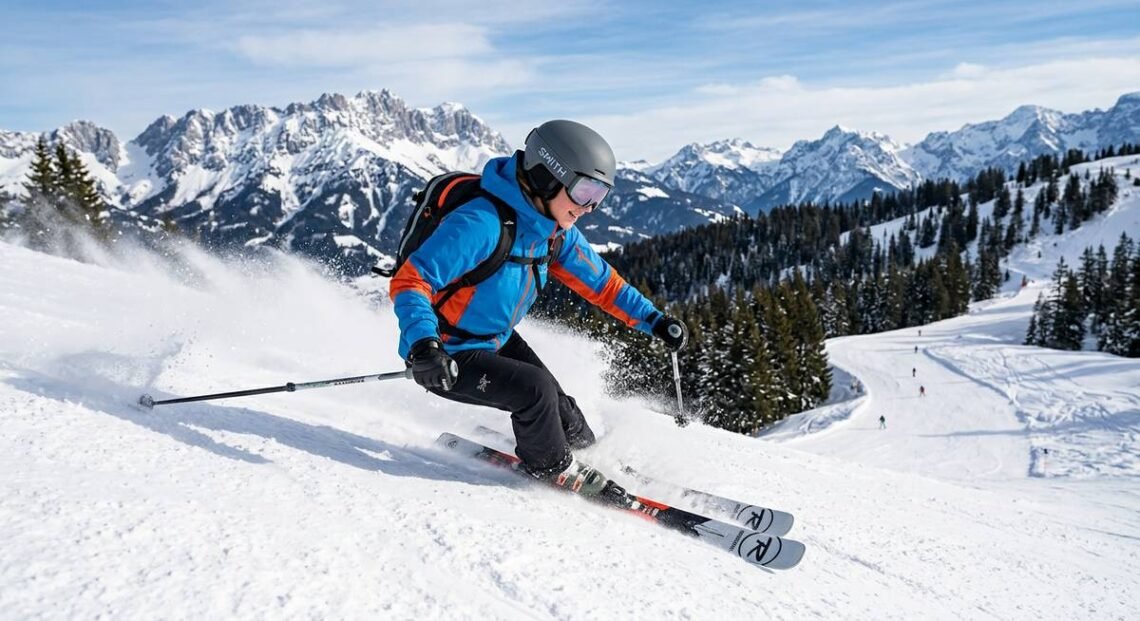
Skiing doesn’t feel like exercise. That’s the whole problem — and the whole point. You’re carving down a mountain, cold air in your face, adrenaline doing its thing, and somewhere in the back of your mind a reasonable question surfaces: is skiing a good workout, or am I just having fun?
The answer is unambiguously yes. Skiing is a legitimate, full-body workout that simultaneously taxes your cardiovascular system, hammers your lower body, and demands constant core engagement — all while being easier on your joints than running. The fact that it doesn’t feel like a treadmill session is a feature, not a flaw.
For recreational skiers wondering whether a weekend on the slopes counts toward their fitness goals, for athletes looking for a serious winter cross-training option, or for anyone trying to decide whether the sport is worth the investment — the physical case for skiing is stronger than most people realize.
What follows breaks down exactly which muscles skiing works, how many calories it actually burns (by skill level and terrain type), how it stacks up against other workouts and winter sports, and how to structure a ski day to get the most out of it physically.
What Muscles Does Skiing Actually Work?
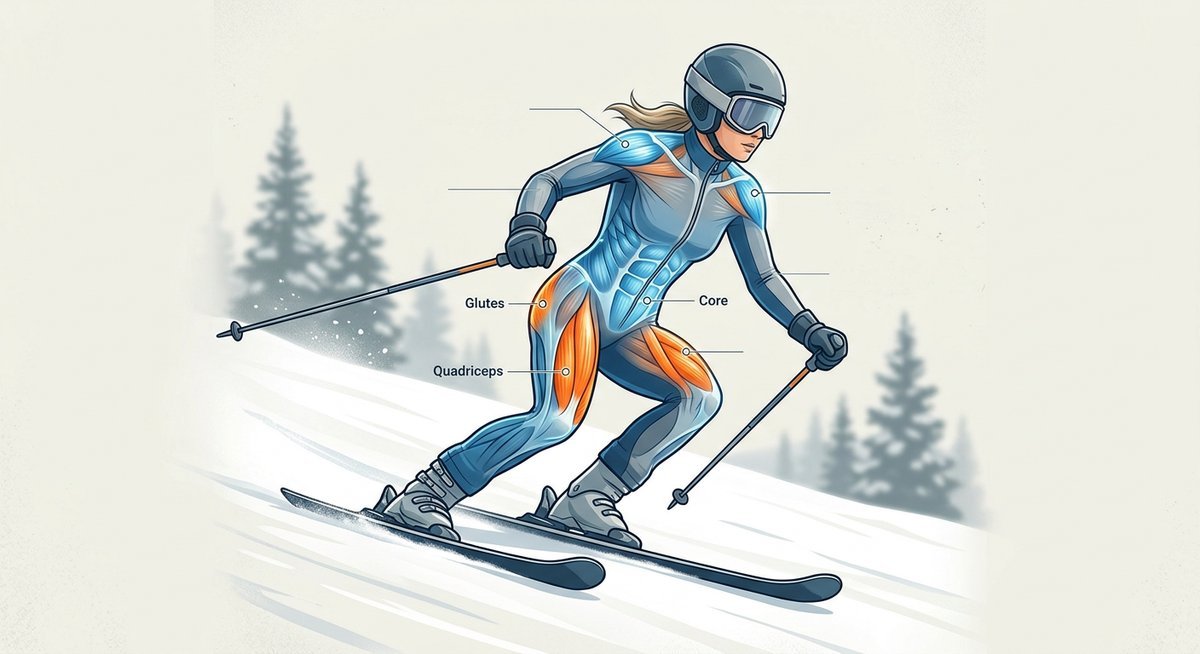
Skiing recruits nearly every major muscle group in the body simultaneously — lower body for power and control, core for stability, and upper body for balance and propulsion. The sustained athletic stance alone places a muscular demand comparable to holding a wall-sit for hours, with dynamic movement layered continuously on top. Few recreational activities match that combination of endurance and functional strength.
Lower Body — The Engine of Every Turn
The quadriceps bear the heaviest load on skis. Holding a flexed-knee stance forces the quads into sustained eccentric contraction — the same type of muscle work that makes downhill running so punishing — except skiers maintain it run after run for hours. According to research published in the Journal of Strength and Conditioning Research, recreational alpine skiing produces significant quadriceps fatigue within a single day of skiing, particularly during extended descents on steeper terrain.
Hamstrings and glutes work in constant opposition to the quads, stabilizing the knee joint and driving hip extension through each turn. The calves contribute more than most skiers expect, actively controlling ankle flex against boot resistance and absorbing vibration on variable snow. Together, these four muscle groups are under near-continuous tension from first chair to last run.
Core, Back, and Upper Body — More Than You’d Expect
The core isn’t just engaged on skiing — it’s essentially never off. Every shift in terrain, every edge change, and every speed adjustment demands rapid stabilization from the deep abdominals and obliques to keep the upper body quiet while the legs move independently beneath it. That rotational demand is particularly pronounced in moguls and powder, where the hips and torso must counter-rotate aggressively through each turn.
The lower back works as a continuous stabilizer, managing the forward lean of the skiing stance and absorbing the compression forces that come with landing small drops or skiing choppy snow. Pole planting adds a meaningful upper-body component that often goes unacknowledged. On steeper pitches and mogul fields, each plant actively engages the shoulders, triceps, and forearms — transforming what looks like a casual flick of the wrist into a rhythmic, load-bearing movement repeated hundreds of times per day.
| Muscle Group | Primary Role in Skiing | Highest Demand Terrain |
|---|---|---|
| Quadriceps | Eccentric loading, stance maintenance | Steeps, moguls |
| Hamstrings & Glutes | Knee stabilization, turn initiation | All terrain |
| Calves | Ankle flex control, vibration absorption | Groomed, variable snow |
| Core & Obliques | Rotational stability, upper-lower body separation | Moguls, powder |
| Lower Back | Postural stabilization, impact absorption | Bumps, off-piste |
| Shoulders & Triceps | Pole planting, balance recovery | Steeps, moguls |
How Many Calories Does Skiing Burn?
Downhill skiing burns roughly 300–600 calories per hour depending on skier skill level, body weight, and terrain — putting it firmly in the same league as cycling or recreational swimming. The harder you ski, the steeper the terrain, and the fewer breaks you take, the higher that number climbs. At the aggressive end, expert skiers on moguls or powder can push past 600 calories per hour.
Calorie Burn by Skill Level
Skill level matters more than most people expect — not because beginners are lazy, but because the mechanics are completely different. A beginner spends significant time on flat terrain, stopping frequently, and using a narrow range of motion. An advanced skier is continuously loading and unloading the quads, driving through turns with full-body engagement, and rarely stopping between runs.
According to the Compendium of Physical Activities, downhill skiing carries a MET (metabolic equivalent of task) value ranging from approximately 4.3 for light effort to 8.0 for vigorous effort. Harvard Health Publishing uses a MET-based formula to estimate that a 155-pound person burns around 446 calories per hour skiing at moderate intensity — a figure that rises sharply with effort level.
| Skill Level | Typical Effort | Est. Cal/Hour (150 lb skier) |
|---|---|---|
| Beginner | Low–Moderate | 280–350 |
| Intermediate | Moderate | 380–480 |
| Advanced / Expert | High–Very High | 500–650+ |
Advanced skiers also benefit from a compounding effect: more aggressive technique recruits more muscle mass, which elevates oxygen demand and drives caloric expenditure higher even at the same speed.
Calorie Burn by Terrain Type
Terrain is the variable that most calorie estimates ignore entirely — and it’s one of the biggest levers available. A groomed blue cruiser and a mogul field are physiologically different workouts, even if both take the same amount of time to descend.
Moguls demand rapid, repetitive eccentric contractions through the quads and force constant core stabilization. Research on high-intensity intermittent exercise consistently shows that this stop-start muscular loading pattern elevates calorie burn 30–50% above steady-state effort at comparable speeds. Powder skiing adds a resistance component — each turn requires pushing through snow rather than gliding over a hard surface — making it arguably the most metabolically expensive terrain type for a given run length.
| Terrain Type | Intensity Level | Est. Cal/Hour (150 lb skier) |
|---|---|---|
| Groomed Cruiser (Green/Blue) | Low–Moderate | 300–400 |
| Steeps (Black Diamond) | Moderate–High | 420–520 |
| Moguls | High | 480–600 |
| Powder / Off-Piste | Very High | 520–650+ |
How Does Skiing Compare to Other Workouts?
Alpine skiing sits in a rare category: it delivers meaningful cardiovascular demand and significant muscular load simultaneously, with relatively low joint impact. Most activities offer one or two of those qualities. Skiing, done with intention on challenging terrain, offers all three — which is why it holds up surprisingly well against workouts people treat as far more “serious.”
Skiing vs. Common Gym and Cardio Activities
Running burns roughly 480–600 calories per hour for a 150-pound person, according to Harvard Medical School’s calorie expenditure data — comparable to a solid intermediate ski day on varied terrain. The key difference is impact. Running is a high-repetition, high-impact activity that accumulates stress on knees, hips, and ankles with every stride. Skiing, by contrast, is low-impact: forces are absorbed through muscular engagement rather than repeated joint collision.
Cycling offers a similar low-impact profile but falls short on upper-body and core engagement. A cyclist primarily works the quads and glutes in a fixed, supported position. A skier works those same muscles plus the core, lower back, and upper body — all in an unstable, reactive environment that demands constant neuromuscular adjustment.
Weightlifting builds strength efficiently but contributes almost nothing to cardiovascular fitness in a single session. Skiing bridges that gap. The sustained eccentric quad loading in the athletic stance is functionally similar to a prolonged set of wall-sits, except it runs continuously for 30 to 60 seconds per run, repeated across an entire day. That’s a training stimulus most gym sessions don’t replicate.
Skiing vs. Other Winter Sports
Cross-country skiing outperforms alpine skiing on pure aerobic output — it’s one of the highest VO2 max demands of any sport, engaging the upper and lower body in a continuous, rhythmic effort. Alpine skiing wins on strength demand and anaerobic intensity, particularly on moguls or steep terrain where short, explosive bursts dominate.
Snowboarding works many of the same lower-body muscle groups as alpine skiing — quads, glutes, and core — but distributes load differently. The sideways stance shifts more demand onto the hip abductors and obliques, and the absence of poles removes most upper-body engagement. Calorie burn is broadly similar between the two sports at equivalent effort levels.
Ice skating is the lightest workout of the group. It develops balance and hip stability, but the lower muscular load and typically flat terrain mean it rarely reaches the cardiovascular or strength intensity of skiing or snowboarding.
| Sport | Cardio Level | Strength Demand | Est. Cal/Hour (150 lb) | Joint Impact |
|---|---|---|---|---|
| Alpine Skiing (intermediate) | Moderate–High | High (lower body + core) | 400–600 | Low |
| Cross-Country Skiing | Very High | High (full body) | 500–800 | Very Low |
| Snowboarding | Moderate–High | Moderate–High (lower body) | 350–550 | Low–Moderate |
| Ice Skating | Moderate | Low–Moderate (legs, hips) | 300–450 | Low |
| Running | High | Low (legs only) | 480–600 | High |
| Cycling | High | Moderate (legs, glutes) | 400–600 | Very Low |
How to Maximize the Workout Value of a Ski Day
Treating a ski day as intentional exercise — rather than just recreation — can double the physical output without adding a single extra hour on the mountain. The difference comes down to run selection, pacing discipline, and a few technique habits that most recreational skiers never think about.
Run Selection and Pacing Strategy
Steeper, more technical terrain is where the real training stimulus lives. Groomed blue cruisers are comfortable, but they allow too much passive gliding — your muscles coast rather than work. Prioritize black runs, mogul fields, or ungroomed pitches where the terrain forces constant muscular engagement and reactive balance corrections.
Minimize lift time where possible. Choosing a high-speed quad over a slow fixed-grip chair might seem trivial, but across a full day, it can add 20–30 minutes of extra ski time. More runs per hour means more accumulated muscle time under load.
Ski in focused blocks rather than marathon sessions with long lunch breaks. Research on intermittent high-intensity activity suggests that shorter, harder efforts with brief recovery periods produce greater cardiovascular and muscular adaptation than the same duration spread loosely across a day.
| Strategy | Workout Benefit | Practical Tip |
|---|---|---|
| Prioritize steeps and moguls | Higher quad and core demand | Aim for at least 60% of runs on black terrain |
| Minimize lift idle time | More ski time per hour | Choose fast lifts; skip long gondola queues |
| Active pole planting | Engages shoulders, triceps, core | Plant deliberately on every turn, not just steep pitches |
| Sustained athletic stance | Intensifies quad and glute load | Resist the urge to stand tall on easy terrain |
| Ski in focused 90-min blocks | Mimics interval training structure | Short lunch break, back on snow before fatigue sets in |
One overlooked technique cue: stay low. Maintaining a deeper knee bend on groomed runs — even when the terrain doesn’t demand it — turns a casual cruise into a sustained isometric challenge. Your quads will notice the difference within three runs.
Frequently Asked Questions
Is skiing better exercise than running?
Skiing and running burn comparable calories per hour, but they stress the body differently. Running delivers a higher sustained cardiovascular load and is easier to do consistently. Skiing provides greater muscular engagement across the full body — particularly the quads, core, and stabilizer muscles — with significantly lower joint impact. For people with knee or hip concerns, skiing offers a more joint-friendly way to achieve similar caloric output.
Can skiing help you lose weight?
A full day of skiing can burn 2,000–3,000 calories depending on intensity, terrain, and body weight. That caloric deficit, sustained across a multi-day ski trip or an entire season of weekend skiing, adds up substantially. The catch: ski lodge meals and post-ski beers can easily offset the burn. Treating the mountain as a workout and watching nutrition afterward is what tips the balance.
How many calories does a full day of skiing burn?
An intermediate skier weighing 150 pounds will burn roughly 400–500 calories per hour of active skiing. Over a 5–6 hour ski day with normal lift breaks and a lunch stop, that totals approximately 2,000–3,000 calories. Expert skiers on aggressive terrain push higher. Beginners on gentle slopes fall toward the lower end.
Does skiing count as leg day?
Absolutely. Skiing places the quadriceps, hamstrings, glutes, and calves under sustained eccentric and isometric load for hours. The muscular demand of maintaining an athletic stance through continuous turns is comparable to high-volume leg training in the gym — except the duration far exceeds a typical squat session. Post-ski soreness in the quads confirms what the research shows: skiing is a legitimate lower-body workout.
Is skiing good cardio?
Skiing elevates heart rate into moderate-to-high training zones, particularly on steeper terrain and during mogul runs. According to the Compendium of Physical Activities, vigorous downhill skiing carries a MET value of 8.0 — equivalent to singles tennis or running at a moderate pace. The intermittent nature of skiing (intense descents followed by lift recovery) mirrors interval training, which research associates with strong cardiovascular adaptation.
What should I do to prepare my body for ski season?
Focus on three areas: quad and glute strength (wall sits, lunges, single-leg squats), core stability (planks, rotational exercises), and cardiovascular endurance (cycling, stair climbing, or running). Starting a pre-season program 6–8 weeks before your first ski day reduces injury risk and lets you ski harder, longer, with less fatigue. The stronger you arrive, the better workout skiing delivers.
The Verdict on Skiing as Exercise
Skiing is one of the few recreational activities that legitimately qualifies as a full-body workout — and a demanding one. It loads the quads, glutes, and core for hours. It burns calories at rates that rival running and cycling. It does all of this with low joint impact and in an environment so engaging that most people forget they’re exercising.
The fitness return depends on how you approach it. Casual green-run cruising with long lodge breaks is pleasant but modest. Aggressive skiing on varied terrain, with intentional pacing and technique focus, turns a ski day into one of the most effective and enjoyable workouts available in any season. The mountain is the gym — and the price of admission is just showing up ready to work.