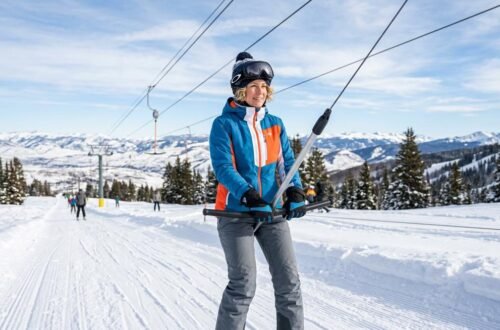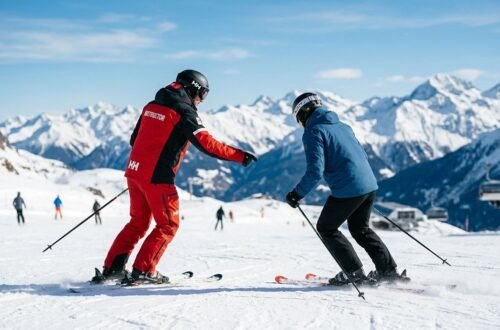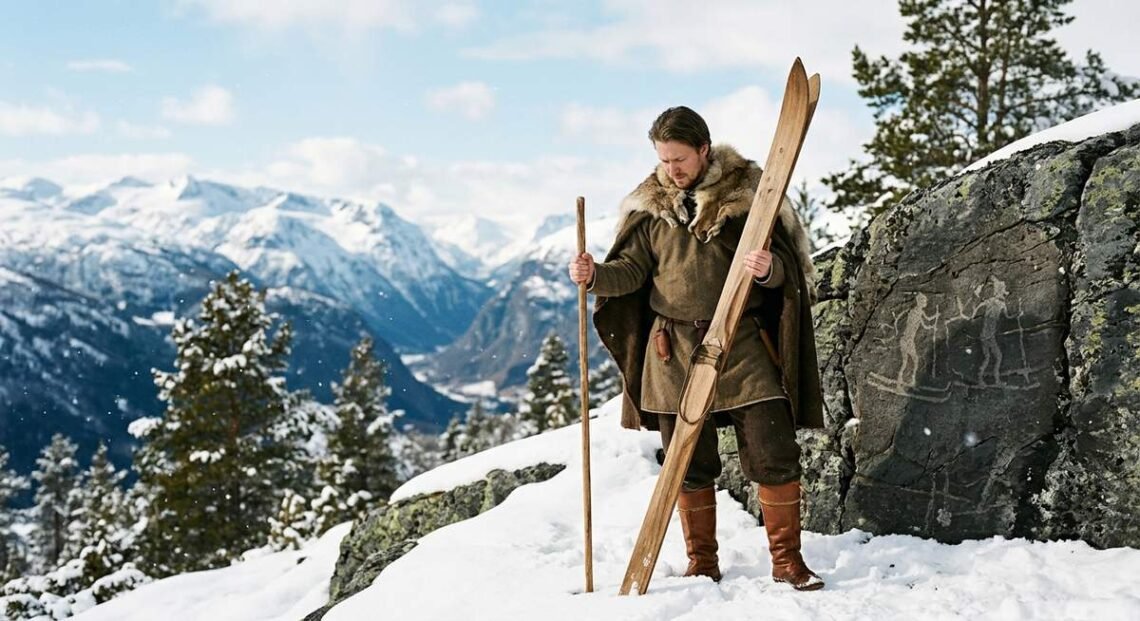
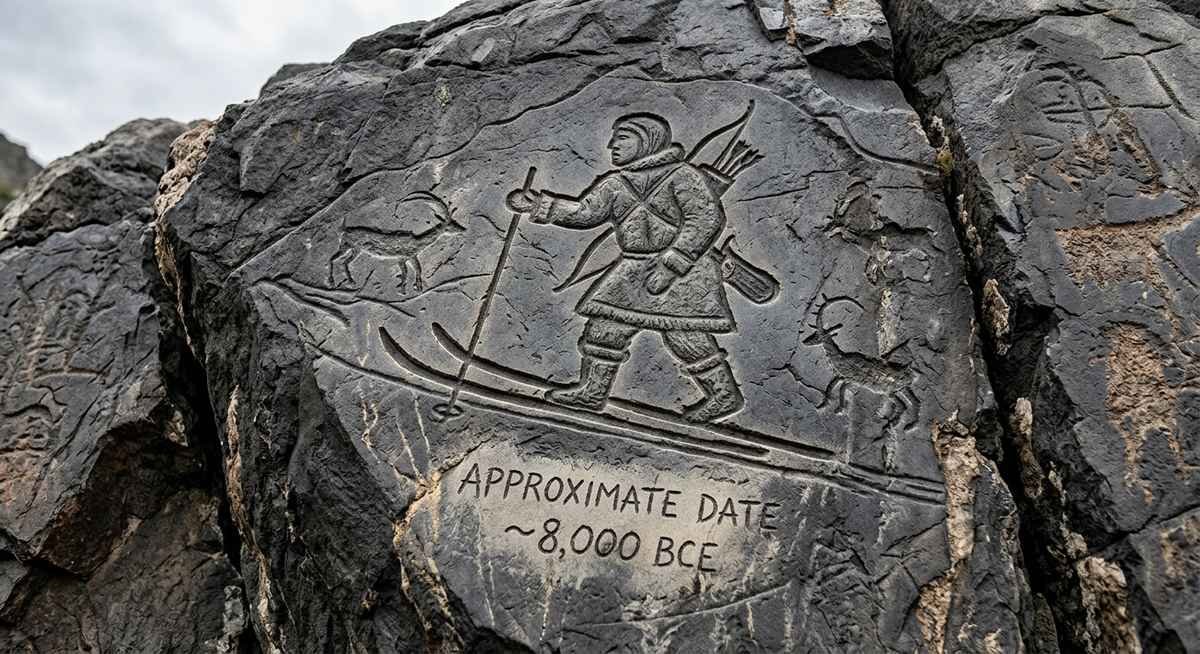
Skiing was invented roughly 8,000 to 10,000 years ago, most likely across the snow-covered regions of Central Asia and Scandinavia, where early humans strapped primitive planks of wood to their feet to hunt and travel through winter terrain. The oldest physical evidence — rock carvings discovered in the Altai Mountains of northern China and Russia — dates to approximately 8,000 BCE and depicts hunters on skis pursuing game.
The oldest surviving ski artifact is the Vis peat-bog ski fragment, unearthed in northwestern Russia and dated to around 6,000 BCE. A close second is the Hoting ski, recovered from a Swedish bog and carbon-dated to roughly 5,000 years ago. These aren’t curiosities — they’re proof that skiing predates the written word by millennia.
What began as a survival tool eventually became one of the world’s most popular sports, spawning more than a dozen distinct disciplines, a multi-billion-dollar equipment industry, and a global resort culture. The story runs from Siberian hunters to California Gold Rush racers, from a Norwegian farmer named Sondre Norheim codifying telemark technique in 1868 to the first chairlift spinning at Sun Valley in 1936.
The Prehistoric Origins of Skiing
Skiing is at least 8,000 years old — possibly older. The earliest confirmed evidence places primitive skis in Central Asia and Siberia long before the first organized civilization emerged. Humans strapped wood to their feet not for recreation, but to survive.
The Oldest Evidence
Three physical artifacts anchor the prehistoric timeline of skiing, each proving something different about how early ski design evolved across thousands of years and thousands of miles.
| Artifact | Location | Approximate Date | What It Proves |
|---|---|---|---|
| Altai rock carvings | Xinjiang, China / Altai Mountains, Russia | ~8,000 BCE | Earliest artistic depiction of a human on skis, showing a hunter using a single pole and short, broad boards |
| Vis peat-bog ski fragments | Vis, Russia (Komi Republic) | ~6,000 BCE | Oldest surviving physical ski fragment; a single wooden plank with a carved animal-head tip, confirming functional construction |
| Hoting ski | Hoting, Sweden | ~5,000 BCE | A near-complete ski with a raised foot ridge — the first evidence of a binding system designed to secure the foot |
The Altai carvings are the oldest known visual record of skiing on Earth. Etched into rock faces in what is now northwestern China, they depict a figure on wide, short planks gripping what appears to be a single long pole — a design optimized for flat terrain and deep powder, not steep descents.
The Vis fragment, recovered from a Russian peat bog and dated by researchers at approximately 6,300 BCE, pushes the physical evidence deep into prehistory. The carved animal-head tip is decorative, but the plank shape is unmistakably functional. Peat preservation kept it intact for eight millennia.
According to the Swedish National Historical Museum, Sweden’s Hoting ski dates to approximately 5,200 years ago. The raised ridge carved along its upper surface is a primitive binding — proof that by 5,000 BCE, skiers were already engineering solutions to keep their feet attached to the board.
Why Skiing Was Invented
Nobody invented skiing for fun. Across Central Asia and Scandinavia, deep winter snowpack made foot travel nearly impossible for months at a time. Skis solved a life-or-death logistics problem: how to hunt, trade, and move troops when the ground disappeared under two meters of snow.
Norse military records from medieval Scandinavia describe ski-mounted soldiers used for reconnaissance — an advantage so decisive that ski troops remained part of Nordic armies well into the 20th century. In Central Asia, the same technology let nomadic hunters pursue elk and reindeer across frozen steppe that would have been impassable on foot.
Skiing as leisure came much later. For roughly 9,000 of the 10,000 years humans have used skis, the activity was purely utilitarian. The pivot toward sport and recreation didn’t begin in earnest until 18th-century Scandinavia.
How Skiing Spread: Regional History
Skiing evolved independently across multiple cold-climate regions before colliding into a unified global sport during the 19th and 20th centuries. Norway formalized competitive skiing in 1767, Austria gave birth to alpine technique in the 1890s, and America’s first ski races emerged during the California Gold Rush of the 1850s — decades earlier than most people assume.
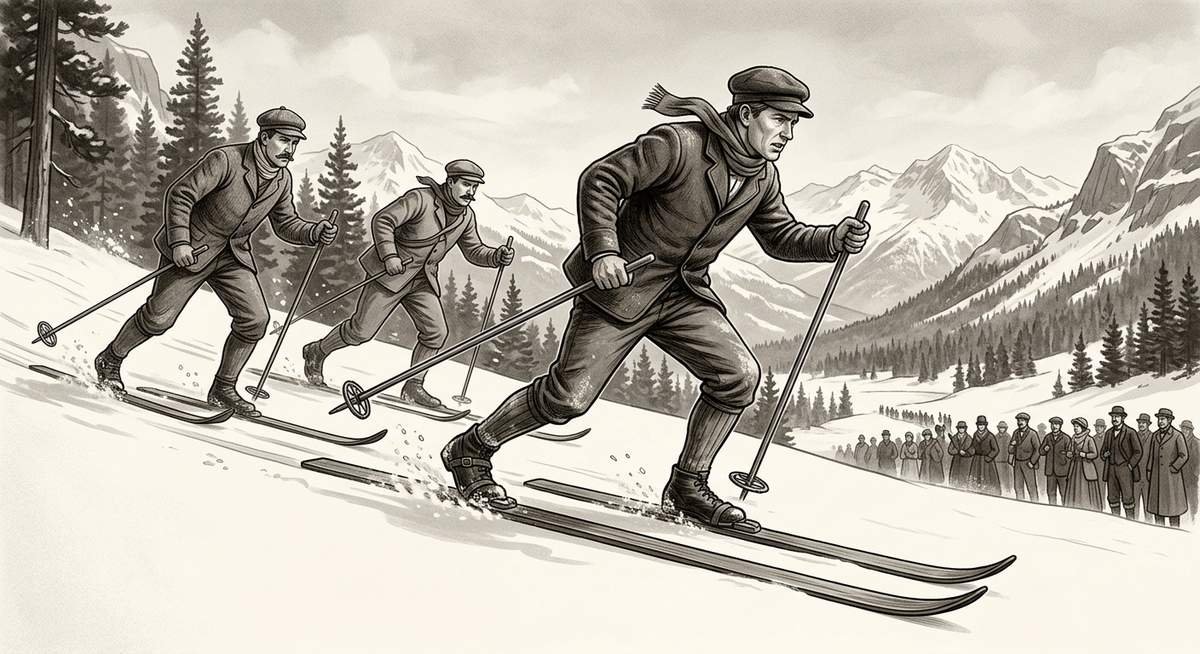
Scandinavia: From Survival to Competitive Sport
Scandinavians wove skiing into their mythology long before anyone timed a race. The Norse god Ullr — deity of winter, hunting, and archery — was depicted gliding on skis, a testament to how central the practice was to Norse identity.
The first formally recorded ski competition took place in Norway in 1767, when military units raced on skis as a training exercise. According to the International Ski and Snowboard Federation (FIS), this makes competitive skiing over 250 years old. The sport’s technical evolution accelerated when Sondre Norheim, a farmer from Telemark, Norway, formalized a revolutionary turning technique in 1868 that would bear his region’s name forever. Norheim also introduced a heel binding that gave skiers far greater control.
The Christiania Ski Club — founded in Oslo (then called Christiania) in 1877 — became one of Norway’s most influential ski organizations, helping standardize competition rules. An even earlier club, the Trysil Rifle and Ski Club, had been operating in Trysil since 1861, making it the world’s first recorded ski club.
Europe: Austria and the Birth of Alpine Skiing
Norwegian skiing was built for flat and rolling terrain. The Alps demanded something entirely different. Austrian instructor Mathias Zdarsky developed a new technique in the 1890s — shorter skis, a single pole, and a stem-turn method suited to steep mountain descents — publishing his landmark manual Lilienfelder Skilauf-Technik in 1896. Zdarsky is widely credited as the father of alpine skiing.
The discipline got its defining competitive format in 1922, when British skier Sir Arnold Lunn organized the first modern slalom race above Murren, Switzerland. The Alps then became the epicenter of recreational skiing — a status cemented when resorts at Davos and St. Moritz began attracting wealthy tourists in the early 20th century.
Skiing in America: Gold Rush Racers to Sun Valley
Skiing did start in the US far earlier than most histories acknowledge. During the California Gold Rush of the 1850s, miners in the Sierra Nevada were already racing on long wooden skis with cash prizes and serious community wagering. The La Porte ski races in Plumas County, California, drew organized competition by the 1860s.
John “Snowshoe” Thompson, a Norwegian-born mail carrier, became the era’s most famous American skier — crossing the Sierra Nevada on 10-foot skis to deliver mail between 1856 and 1876, covering roughly 90 miles each way. His 20-year career as a ski-mail carrier made him a folk legend in the American West.
The first U.S. ski club — the Nansen Ski Club — was founded in Berlin, New Hampshire, in 1872. According to the National Ski Areas Association (NSAA), Sun Valley, Idaho, opened in 1936 as America’s first destination ski resort, featuring the world’s first chairlift. Skiing reached Montana through early 1900s mining communities, with Big Mountain (now Whitefish Mountain Resort) opening in 1947.
When Each Skiing Discipline Was Invented
Cross-country skiing is the oldest discipline, with prehistoric roots stretching to 6,000 BCE. Alpine skiing formalized in 1911. Freestyle arrived in the 1960s. Park skiing? That waited until the 1990s. The gap between the first and last discipline invention is roughly 8,000 years — and counting.
According to the International Ski and Snowboard Federation (FIS, 2023), competitive ski racing began formally in Norway during the 1860s, establishing the institutional framework that now governs every discipline from slalom to ski cross.
Discipline-by-Discipline Timeline
| Discipline | Approximate Origin | Key Development |
|---|---|---|
| Cross-country skiing (XC / Nordic skiing) | c. 6000 BCE | Prehistoric transport; earliest ski artifacts found in Russia and Scandinavia |
| Ski jumping | 1808 | First recorded jump by Olaf Rye in Eidsberg, Norway |
| Telemark skiing | 1868 | Sondre Norheim pioneered the telemark turn in Telemark, Norway |
| Slalom skiing | 1922 | Sir Arnold Lunn organized the first formal slalom race in Murren, Switzerland |
| Alpine / downhill skiing | 1911 | First downhill race organized in Crans-Montana, Valais, Switzerland |
| Ski touring / ski mountaineering | 1911 | Roald Amundsen’s polar expedition popularized long-range ski travel |
| Ski racing (Olympic) | 1924 | Nordic events debuted at the first Winter Olympics in Chamonix |
| Heli-skiing | 1965 | Hans Gmoser launched the first commercial heli-skiing operation in Canada |
| Freestyle skiing | 1966 | Hotdog skiing exhibitions emerged in the United States |
| Skate skiing | 1980s | Bill Koch popularized the skating technique at the 1982 World Cup |
| Grass skiing | 1966 | Josef Kaiser invented roller-based grass skis in Germany |
| Ski cross | 1990s | Evolved from boardercross; became an Olympic discipline in 2010 |
| Park skiing | Mid-1990s | Terrain parks built for snowboarders were adopted by twin-tip ski pioneers |
| Ice skiing | Early 1900s | Nordic countries; skiing on frozen lakes with metal-edged skis |
The Evolution of Ski Equipment
Ski boots, bindings, poles, lifts, and protective gear evolved over 5,000 years — from the Hoting ski’s crude foot ridge to Elan’s 1993 carving revolution. According to the International Ski History Association (2021), most of the gear modern skiers take for granted was invented in a compressed 100-year burst between the 1860s and 1960s.
Boots, Bindings, and Poles
Norwegian skiers laced the first dedicated ski boots directly to wooden planks in the mid-1800s. Toe-iron ski bindings appeared alongside them in the 1860s, but the safety release binding — the one that saves knees today — didn’t arrive until the 1930s. That 70-year gap between attaching your foot and safely detaching it tells you something about early skiing’s tolerance for risk.
Ski poles are older than most people realize. Single-pole skiing was documented in Scandinavia as early as the 1600s, with paired poles becoming standard only by the late 1800s. Ski skins — strips of animal hide attached to ski bases for climbing — predate resorts by centuries, developed by Nordic hunters who needed to go uphill before they could come down.
Lifts, Resorts, and Slopes
A rope tow powered by a car engine in Shawbridge, Quebec, in 1932 was the first ski lift — unglamorous, effective, and the start of everything. Ski chairlifts followed just four years later at Sun Valley, Idaho, engineered by Union Pacific Railroad’s James Curran. Enclosed ski gondolas arrived in the 1940s, finally giving skiers a way up the mountain that didn’t require frostbitten fingers.
St. Moritz, Switzerland, claims the title of first ski resort, attracting winter tourists starting in the 1860s. But groomed ski slopes as a concept didn’t exist until mechanical piste machines rolled out in the 1950s — before that, you skied whatever the mountain gave you. The National Ski Patrol, founded in 1938 by Minnie Dole, formalized on-mountain safety for the first time.
Protective and Performance Gear
Ski goggles were borrowed from military aviator eyewear in the early 1900s. Ski helmets took far longer to catch on — hard-shell versions existed by the 1950s for racers, but recreational skiers resisted them until the 1990s. Ski pants made the journey from heavy wool trousers to waterproof technical gear over roughly half a century.
Ski brakes replaced dangerous retention straps in 1974, ending the era of runaway skis clobbering bystanders. Carving skis, with their distinctive hourglass sidecut, changed recreational skiing permanently when Elan introduced the prototype in 1993. Niche categories like ski bikes and ski skates appeared in the late 20th century — inventive, occasionally bizarre, never mainstream.
| Equipment | Approximate Date | Origin / Notable Detail |
|---|---|---|
| Ski poles (single) | 1600s | Scandinavia; paired poles by late 1800s |
| Ski boots (leather) | Mid-1800s | Norway; rigid plastic shells arrived 1960s |
| Ski bindings (toe-iron) | 1860s | Safety release binding added 1930s |
| First ski resort | 1860s | St. Moritz, Switzerland |
| Ski goggles | Early 1900s | Adapted from aviation eyewear |
| First ski lift (rope tow) | 1932 | Shawbridge, Quebec, Canada |
| Ski chairlift | 1936 | Sun Valley, Idaho, USA |
| Ski gondola | 1940s | Alpine Europe; enclosed cabins for steeper terrain |
| Ski helmet | 1950s (hard-shell); widespread 1990s | Adopted from racing; mainstream after safety campaigns |
| Ski pants (waterproof) | Mid-1900s | Evolved from heavy wool trousers |
| Ski brakes | 1974 | Replaced dangerous strap retention leashes |
| Carving skis | 1993 | Elan introduced hourglass-shaped prototype |
| Ski patrol | 1938 | National Ski Patrol founded in the USA by Minnie Dole |
Water Skiing, Snowboarding, and Related Inventions
Water skiing was invented on June 28, 1922, when 18-year-old Ralph Samuelson rode two pine boards across Lake Pepin, Minnesota — making the USA the birthplace of water skiing. Snowboarding came 43 years later. Snow skiing predates snowboarding by roughly 10,000 years, making any “which came first” debate extremely one-sided.
Ralph Samuelson and Water Skiing
According to the American Water Ski and Wakeboard Foundation (2023), Samuelson used a clothesline as a tow rope and his brother’s motorboat to pull off that first ride. Nobody else had tried it. Slalom water skiing — riding on a single ski through a timed course — developed as a competitive format through the 1940s and remains the sport’s marquee discipline.
Jet Skiing and the Snowmobile Timeline
Kawasaki introduced the JS400 stand-up personal watercraft in the early 1970s, inventing jet skiing as a consumer activity. Bombardier beat them to winter by a decade — the first Ski-Doo snowmobile rolled out of the Quebec factory in 1959, replacing dog sleds across rural Canada practically overnight.
The SkiErg, invented in 2003 by Vermont-based Concept2, brought cross-country skiing biomechanics indoors. It’s now a fixture in CrossFit boxes and Nordic training facilities worldwide.
Skiing vs. Snowboarding: A Quick Timeline
| Invention | Year | Origin |
|---|---|---|
| Snow skiing (prehistoric) | ~8000 BCE | Scandinavia/Central Asia |
| Water skiing invented | 1922 | USA (Minnesota) |
| First Ski-Doo | 1959 | Canada |
| Snowboarding invented | 1965–1980s | USA |
| Jet skiing invented | 1972 | Japan/USA |
| SkiErg invented | 2003 | USA (Vermont) |
Skiing and snowboarding share cultural DNA but not a timeline. Snow skiing predates snowboarding by millennia, and the two only began sharing the same mountain terrain commercially in the late 1980s.
Frequently Asked Questions
When was skiing introduced into the Olympics?
Skiing was introduced into the Winter Olympics in 1936 at the Garmisch-Partenkirchen Games in Germany, where alpine skiing made its Olympic debut. Nordic skiing events had appeared even earlier, dating back to the first Winter Olympics in Chamonix, France, in 1924. According to the International Olympic Committee (2024), the alpine combined event was the sole alpine discipline contested at those 1936 Games.
Was skiing invented in Norway?
Norway has one of the strongest claims to the origins of skiing, with rock carvings in Rødøy estimated to be around 5,000 years old depicting a figure on skis. The Norwegians also formalized competitive skiing, holding what is widely regarded as the first organized ski race in Tromsø in 1843. According to the International Ski and Snowboard Federation (FIS) (2023), Scandinavian cultures were among the earliest documented users of skis for both transport and sport.
Was skiing invented in Austria?
Austria did not invent skiing, but it played a pivotal role in developing the modern alpine skiing technique. Mathias Zdarsky, an Austrian, pioneered a stem-turning technique in the late 19th century and published the first alpine ski instruction manual in 1896. His work laid the groundwork for what would become the dominant style of downhill skiing practiced worldwide today.
When was skiing invented in Montana?
Skiing arrived in Montana in the late 1800s, brought primarily by Scandinavian and European immigrants who used skis for winter travel and mail delivery. The first organized ski clubs in Montana began forming in the early 20th century. Red Lodge Mountain, one of the state’s oldest ski areas, opened in 1960, marking a significant moment in Montana’s recreational skiing history.
When was recreational skiing invented?
Recreational skiing and skiing for fun began gaining traction in the mid-19th century, particularly in Norway and the Alps, as skiing transitioned from a survival tool into a leisure pursuit. The Trysil Rifle and Ski Club, founded in Norway in 1861, is the earliest known organization dedicated to skiing as sport. By the early 1900s, winter tourism built around recreational skiing was already flourishing across the European Alps.
When was modern skiing invented?
Modern skiing as practiced today took shape in the early 20th century, driven largely by Austrian and Swiss instructors who codified downhill technique. Hannes Schneider developed the Arlberg technique in Austria around 1907, which became the foundation of modern ski instruction globally. According to ski historian E. John B. Allen (2007), the interwar period of the 1920s and 1930s was the critical era that transformed skiing into the modern sport recognized today.
When was the Nike ski mask invented?
Nike did not invent the ski mask. The balaclava-style ski mask has military and mountaineering origins dating to the 19th century, named after the Battle of Balaclava in 1854 during the Crimean War. Nike produces ski and winter sports accessories, but the ski mask as a functional piece of cold-weather headgear predates the brand’s founding in 1964 by roughly a century.
When was commercial skiing invented and when were the first ski resorts built?
Commercial skiing emerged in the late 19th century. St. Moritz, Switzerland, began hosting winter tourists in the 1860s, making it one of the earliest ski resorts. In the United States, Sun Valley, Idaho, opened in 1936 as the first purpose-built destination ski resort, complete with the world’s first chairlift. According to the National Ski Areas Association (2024), groomed ski slopes became standard only after mechanical piste grooming machines were widely adopted in the 1950s and 1960s.
When did skiing become popular in the United States?
Skiing became popular in the United States during the 1930s and 1940s, driven by the opening of Sun Valley in 1936 and the establishment of ski areas across New England and the Rocky Mountains. The sport surged in mainstream appeal after the 1960 Winter Olympics at Squaw Valley, California, which brought competitive skiing into American living rooms via television broadcast for the first time.
When was heli-skiing invented?
Heli-skiing was invented in 1965 by Austrian-Canadian mountain guide Hans Gmoser, who launched the first commercial helicopter-assisted skiing operation in the Bugaboo Mountains of British Columbia, Canada. According to Canadian Mountain Holidays (CMH), Gmoser’s venture pioneered an entirely new category of skiing that now operates across five continents.
Conclusion
Skiing is roughly 10,000 years old, born out of necessity in the snow-covered regions of Central Asia and Scandinavia. What began as a survival tool — a way to hunt and travel across frozen terrain — gradually transformed into one of the world’s most popular recreational sports.
The shift from function to leisure took millennia, but the core mechanics have remained remarkably consistent. As technology advances and climate pressures reshape snow conditions globally, skiing will continue adapting, just as it always has.