Picture this: a skier in a puffy rental jacket, goggles shoved up on their forehead, skis pointed straight downhill like twin missiles — barreling toward a crowded beginner run with absolutely no plan to stop. Everyone on the slope sees it coming. Nobody is surprised. That person has a name in ski culture, and it’s a jerry.
A jerry is ski slang for someone who causes chaos on the mountain through cluelessness or reckless disregard. The term has nothing to do with ability — it’s about behavior. And it predates Instagram by decades.
What Does “Jerry” Mean in Skiing?
A jerry is a skier or snowboarder who displays reckless, clueless, or dangerously unaware behavior on the mountain — not out of malice, but out of a fundamental absence of situational awareness. The term functions as a behavioral label, not a skill classification. Advanced skiers can be jerries too. First-timers can avoid the label entirely.
The Core Definition in Ski Slang
In ski slang, “jerry” describes someone who doesn’t know what they don’t know — stopping dead mid-run, attempting a black diamond on day one, wearing a helmet strapped over a thick winter hat. Being a beginner doesn’t make someone a jerry. The distinction kicks in when inexperience meets a total absence of self-awareness. Skill is fixable. Obliviousness is the actual problem.
The National Ski Areas Association (NSAA) publishes a Skier Responsibility Code that captures behaviors jerries consistently violate: yield to downhill skiers, don’t stop where you obstruct a trail or aren’t visible from above, always stay in control.
How Skiers Use the Term Today
On the mountain, “jerry” gets deployed in lift lines, lodge conversations, and group chats — usually right after someone witnesses a spectacular wipeout. Among friends, it’s affectionate ribbing. Directed at a stranger who just cut off a ski patrol officer, it carries genuine edge.
Social media sharpened the term considerably. The Instagram account Jerry of the Day (@jerryoftheday), launched in 2011, has amassed over 2.2 million followers by posting user-submitted clips of slope disasters. It turned “jerry” from regional resort shorthand into globally recognized ski vocabulary. Reddit communities like r/skiing and r/snowboarding use the term daily, further cementing its place in modern ski culture.
| Trait | Beginner Skier | Jerry |
|---|---|---|
| Skill level | Low, but improving | Variable — not the defining factor |
| Self-awareness | Cautious, observant | Absent or dangerously low |
| Slope etiquette | Learning and following rules | Ignoring or unaware of rules |
| Gear usage | May be imperfect but functional | Frequently misused or unsafe |
| Risk to others | Minimal with proper terrain choice | Elevated due to unpredictable behavior |
Where Does the Term Jerry Come From in Skiing?
No single verified origin exists for “jerry” as ski slang — the word emerged organically from Western U.S. resort culture sometime between the 1980s and early 1990s, with ski patrol crews and lift operators widely credited as its earliest adopters. That ambiguity is exactly what makes it genuine folk language rather than a manufactured marketing term.
Disputed Origins and Early Ski Culture
The most widely accepted theory ties “jerry” to the generic everyman quality of the name — the same logic that produced “Average Joe.” A Jerry wasn’t anyone specific. That was the point. Ski patrol and lift operators at resorts across Colorado, Utah, and California used the term internally to flag tourist skiers who showed up unprepared and somehow always in the wrong place at the wrong time.
A secondary theory connects it to a shortening of “geriatric.” A third, popular on Newschoolers forums, ties the word to a specific (unnamed) frequent visitor at a Colorado resort whose consistent ineptitude became legendary among staff. None have documentary evidence. No archived ski patrol manual pins down a clean first use.
According to linguist Ben Zimmer, writing for the American Dialect Society (2019), slang born inside tight-knit occupational subcultures typically spreads through oral transmission for years before achieving written documentation. Ski patrol crews and lift operators fit this pattern precisely.
How “Jerry” Went Mainstream
Snowboarding’s explosion in the 1990s brought a sharper, more irreverent edge to slope slang, and “jerry” found a receptive audience beyond the ski patrol shack. Early forums in the 2000s — EpicSki, Newschoolers, TGR — gave the word its first written, searchable life. Urban Dictionary entries from this era remain among the most-cited definitions online.
The real acceleration came in the 2010s. Jerry of the Day, founded in 2011, aggregated chaotic slope videos and turned a regional insider term into a globally recognized concept. By 2020, “jerry” had crossed from subculture to mainstream — Reddit threads with thousands of upvotes and TikTok compilations with millions of views ensured that.
| Era | How “Jerry” Spread | Primary Audience |
|---|---|---|
| 1980s-1990s | Verbal, resort-to-resort word of mouth | Ski patrol, lift operators, resort staff |
| 2000s | Ski and snowboard internet forums | Enthusiast skiers and snowboarders online |
| 2010s-present | Instagram, YouTube, Reddit, TikTok | Global ski and snowboard community |
Classic Jerry Behaviors on the Slopes
Jerry moments fall into three categories: gear misuse, dangerous on-slope decisions, and basic etiquette failures. Check enough boxes across all three and ski patrol will have a nickname for you by lunchtime. According to the NSAA, the majority of ski area collisions involve skiers or snowboarders who violated at least two elements of the Skier Responsibility Code simultaneously.
Gear Red Flags
The helmet-over-a-thick-hoodie look is practically the official jerry uniform. A helmet only protects when it sits flush against the skull — stuffing a bulky hood underneath destroys the fit. According to the Consumer Product Safety Commission (CPSC), an improperly fitted ski helmet can reduce impact protection by up to 40%.
Unbuckled ski boots rank second. Loose boots mean zero lateral control, turning a green run into a dangerous situation for everyone nearby. Carrying skis horizontally over one shoulder through a crowded base area — spinning without looking — completes the jerry gear trifecta.
On-Slope Behavior
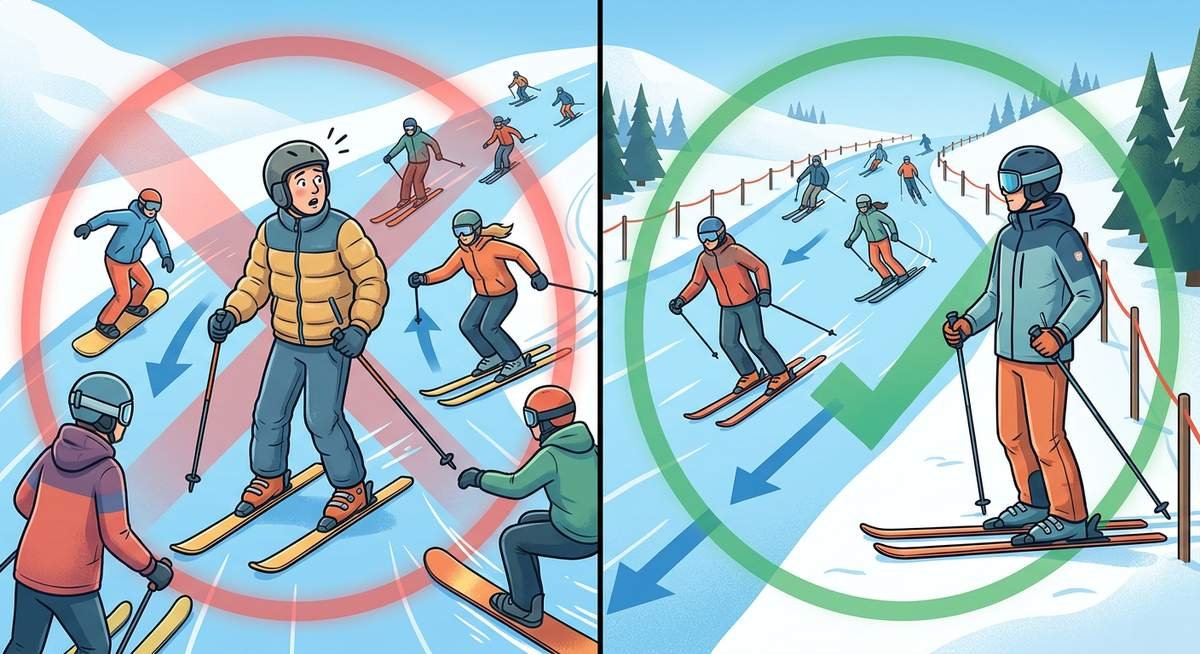
Stopping dead mid-run without checking uphill is the single most common jerry move on any mountain. The NSAA Skier Responsibility Code states explicitly: “Do not stop where you obstruct a trail or are not visible from above.”
Ignoring trail difficulty ratings escalates things from embarrassing to dangerous. A first-timer on a black diamond becomes an unpredictable obstacle for experienced skiers moving at speed. Cutting off other skiers without warning rounds it out. A jerry operates in a private universe where other people on the mountain are background scenery.
| Jerry Behavior | Why It’s a Problem | What to Do Instead |
|---|---|---|
| Stopping mid-slope without looking uphill | Creates collision risk for faster skiers above | Pull to the side edge of the trail before stopping |
| Helmet over a hoodie or thick beanie | Compromises helmet fit and impact protection | Wear a thin balaclava or liner; helmet sits flush against skull |
| Attempting black diamond runs as a beginner | Endangers self and experienced skiers on the run | Progress through green and blue runs; take a lesson first |
| Goggles on forehead in poor visibility | Reduces vision in exactly the conditions that demand it most | Keep goggles over eyes whenever skiing; use clear lenses for flat light |
| Not knowing how to load a chairlift | Causes delays and potential injuries at the loading zone | Watch one cycle before your turn; ask the lift operator for help |
Jerry in Skiing and Snowboarding
The jerry label applies equally across skiing and snowboarding. A snowboarder sitting mid-cat-track with their board unstrapped, blocking the entire lane, is just as much a jerry as a skier bombing a crowded green run. Snowboarders arguably popularized the term more aggressively through their historically more irreverent online communities on platforms like r/snowboarding on Reddit.
What Is a Jerry Gap in Skiing?
A jerry gap is the visible strip of exposed forehead between a skier’s helmet and their goggles — a telltale sign that the gear doesn’t fit properly, isn’t being worn correctly, or was assembled by someone with no idea how the pieces work together. The gap is both a safety failure and a visual identifier that experienced skiers recognize instantly.
Why the Gap Matters
The jerry gap isn’t just cosmetic. That exposed strip of skin is vulnerable to frostbite, altitude sunburn (UV intensity increases roughly 4% per 300 meters of elevation, according to the World Health Organization), and direct impact in a crash. Properly fitted ski goggles sit flush against the helmet brim with no forehead showing.
The gap results from goggles too small for the helmet, a helmet pushed too far back, or goggles pulled too low on the nose bridge. Most rental shops don’t check for this, which is why it’s overwhelmingly associated with first-time visitors.
Jerry Gap vs. Gaper Gap
“Jerry gap” and “gaper gap” refer to the same thing. “Gaper gap” is the older term; “jerry gap” gained traction as “jerry” became the dominant ski slang term, particularly after Jerry of the Day popularized it on social media. Either signals the same message: this person didn’t get the memo on gear fit.
Jerry vs. Gaper: What’s the Difference?
A jerry and a gaper overlap but aren’t identical. A jerry is defined by reckless or clueless behavior — what someone does on the mountain. A gaper is defined by appearance — specifically the helmet-to-goggle gap that signals tourist-level gear assembly. Someone can be both simultaneously, but the distinction matters in ski culture.
Defining a Gaper
“Gaper” originates from the telltale gap between an improperly fitted helmet and goggles. It’s purely visual. Someone can look like a complete gaper and still ski a double black diamond without incident. The gaper gap became so iconic that Gaper Day is now an annual tradition at Arapahoe Basin in Colorado, where experienced skiers dress in retro, mismatched gear as ironic celebration.
| Term | Based On | Key Identifier | Can They Ski Well? |
|---|---|---|---|
| Jerry | Behavior | Reckless or clueless actions on the slope | Sometimes — not always beginners |
| Gaper | Appearance | Helmet-to-goggle gap; mismatched or tourist gear | Yes — appearance doesn’t determine ability |
Among ski patrollers, the difference is clear: gapers offend the eyes, jerries endanger everyone around them. Being called a jerry carries more weight because it implies a safety hazard, not just a fashion miss.
Jerry in Ski Culture: Harmless Fun or Gatekeeping?
The debate around “jerry” splits ski communities. Defenders call it harmless ribbing reinforcing safety norms. Critics — particularly on Reddit’s r/skiing — argue it functions as gatekeeping that discourages beginners. Both sides have legitimate points.
The Case for the Term
Proponents argue that naming dangerous behavior creates social accountability. A 2022 survey by Snowsports Industries America (SIA) found that 73% of ski area visitors rated “other skiers’ behavior” as their top safety concern — ahead of avalanche risk and equipment failure. Giving that behavior a name makes it discussable.
The Criticism
The counterargument: every expert was once a beginner. The Professional Ski Instructors of America (PSIA) has noted in training materials that welcoming newcomers is essential for the sport’s long-term health, particularly as the ski industry faces declining participation among younger demographics.
The healthiest take sits between these poles. Using “jerry” to describe genuinely dangerous behavior serves a purpose. Using it to mock a nervous first-timer on the bunny hill doesn’t.
How to Avoid Being Called a Jerry on the Mountain
Avoiding the jerry label comes down to preparation and humility — no advanced skill required. Five steps handle it.
- Take a lesson before your first run. Even a single 90-minute group lesson covers the fundamentals of stopping, turning, and mountain awareness that prevent 90% of jerry behavior.
- Check your gear fit. Helmet flush against your head, goggles flush against helmet brim (no jerry gap), boots buckled, bindings checked by the rental shop.
- Start on green runs and stay there until you’re comfortable. No beginner has ever regretted spending an extra hour on a green before moving to blue terrain.
- Never stop in the middle of a trail. Pull to the side edge, stay visible from above, and check uphill before merging back onto the slope.
- Learn chairlift protocol. Watch one loading cycle before it’s your turn. Keep your tips up on the ride. Look before you ski off the ramp at the top.
None of these require advanced skill. But they’ll keep you out of every Jerry of the Day compilation ever posted.
Frequently Asked Questions
What does “jerry” mean in ski slang?
A jerry is ski and snowboard slang for someone who behaves recklessly or dangerously on the mountain through a lack of self-awareness rather than athletic ability. The term describes behavior, not skill level.
Where does the term “jerry” come from in skiing?
The term originated in Western U.S. ski resort culture during the 1980s-1990s, likely coined by ski patrol and lift operators as a generic everyman name, similar to “Average Joe.” No single documented origin exists.
What is a jerry gap when skiing?
A jerry gap is the visible strip of exposed forehead between helmet and goggles, indicating improper gear fit. Also called a “gaper gap,” it exposes the wearer to frostbite, sunburn, and impact risk.
Why are skiers called jerry?
Skiers earn the jerry label through specific behaviors: stopping mid-slope, ignoring trail ratings, wearing gear incorrectly, or creating hazards through cluelessness. “Jerry” was chosen as a generic everyman name, not a reference to any specific person.
Is a jerry the same as a gaper?
Not exactly. A jerry is defined by dangerous behavior; a gaper by appearance — specifically the helmet-to-goggle gap. Someone who looks like a gaper might ski perfectly well, while a jerry might have proper gear but terrible judgment.
What is Jerry of the Day?
Jerry of the Day is an Instagram account (@jerryoftheday) founded in 2011 that posts user-submitted videos of chaotic, reckless, or clueless behavior on ski slopes. With over 2.2 million followers, it is the single biggest reason the term “jerry” became globally recognized beyond local resort culture.
Can snowboarders be jerries too?
Absolutely. The jerry label applies to skiers and snowboarders equally. Anyone on the mountain demonstrating dangerous obliviousness earns the term regardless of equipment choice.
How do you avoid being a jerry on the ski slopes?
Take a lesson, fit your helmet and goggles properly with no gap, start on green trails, never stop mid-run, and learn chairlift protocol. These five steps prevent the vast majority of jerry behavior.
Is calling someone a jerry considered offensive in ski culture?
Opinions are split. Most skiers view it as harmless ribbing reinforcing safety norms. Critics call it gatekeeping that discourages beginners. Context matters — labeling genuinely dangerous behavior differs from mocking a nervous first-timer.
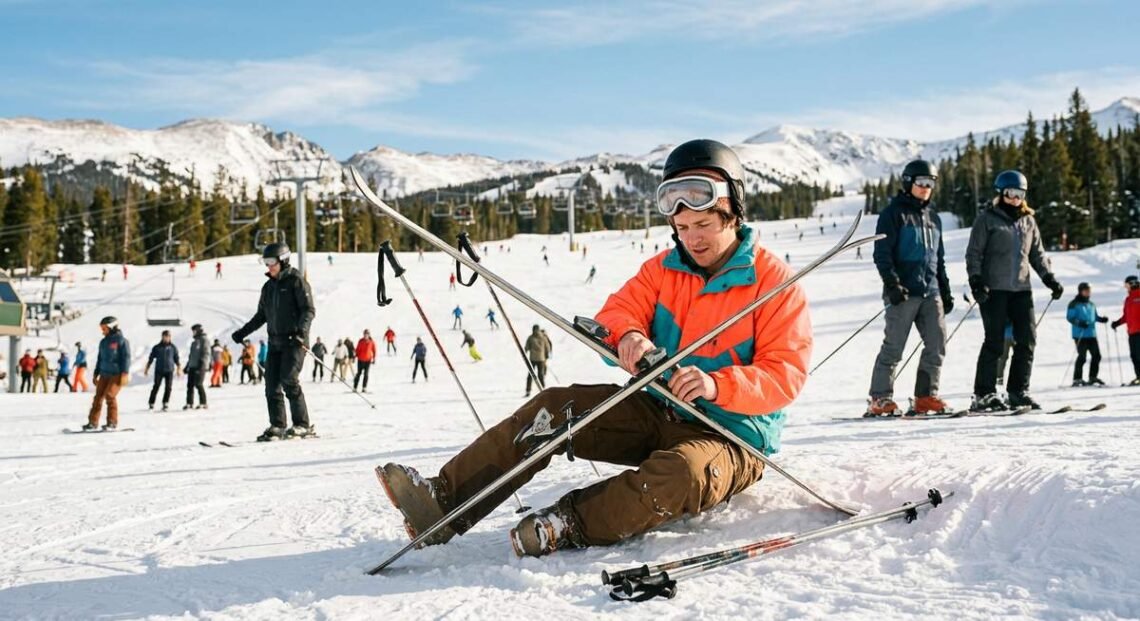
What is a “yard sale” in skiing?
A yard sale is a crash where equipment scatters across the slope — skis, poles, goggles, hat flying in different directions, resembling a garage sale spread. Yard sales are a signature jerry moment, though they can happen to anyone.